
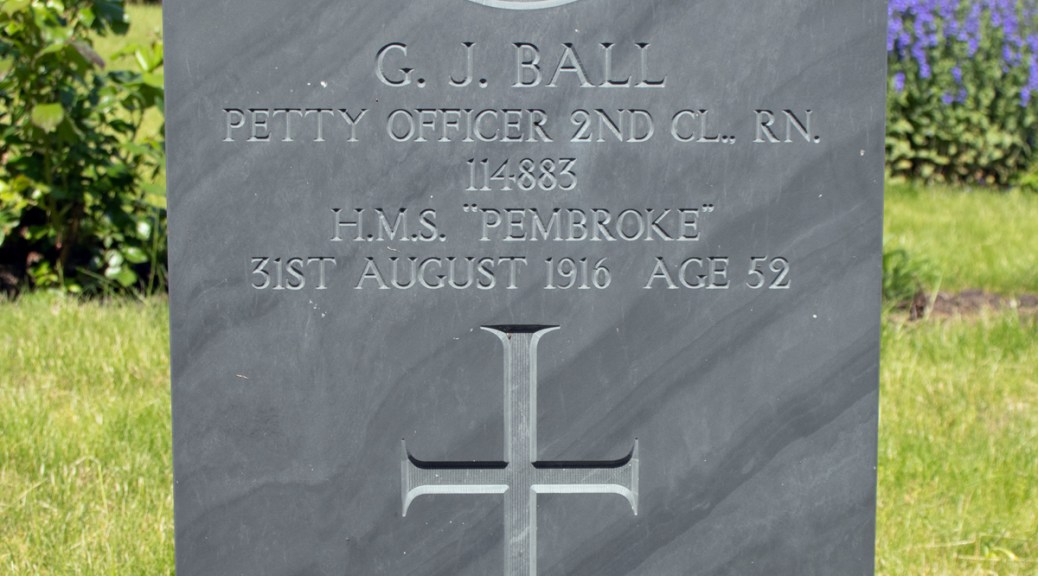

The early life of George John Ball is a challenge to piece together.
His naval records confirm that he was born in Bedminster, Somerset, on 11th October 1865. There are census records that link his name to parents coal miner Luke Ball and his wife, Ann, but these cannot be confirmed.
George’s papers show that he found work as a butcher when he finished his schooling. He was set on a life at sea, however, and, on 25th November 1880, he joined the Royal Navy. Given the rank of Boy 2nd Class, he was sent to the training base HMS Impregnable for his induction. The Devon establishment would remain his home for the next two years, and, during this time, he rose to the rank of Boy 1st Class.
On 10th October 1882, George was given his first sea-faring assignment, on board the armoured cruiser HMS Northampton. He stayed with her for the next two years, during which time he came of age. Now formally inducted to the Royal Navy, he was promoted to Ordinary Seaman. His service records from the time give an indication as to the man he had become. Short of stature, he was just 5ft 1.5ins (1.56m) tall, and had light brown hair, hazel eyes and a fresh complexion.
Ordinary Seaman Ball signed up for a ten-year contract. Over that time, he would serve on a total of eight vessels, rising to the rank of Able Seaman in January 1889. George’s slate was not completely clean, however, and his record notes three serious demeanours in that time.
In the spring of 1888 George spent 27 days in Canterbury Gaol for ‘breaking out of [the] ship’ he was then serving on, HMS Duncan. He was sent to the brig for a further fourteen days in January 1892 for an undisclosed crime.
Able Seaman Ball was also fined £3 10s (£575 in today’s money) for staying away beyond his allotted shore leave. His papers note an absence of seventeen weeks from 10th October 1893, and this time would have been added to the end of his contract.
George re-enlisted on 9th February 1894, and his service record noted that he had grown half and inch (1.3cm) since he enlisted. He had also had a number of tattoos in that time, including an anchor on his right arm and a bracelet and sailor on his left.
Over the next decade, Able Seaman Ball continued his steady progression through the ranks. He would serve on seven ships, returning to what had become his shore base – HMS Victory, the Royal Naval Dockyard in Chatham, Kent – in between assignments. In October 1897, George was promoted to Leading Seaman: by the following July he was given the rank of Petty Officer 2nd Class.
On 29th April 1904, after more than twenty years in service, George was formally stood down to reserve status. The next document for him – the 1911 census – gives an insight into his life away from the sea. By this point, George was living in a small terraced house at 234 Luton Road, Chatham, Kent.
The document confirms he had been married for fourteen years, to a woman called Sarah. The couple had a daughter – six-year-old Doris – and Sarah’s son from a previous marriage, Albert, was also living with them. George had not distanced himself too far from the sea, however. He was employed as a Ship’s Canteen Manager, a position his stepson also held.
When war came to Europe, George was called upon to play his part once more. Taking up the rank of Petty Officer 2nd Class again, he would be based at HMS Pembroke – Chatham Dockyard – and he remained in service for the next two years.
In August 1916, George was admitted to the Royal Naval Hospital in Chatham, with a combination of pychtis and a stricture. The conditions were to prove fatal: he breathed his last on 31st August 1916, at the age of 50 years old.
George John Ball was laid to rest in the military section of Woodlands Cemetery, Gillingham, Kent, not far from the dockyard that had been his home for many years.
 Death and Service