
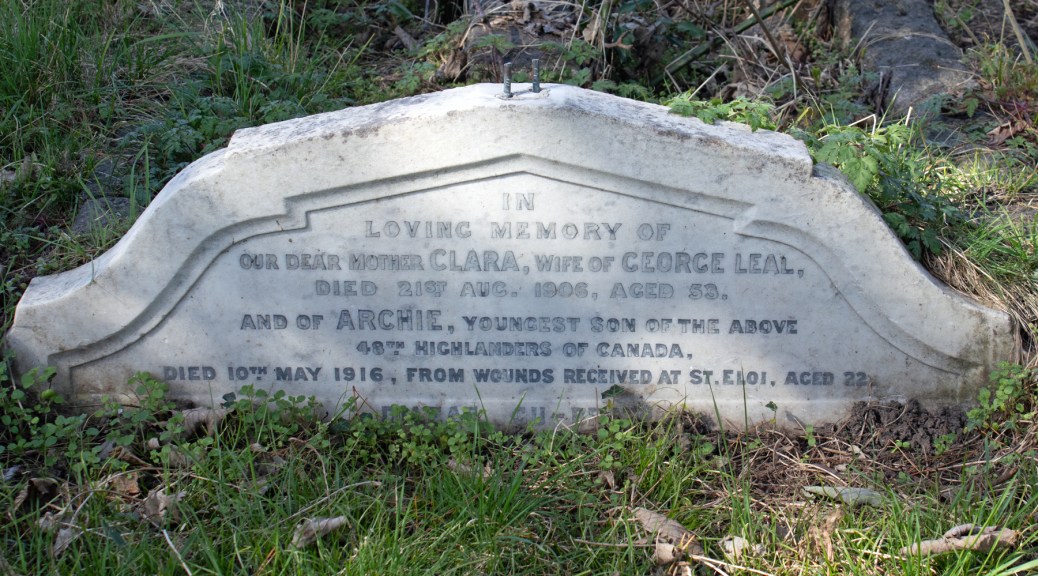
Archibald Edmund Leal was born in Tinwood, West Sussex on 13th September 1894. The youngest of six children, his parents were George and Clara Leal. George was a dairyman, and, by the time of the 1901 census, the family had moved to a terraced cottage at 66 Newland Road in Worthing.
Clara died in 1906, and Archibald – who was better known as Archie – and two of his siblings took the opportunity to seek a better life across the Atlantic. In 1910, the three of them – Archie, brother Phillip and sister Winifred – emigrated to Canada, settling in Breakeyville, to the south of Quebec.
Archie found work as a chauffeur, but when war was declared, he was quick to step up and serve his King and Empire. He enlisted on 10th September 1914, joining the Canadian Expeditionary Force as a Private. His service records show that he was 5ft 6in (1.67m) tall, with fair hair, brown eyes and a dark complexion. He was also noted as having “very many [acne] scars over [his] chest and back.”
Assigned to the 15th Battalion of the Canadian Infantry, Private Leal sailed to Britain, arriving at Tidworth Camp in Wiltshire on 12th February 1915. By April he was in France, and, on 28th July he was in a front line trench near the town of Ypres. A shell exploded nearby and, in seeking shelter, he badly twisted his ankle and back. Medically evacuated to Britain, Archie spent a month recuperating at the Royal Herbert Hospital in Woolwich, Kent, before returning to his unit in Wiltshire.
By December 1915, Private Leal was back on the Western Front and remained there for the next five months. In April his unit was on the front line, and he was injured in his right leg when a rifle grenade exploded. Archie was initially treated by a field ambulance, but his injury was such that evacuation to Britain was again necessary. He was admitted to the County of London War Hospital in Epsom, Surrey, but had contracted tetanus by this point. This was to prove fatal, and his body succumbed on 10th May 1916: he was 21 years of age.
The body of Archibald Edmund Leal was taken back to Worthing for burial. He was laid to rest with full military honours in the town’s Broadwater Cemetery. A local newspaper reported that “Private Leal, although not a Canadian, was possessed of true Colonial grit, and had had his full share of active service.” [Sussex Daily News: Wednesday 17th May 1916]
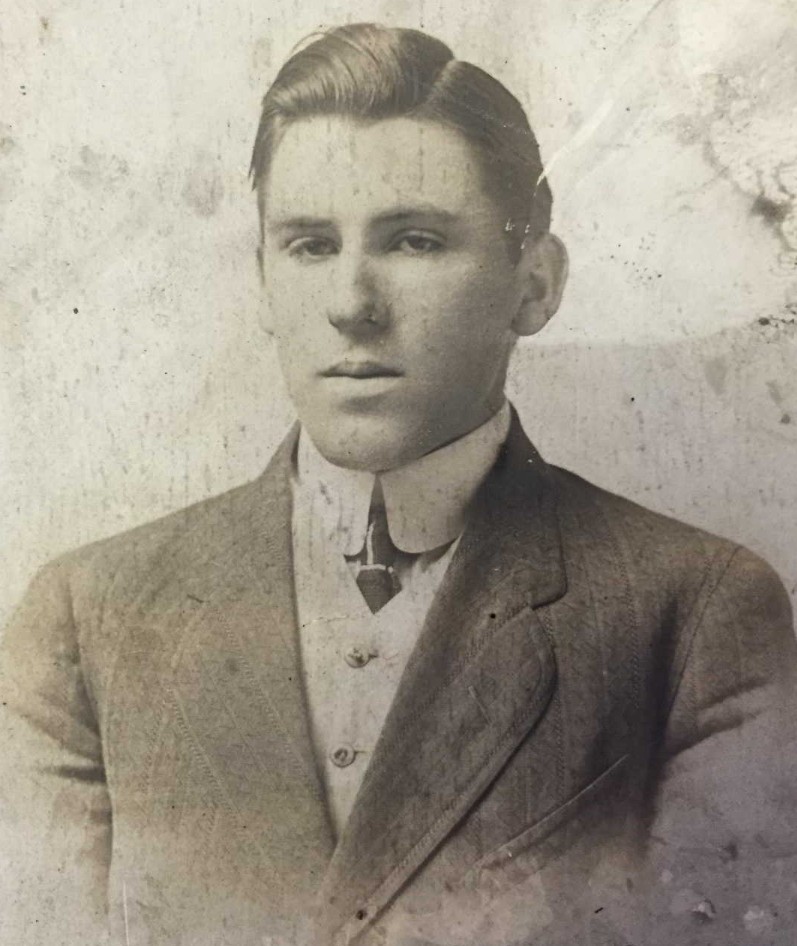
(from ancestry.co.uk)
 Death and Service