
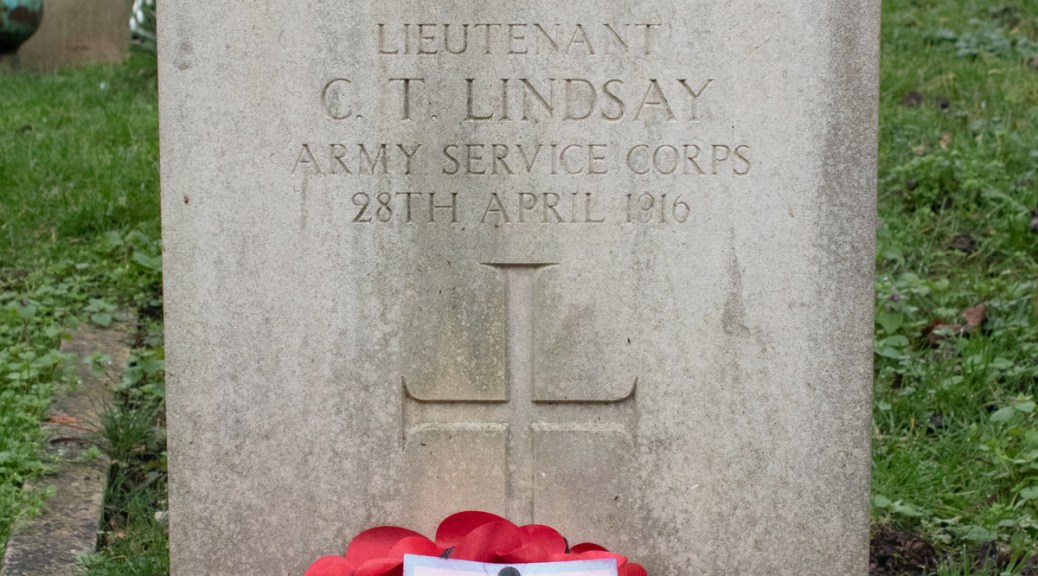
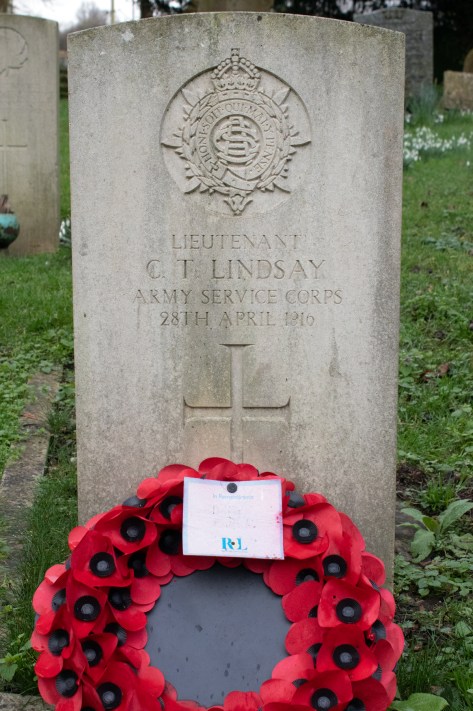
Courtenay Traice Lindsay was born in Belfast, Northern Ireland, on the 11th December 1874. The second of four children, he was the only son to Thomas and Ruth Lindsay. Thomas was an art teacher and examiner and, by the time of the 1881 census, he had moved the family to Rugby, Warwickshire, setting them up in the Temple Art Museum on Barby Road.
Education was important to Thomas, and it was obvious that his son’s passion was art. “He entered [Rugby] School in 1888 and left in 1892. He was afterwards Drawing Master at Seafield Park Engineering College, Hampshire, Trad Designer for textiles and pottery, and Examiner under the Board of Education in Geometrical Drawing.” [Memorials of Rugbeians Who Fell In The Great War, Volume VII]
On 10th January 1903, Courtenay married Charlotte Wetenhall. The daughter of a man of means, she was born in Stanwick, Northamptonshire, and the couple exchanged vows in her local parish church.
Courtenay’s mother died in 1905 and by the time of the 1911 census, he and Charlotte were living at 143 Beaufort Street, Chelsea, Middlesex. A five-storey Georgian building, they had let our rooms to aspiring artist Marion Forbes. Courtenay was an artist and designer himself, and he and Charlotte had an eight-month-old son, Courtenay Jr.
When war broker out, Courtenay stepped up to play his part. He gained a commission in the Army Service Corps, but did not see any service overseas. “He… was engaged on Road Transport, in the Northern Command. Hard work in the Transport Service undermined his constitution, and he died of heart failure, following on septic poisoning, on April 28th, 1916. Age 41.” [Memorials of Rugbeians Who Fell In The Great War, Volume VII]
Courtenay Traice Lindsay died at Burnham Abbey, near Maidenhead, Buckinghamshire. Interestingly, while Charlotte and their son were living four miles north in Burnham Beeches, he was laid to rest in Dorney Burial Ground, a short walk to the south of the hospital.
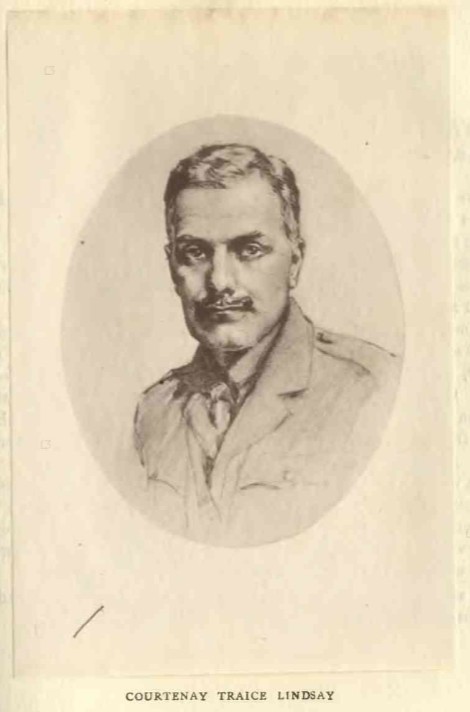
(from Memorials of Rugbeians Who Fell In The Great War, Volume VII)

