
Within a few weeks of following his youngest brother Fred to the grave, Sergt. Alexander Hurst has himself passed away, after a shirt but severe illness, in his 55th year. Born at the Grammar School, Cavendish, on Michaelmas Day, 1862 (being the day on which his father, the late Mr Robert Hurst, commenced his duties as headmaster there) he early closely associated himself with the social life of the village. A keen sportsman, he achieved considerable success on the cricket field, being a stead batsman, and a bowler with plenty of “spin.” He also devoted much time and study to campanology, an ort of which he was a skilful exponent, and composed several peals. On leaving Cavendish in 1884, he was the recipient of a handsome testimonial from the parishioners in recognition of the good work he had done in the village… At Long Melford he was for many hears a member of the Volunteer force, in which he attained the rank of Sergt. He was an excellent rifle shot, and on several occasions he the satisfaction of figuring in the prize list at Bisley. On the football field he was a particularly neat half-back, and was a member of the winning County Senior Cup team in the season 1887-88. As a musician Sergt. Hurst showed considerable ability, being gifted with a critical ear, and possessing a baritone voice of sympathetic timbre. For many years he officiated as organist at Bulmer Parish Church. For the past twelve years or so Sergt. Hurst had resided in London, where he was in the employ of Sir Herbert Marshall & Rose as expert piano tuner. Shortly after the outbreak of war, notwithstanding his 50 odd years, he offered himself for service and joined the County of London Battalion with the rank of Sergeant. He devoted himself to his military duties with utmost zeal, and it seems more than probable that his anxiety to serve his country to the best of his ability hastened his end.
[Suffolk and Essex Free Press: Wednesday 7th March 1917]
Alexander Burnett Hurst was the middle of seven children – all boys – to Robert and Margaret Hurst. By the time of the 1881 census, he was teaching at Cavendish Grammar School, Suffolk, which was a small educational establishment with a dozen boarding students.
The next census followed the family’s move to Long Melford, and by this time Alexander was working as a pianoforte tuner, while his older brother Bernard was employed as an organist.
On 30th October 1899, Alexander married Maude Thurston. The daughter of a chemist from Ipswich, Suffolk, the couple married in her local parish church, St Lawrence’s. The couple’s wedding certificate recorded the groom as an organ builder.
By 1901, the newlyweds had set up home in Long Melford, taking a cottage two doors up from the historic Bull Hotel, and next door to Bernard and his family. Alexander was now working as a music teacher, although it seems likely that he had his fingers in many melodic pies by this point.
Alexander and Maude would go on to have three children – daughters Geraldine and Evelyn, and son Kenneth. The 1911 census suggests that the family had moved south by 1907, as this is where young Kenneth was born. The document recorded them in rooms at 134 Kennington Park Road, sharing the building with teachers, actresses and music hall artists.
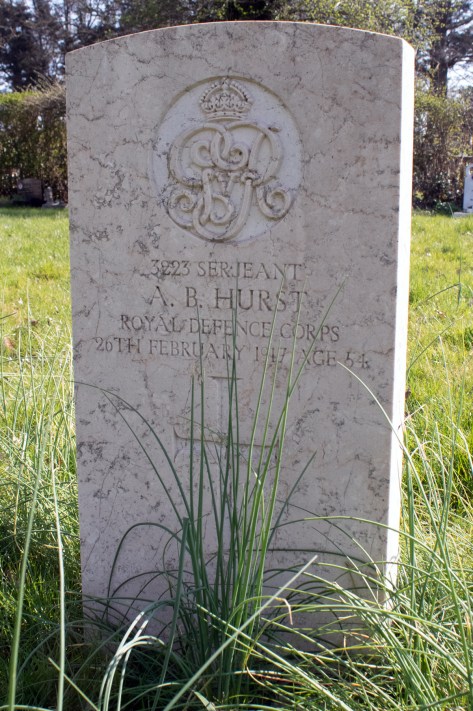
Little information remained about Alexander’s military service. While the newspaper report suggests he was assigned to the London Regiment, other documents confirm he was a member of the Royal Defence Corps. The unit was specifically set up for older service personnel and, attached to No. 1 Protection Company, Serjeant Hurst was based in London.
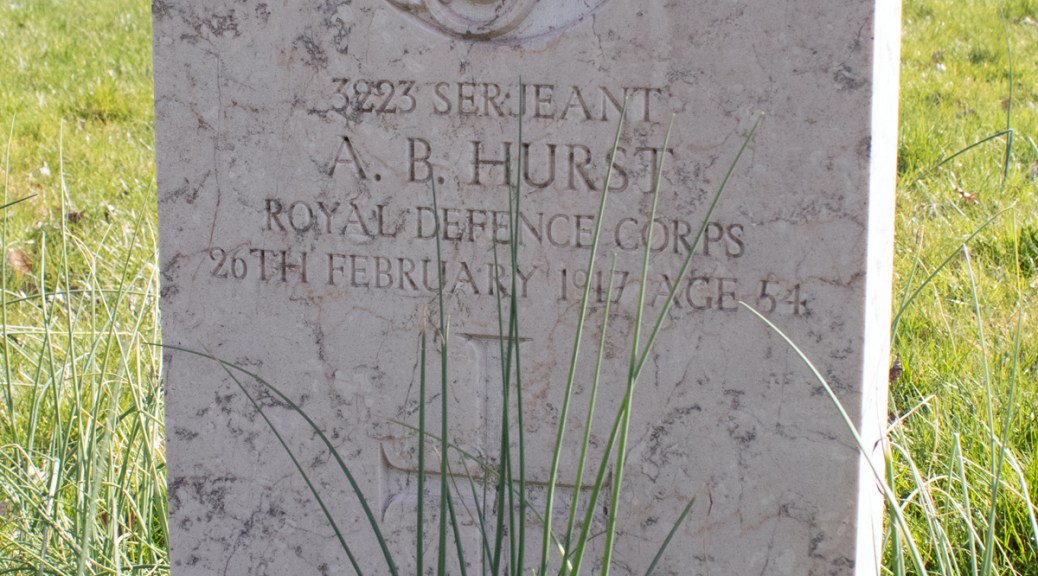
Alexander Burnett Hurst died from pneumonia on 26th February 1917: he was 54 years of age. He was laid to rest in Streatham Park Cemetery, a short distance from where his widow and family were living.
Maude remained living on Kennington Park Road. By the time of the 1921 census she shared her home with her two daughters – the eldest of whom was working as a clerk and typist for the Shell Motor Oil Company – and her widowed mother, Mary Thurston.

