Tag Archives: exhaustion

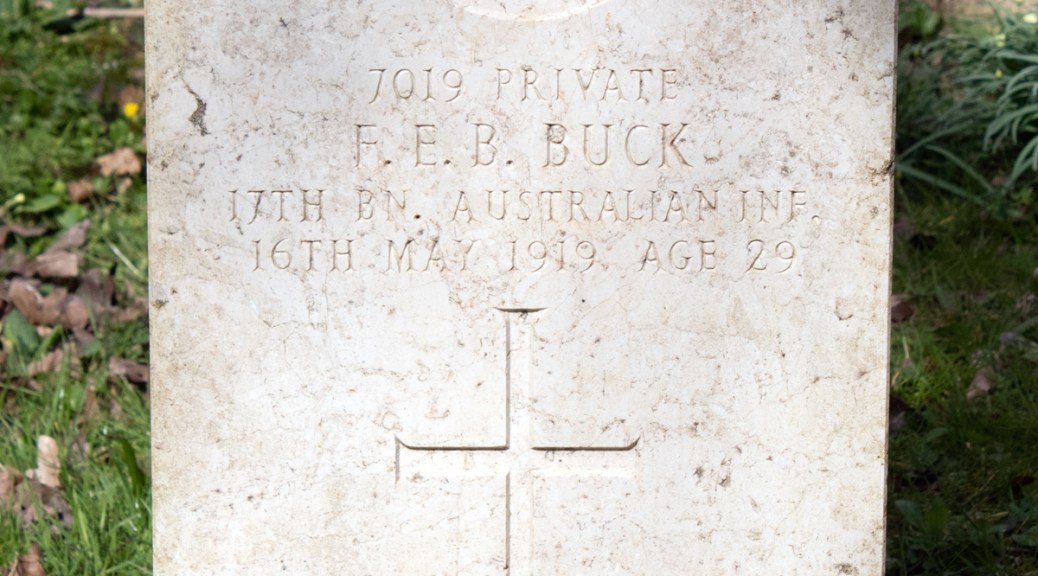
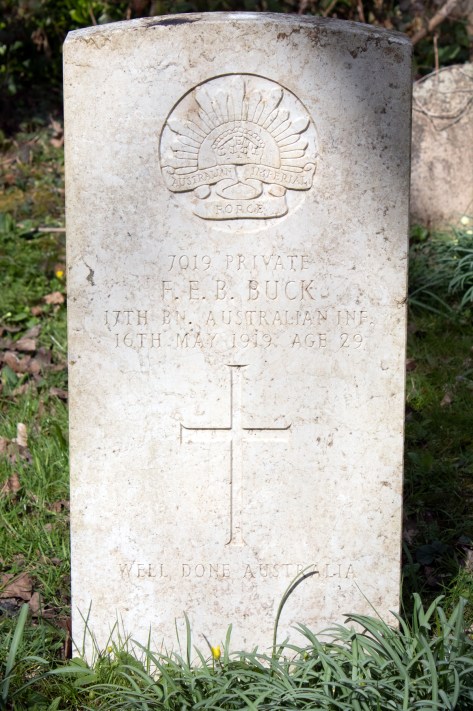
Private Frank Buck

Private Frank Buck

Frank Ernest Brydgnes Buck was born in Islington, Middlesex, early in 1889, his mother’s name was Rosina, but his father’s details have been lost to time, the 1901 census confirming that she was a widow. The document notes that Frank was the youngest of four children, and the family had taken rooms in a three-storey house on Yerbury Road.

By the summer of 1917, Frank had emigrated to Australia. Settling in the town of Inverell, New South Wales, he took employment as a clerk. However, when war came to Europe, he was called on to play his part, and enlisted in the Australian Imperial Force on 16th July 1917.

Private Buck’s service records confirm that he was 5ft 11.5ins (1.82m) tall and weighed 11st 4lbs (71.7kg). He was recorded as having dark hair, blue eyes and a dark complexion. He had a burn scar on his right forearm, and a third nipple on the right side of his chest.

Frank’s unit departed from Sydney on 31st October 1917, and he spent the next two months on board the SS Euripides. During that time he was promoted to Acting Corporal and, when he disembarked in Devonport, Devon, on 26th December, he marched to the ANZAC camp in Fovant, Wiltshire.

Assigned to the 5th Training Battalion, Frank seems to have taken this unexpected return to Britain as a free ticket home: on 6th February 1918 he went AWOL, and only surrendered back to his unit on 9th April. Help in detention for a day, he forfeited 63 days’ pay, and was demoted to the rank of Private for his actions.

On 13th May, Private Buck was dispatched to France. He was assigned to the 17th Battalion of the Australian Infantry, but his time overseas was not to be a lengthy one. In July he was admitted to the 5th Australian Field Ambulance with gastritis: he was then transferred to the 5th Casualty Clearing Station, then the 3rd General Hospital in Le Treport. Medically evacuated to Britain for treatment, he ended up in Reading War Hospital for ongoing treatment.

Placed on furlough on 16th September, Private Buck went AWOL again on just two weeks later. Arrested on 26th November 1918, he was hauled before a judge at Highgate Police Court: his crimes amounted to being absent without leave, but also stealing three blank cheques and forgery. Pleading guilty, he was sent to Wormwood Scrubs for nine months.

Frank would not end up serving his time, however. He was admitted to the infirmary with a perforated duodenal ulcer, and died from exhaustion on 16th May 1919. He was 29 years of age.

Frank Ernest Brydgnes Buck was laid to rest in Highgate Cemetery.


Gunner William Howard

Gunner William Howard

William Arnold Howard was born in Cumbria towards the end of 1887. He was the youngest of two children, the son of gospel minister Edwin Howard and his wife Alethea. Edwin’s role took him across the country; by the time William was four, the family were settled in Worksop, Nottinghamshire; ten years later, they were based in Taunton, Somerset.

William’s older sister became a music teacher, and was presumably inspired by her father’s calling. William, however, took a different route, and, by the time of the 1911 census, was listed as a physical culture expert.

He had, by this time, met and married a woman called Alice, and the couple had two children, Edna and Marjorie. The census found the young couple living in a three-roomed house in the middle of Taunton.

War was on the horizon, and William enlisted as a Gunner in the Royal Garrison Artillery. His battalion – the 3rd/4th Siege Reserve Brigade – were those manning with large scale weaponry, although, as part of the reserve, Gunner Howard was based in England for the duration of the conflict.

William was awarded the Victory and British Medals for his service but once the Armistice was declared it seems that he fell ill. He was admitted to the Military Hospital in Taunton with exhaustion following a bout of enteritis, and succumbed to this on 15th January 1919. He was 31 years old.

William Arnold Howard lies at rest in the St James Cemetery in Taunton, Somerset.


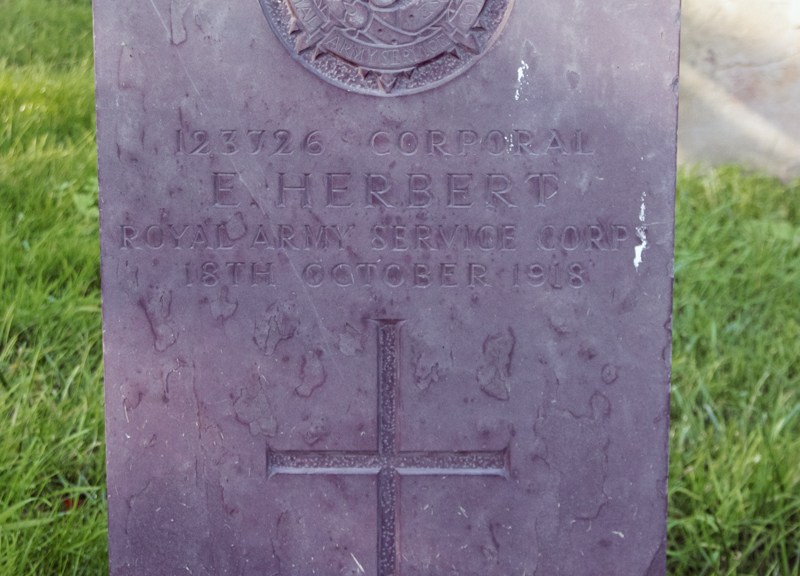
Corporal Edwin Herbert

Corporal Edwin Herbert

Edwin Herbert was born in 1864, the third of three children to Moses and Melina Herbert of Hove in East Sussex. Moses worked in the cement industry as a labourer, a job that had taken him from his home in Kent to Sussex, and which, by the 1871 census, would return him to his home county.

Edwin married Amelia Charlotte Titus in 1885 and the couple’s first child – a daughter, Nelly – was born a year later.

By the 1891 census, Edwin was also labouring in the North Kent cement industry, something he continued to do for at least the next twenty years, as confirmed in the following two censuses.

The Herberts’ second child, Amelia, was born in 1901, the year after Edwin’s mother passed away. The family were, by then, living in Cuxton, just to the south of Rochester. The cement industry was one of the large employers in the Medway valley, and it is not surprising that the family lived in and around that area for so long.

In 1910, Edwin’s father also died, at the age of 69. After the death of Melina, Moses had moved in with his daughter – Edwin’s older sister – in Rochester, and the family were also still labouring in the cement and brickmaking industry.

Edwin’s military records are sketchy. Piecing the evidence together, he enlisted in the Royal Army Service Corps.

It is likely that he did so on a voluntary basis. The cement industry was not protected by exemption. Kitchener’s initial conscription in March 1916 excluded married men. When this was extended in May 1916, there was still a maximum age limit of 41 (Edwin was 52 year old by this point).

By whichever means he had enlisted, Edwin served as a Corporal (there is nothing to confirm whether he was promoted from Private, or if he went straight into service at that rank). He was discharged on 30th July 1918, and it is likely that this was on a medical basis.

Corporal Herbert’s pension documents record that he passed away on 30th October 1918, as a result of carcinoma of the liver and exhaustion. He was 54 years old.

Edwin Herbert lies at peace in the quiet churchyard of St Helen’s in Cliffe, Kent.


The majority of the the Commonwealth War Graves Commission headstones in the UK are made from Portland stone, although, in face, over 50 different natural stones have been used.

Corporal Cornell’s headstone is one of two in St Helen’s Churchyard that have been fashioned from dark grey slate.