
Tag Archives: Farrier

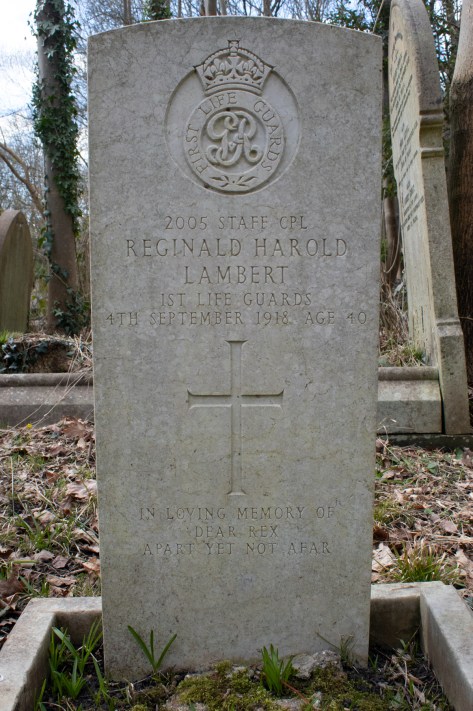
Farrier Staff Corporal Reginald Lambert

Farrier Staff Corporal Reginald Lambert

Reginald Harold Lambert was born in the spring of 1878 in Hurstpierpoint, Sussex. One of eight children, his parents were Henry and Elizabeth Lambert. Henry was a surgeon dentist, who had five more children from first marriage, giving Reginald a total of twelve siblings.

When Reginald finished his schooling, he took up work as a dental assistant, presumably under his father’s tutelage. Away from this, he volunteered for the Royal Sussex Regiment, and the military life drew him in. On 8th July 1897, he joined the 1st Life Guards: based in London, he took on the role of Farrier, tending to the regiment’s horses and looking after their hooves in particular.

On 25th April 1909, Reginald married Lilian Burns at St George’s Church in Tufnell Park, Middlesex. There is little information about her background, but she was the daughter of a grocer and, at 38 years old, seven years her new husband’s senior.

As the point of his marriage, Reginald was listed as a Corporal, and gave his address as Knightsbridge Barracks. By the time of the 1911 census, however, he and Lilian had set up home in second floor rooms at 6 Princess Road, Camden.

When war broke out in 1914, Corporal Lambert was called upon to play his part. His service records are long since lost, but the 1st Life Guards fought in some of the key battles of the conflict: at Ypres in both 1914 and 1915, at Loos in 1915, and at Arras in 1917. Exactly where and how Reginald served, however, is unknown, but by the end of the war he had risen to the rank of Farrier Staff Corporal.

The next record for Reginald is that of his death, which was registered in Islington, Middlesex. It seems likely that he either returned home, or was hospitalised close to home. He passed away through illness on 4th September 1918, at the age of 40 years old.

Reginald Harold Lambert was laid to rest in Highgate Cemetery, not far from where his widow still lived. His epitaph gave a nod to her pet name for him: In loving memory of dear Rex. Apart yet not afar.


Serjeant Major Ernest Simmons

Serjeant Major Ernest Simmons

Ernest Simmons was born in Priddy, Somerset, in 1869, the oldest child to Henry and Ellen Simmons. Henry was a mason who, by the time of the 1881 census, was employing ten men and a boy. Three doors down lived another Simmons family, Daniel and Elizabeth, and it is likely that Ernest’s father was somehow related to them.

Ernest sought a bigger and better life away from the Somerset countryside, and enlisted in the army, joining the Army Veterinary Corps. “[He] served for 28 years… 10 of which were spent in India and 5 in South Africa.” [Wells Journal: Friday 23rd August 1918]

His service did him well, and he progressed through the ranks. The 1911 census recorded him back in the UK, renting a room in a terraced house in Preston, near Brighton. He was still serving in the army, however, and was listed as being a Farrier Sergeant Major in the 4th Battalion of the Dragoon Guards.

When war was declared, Ernest was quick to return to the fray, arriving in France on 16th August 1914. He served his battalion well, and was mentioned in dispatches for his action in the retreat from Mons the following month.

Farrier Sergeant Major Simmons returned to Britain, and transferred across to the 6th Reserve Regiment of Cavalry. This new regiment, formed in 1917, trained men for a number of regiments, including the 3rd, 4th, 6th and 7th Battalions of the Dragoon Guards. Ernest’s previous experience with horses, including his time in the Army Veterinary Corps, likely stood him in good stead for the role.

It was while he was at the camp in Tidworth, on Salisbury Plain, Wiltshire, that Ernest met with an accident. “[He] was thrown through his horse tripping over some wire. He was found in an unconscious state and died the same day.” [Wells Journal: Friday 23rd August 1918] Farrier Sergeant Major Simmons died on 26th July 1918: he was 49 years of age.

Ernest Simmons’ body was brought back to Somerset for burial. He was laid to rest in the peaceful graveyard of St Lawrence’s Church in his home village of Priddy.


Farrier Ernest Rowsell

Farrier Ernest Rowsell

Ernest Rowsell was born in the spring of 1894, in the Somerset town of South Petherton. One of nine children, his parents were John and Bessie Rowsell. Builder and wheelwright John had been married before Bessie, and Ernest had five half-siblings as well.

When Ernest left school, he found work with a blacksmith – presumably, a connection made through his father. In his spare time, he joined the West Somerset Yeomanry, building on his skills and training.

War came to Europe in 1914, and it was a natural progression for Ernest to play his part, He formally joined the regiment he had previously trained with, enlisting on 24th September 1914. Given the rank of Farrier, Ernest was sent to a camp in Minehead for training.

His service records show that he was 5ft 3ins (1.6m) tall, had good vision and was of good physical development. Something came up during the medical examination, however, which was held on 1st February 1915. Farrier Rowsell was deemed medically unfit for army service and discharged.

Ernest returned home, but, whatever the condition was, it was to swiftly get the better of him. He passed away at home on 13th February 1915, at the age of just 21 years old.

Ernest Rowsell was laid to rest in South Petherton Cemetery, a short walk from where his parents lived.