
Tag Archives: Huntingdonshire

Chief Artificer Engineer Alfred Ward

Chief Artificer Engineer Alfred Ward

The life of Alfred Ernest Ward is a challenge to unpick. He lies at rest in Paignton’s sweeping cemetery in Devon, his headstone confirming that he was Chief Artificer Engineer on board the destroyer HMS Magic.

Alfred’s Pension Index Card confirms his beneficiary as his father, also called Alfred Ernest Ward, who lived at 41 Crown Hill Park in Torquay. Another document, the Naval Officer Casualty Docket, states that he died of pneumonia on 12th February 1919, while he was admitted to the Wallasey Cottage Hospital in Birkenhead on the Wirral.

There is a navy service record for an Alfred Ernest Ward, and, while there is nothing to definitively connect this to the man buried in Paignton, it seems likely that they are the same person. This Alfred was born in Huntingdon, Huntingdonshire, on 30th September 1876, and was working as a fitter and turner when he enlisted on 11th October 1897.

Over the eight years that the document records, Alfred rose from his initial rank of Engine Room Artificer 4th Class to Engine Room Artificer 2nd Class. His service details end on 5th December 1905, when he seems to have transferred to the Officer’s Section.

There are census records for the late 1800s for Ernest Ward (presumably forsaking Alfred to avoid confusion with his father). Alfred Sr working as a rope and marquee rick cloth maker. Married to Eliza Ward, the couple had three children, of whom Ernest was the oldest. By 1901, Engine Room Artificer Ward was assigned to HMS Furious, a cruiser based at Sheerness in Kent.

There are no further details for Chief Artificer Engineer Alfred Ernest Ward between 1905 and 1919, and his life during this time is destined to remain lost to time.

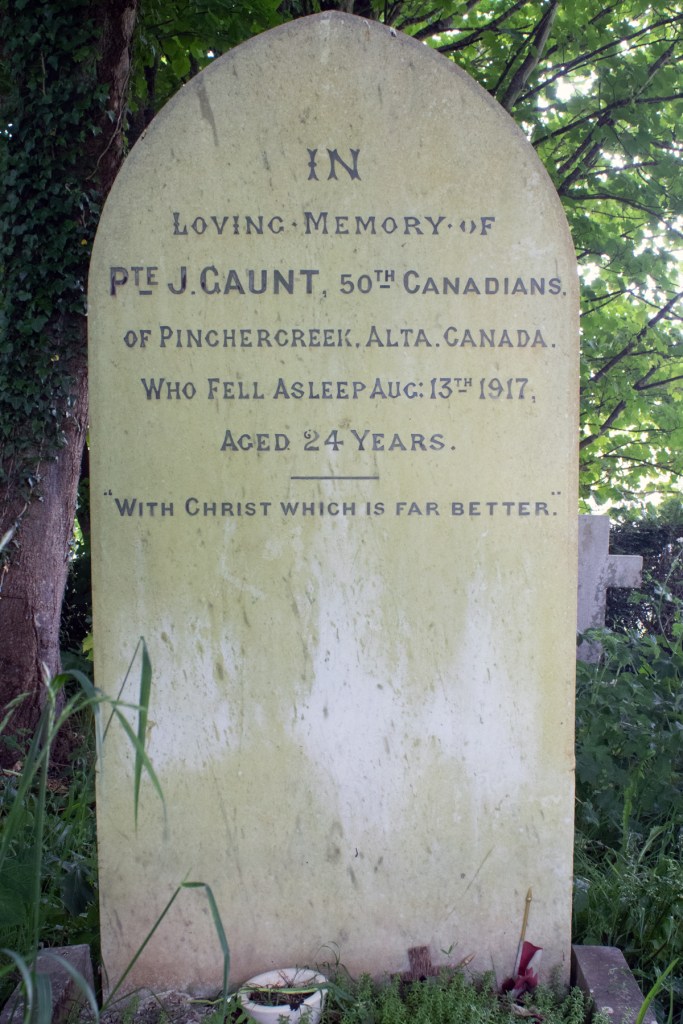
Private John Gaunt

Private John Gaunt

John Alfred Gaunt was born on 15th October 1893, the fourth of five children to John and Jane Gaunt. John Sr was a cattle dealer from St Ives in Huntingdonshire, and it was in the nearby village of Needingworth that the family were born and raised.

John Sr sought out opportunities to support his wife and children and, in 1902 he moved the family to Canada, settling in Pincher Creek, Alberta. There isn’t a great deal of detail available about the Gaunts’ time in North America, but it is likely that farming became their way of life.

Tragedy struck the family in October 1912, when John Sr died, at the age of 61. By this point it seems that they had moved on to British Colombia. Just six months later, Jane also died, John Jr was left an orphan while still a teenager.

Most of the family seemed to remain on the west coast – a later document shows John’s older sister Julia living in Cranbrook, British Colombia – but John was working as a farmer by this point and had either returned to Pincher Creek after his parents’ deaths, or had remained there when they went west.

When war broke out in Europe in the summer of 1914, the Empire were called upon to serve, and John was to return to the country he had left more than a decade earlier. He enlisted on 20th January 1916, joining the Canadian Expeditionary Force.

Private Gaunt’s service records show that he was 5ft 8ins (1.72m) tall, 130lbs (59kg) in weight and had light brown hair, blue eyes and a fresh complexion. It was also noted that he had a fine scar, some 3.5ins (9cm) long, on his upper left arm and had a slight defect in his speech (although this is not elaborated on).

John departed for Europe on 21st August 1916, boarding the HMS Olympic for Liverpool, Lancashire. His unit was initially based in Witley Camps near Aldershot, Hampshire, and he would remain on base until the end of the year. This included eight weeks admitted to the Connaught Hospital, when he was suffering from a bout of syphilis.

By January 1917, John was transferred to the 21st Reserve Battalion, which meant a move to Seaford, East Sussex. He transferred again to the 50th Battalion on 19th March, a move which included being shipped off to France.

Over the next couple of months, things were to change dramatically for Private Gaunt. His service records note that he was wounded on 10th May, but that he remained on duty. On 21st July, he wad admitted to the No. 11 Ambulance Station in Rouen, suffering from jaundice.

He was medically evacuated to Britain for treatment, initially to the Auxiliary Hospital in Exeter, Devon, then to Uplyme Hospital, just to the north of Lyme Regis. By this point, John was severely ill. He passed away on 13th August 1917, at the age of 23 years of age.

With the majority of his family living on the other side of the Atlantic, John Alfred Gaunt was, instead, laid to rest in the churchyard of Ss. Peter & Paul Church in Uplyme, not fat from where he had breathed his last. He is also among those servicemen to be commemorated on the Pincher Creek War Memorial.