
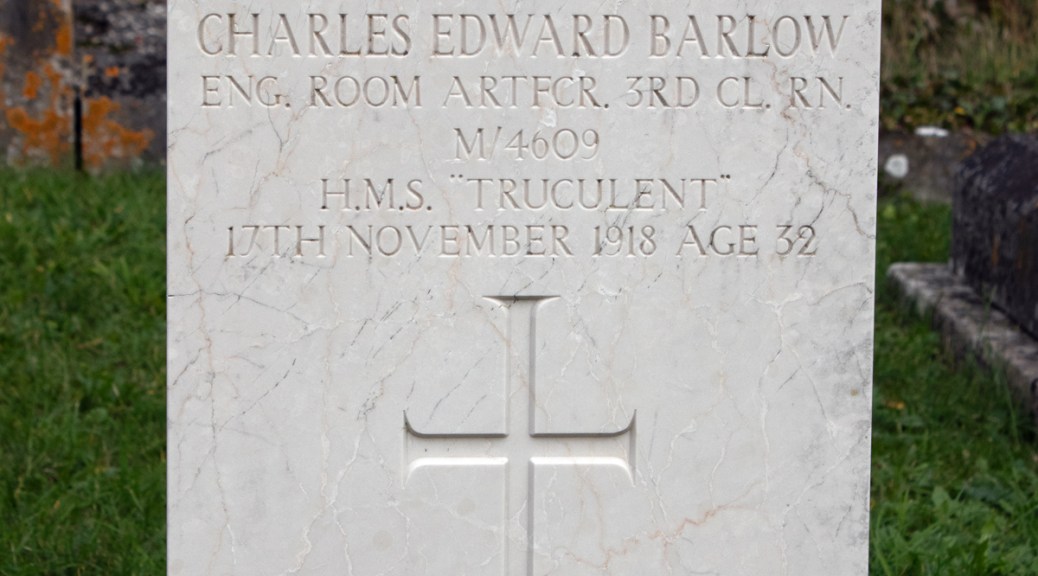
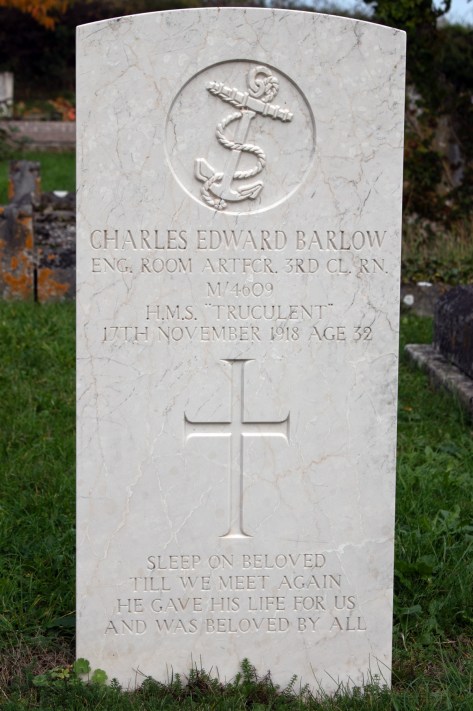
Charles Edward Barlow was born on 3rd January 1886, and was the second of eight children to John and Agnes. John was a Serjeant Major in the Royal Fusiliers, and his work meant the family moved a lot. Charles and his older brother were born in Dublin, Ireland, while Agnes gave birth to his younger siblings in Essex, Ireland, Hampshire and London.
John died in the late 1890s, and the 1901 census found Agnes and four of the children – including Charles – living at 18 Ethel Road, a small terraced cottage in the centre of Portsmouth, Hampshire. Agnes was listed as a shirt maker, while Charles was apprenticed to a boiler maker.
The apprenticeship obviously stood Charles in good stead, and he later found employment as the local dockyard, HMS Victory. The 1911 census recorded mother and son living at 124 Ernest Road, in the Buckland area of Portsmouth. Slightly further from where Charles was working, this was, however, a larger property.
A new opportunity presented itself in the spring of 1912, when Charles formally enrolled in the Royal Navy. His engineering background served him well, and he took the rank of Engine Room Artificer 4th Class. Initial training was provided at Portsmouth Dockyard, and he then moved to the neighbouring bases HMS Fisgard that autumn, and HMS Dryad in February 1913.
After a two month posting on board the torpedo gunboat HMS Harrier, Charles would return to shore in the summer of 1914. On 1st January 1915, however, he was assigned to the depot ship HMS Dido, and she would remain his home for nearly four years. During this time, he was promoted to Engine Room Artificer 3rd Class.
In the autumn of 1918, with the war in its final weeks, Charles fell ill. He was disembarked and admitted to the War Hospital in Bath, suffering from pneumonia. The condition would prove his undoing, and he passed away on 17th November: he was 32 years of age.
The body of Charles Edward Barlow was taken to Bradford on Avon for burial, possibly due to a familial connection in the area, and he was laid to rest in the town’s cemetery.


