Tag Archives: King’s Own (Royal Lancashire Regiment)

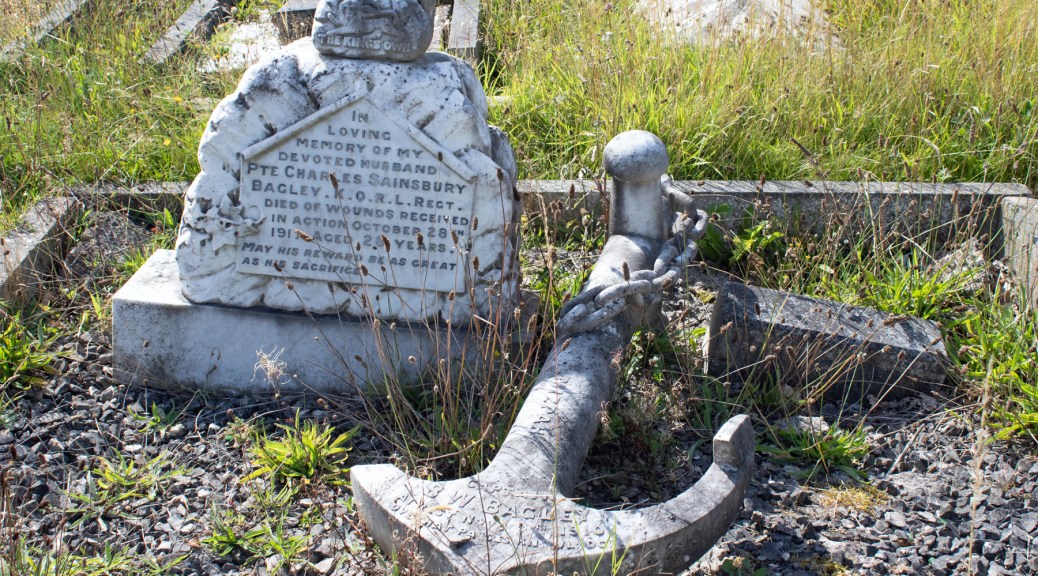
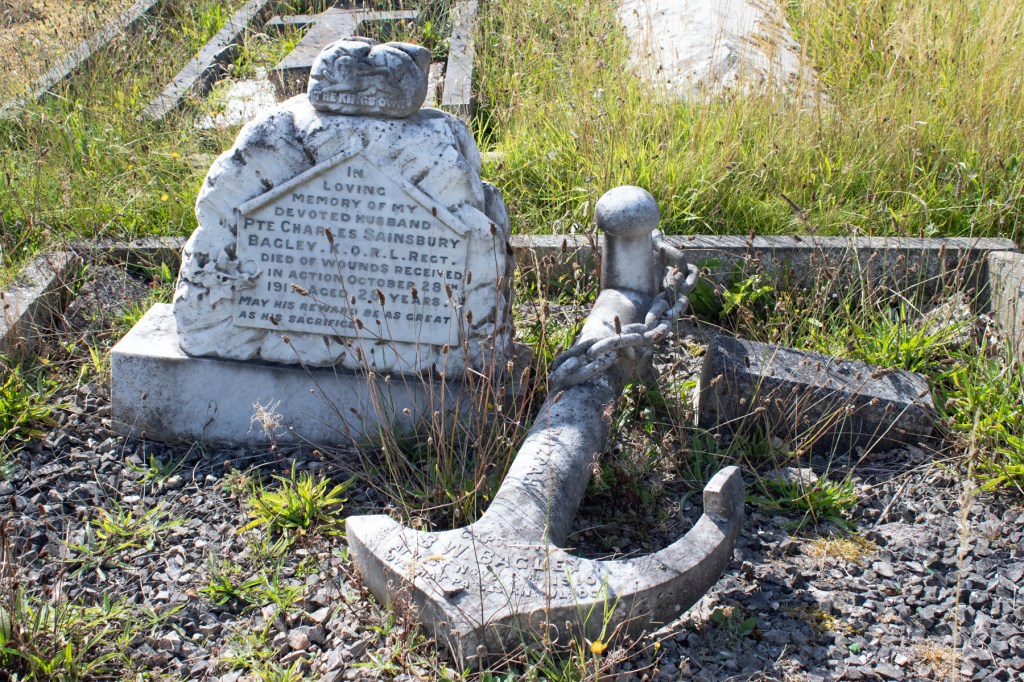
Private Charles Bagley

Private Charles Bagley

Charles Sainsbury Bagley was born in the autumn of 1889, one of eleven children to Benjamin and Jane Bagley. The couple’s early life was an intriguing one: they had both been born in Shoreham-by-Sea, West Sussex. The 1891 census recorded the couple living on board the barque Mizpah, with their three oldest children. Benjamin was the vessel’s master and there were ten other members of crew on board.

By the time Charles was born, the family had returned to shore and settled in Minehead, Somerset. By now Benjamin was working as a hairdresser and tobacconist on Park Street near the centre of the town.

Benjamin died in 1910, but left a thriving business to support Jane. At least three of the Bagley siblings went into hairdressing, while Charles’ older brother, Joseph, set up a bakery and confectioner’s in the town with his wife. Charles is absent from the 1911 census, although later records would suggest that he had moved to Lancashire, where he was also working as a hairdresser.

On 3rd July 1915, Charles married Celia Rogers in Lancaster. War was raging across Europe at this point and, in August 1916, he enlisted in the army. His service records confirm that he was 5ft 7.5ins (1.71m) tall and weighed 128lbs (58kg). Private Bagley joined the 5th Battalion of the King’s Own (Royal Lancaster Regiment) and by the end of the year he was on the Western Front, based around the Ypres salient.

The early part of 1917 proved relatively quiet for Private Bagley’s troop. At the end of July, however, he was caught up in the battle of Pilkem Ridge, and was shot in his left leg. Initially treated on site, the wound was severe enough for him to be medically evacuated to Britain for treatment.

Charles was admitted to the Royal Surrey County Hospital in Guildford, but his wounds were to prove to be too severe. He passed away on 28th October 1917, at the age of 27 years old.

The body of Charles Sainsbury Bagley was taken back to Somerset for burial. He was laid to rest in the family plot in Minehead Cemetery, reunited with his parents, Jane having died at the beginning of 1917. The seafaring headstone paid homage to his father’s maritime service.


Sapper William Dove

Sapper William Dove

William Henry Dove was born in the autumn of 1871 in Stafford, Staffordshire and was one of seven children to William and Louisa Dove. William Sr was a gardener by trade, but his son wanted bigger and better things.

On leaving school, he initially took up a post as a junior teacher, but military service was calling him and, on 21st February 1891 he enlisted in the Royal Lancaster Regiment. Private Dove’s service records show that he was 5ft 7ins (1.70cm) tall and 136lbs (61.8kg) in weight. He had sandy hair, grey eyes and a fair complexion. He also gave his age as 18 years and 3 months, although he was actually a year older.

Private Dove signed up for seven years’ service and completed this on home soil. In October 1891 he was promoted to Lance Corporal, and a year later he was promoted again, this time to Corporal.

In November 1894, William was found guilty of ‘conduct to the prejudice of good order and drunkenness‘ and was sentenced to be reduced in rank, so became a Private again. He learnt the error of his ways, though, and was reinstated to Lance Corporal in March 1897.

William’s service was completed in February 1898, and he was transferred across to the Army Reserve. This was intended to be for a further five years, but on 15th February 1900, he was discharged from future active service, having been found to be medically unfit. During his time in the army, William had been treated for a two bouts of gonorrhoea, as well as four further infections. The cause of his final medical discharge, however, is unclear.

While on reserve, William had found employment as a railway porter. His work took him to Llangollen, Denbighshire and, this is where he set up home. On 18th April 1899, he married Ellenor Roberts, a labourer’s daughter from the town: the young couple set up home in Ashfield House, Regent Street – now the busy A5.

The 1911 census records William as a porter: the couple had no children of their own, but had adopted a girl, Cissie, who was then eight years old. A live-in domestic servant – Esther Williams – was also recorded on the census.

War was coming to Europe by this point and, while details of his service are unclear, William stepped up to play his part once more. He enlisted in the Royal Engineers as a Sapper, at some point during the conflict, although exact details are lost to time.

Sapper Dove survived the war and returned to Llangollen. The 1921 census records him Ellenor and Cissie living at Bronhaul, and that William was working as a parcel’s porter for Great Western Railways. On 18th August 1921, he collapsed and died with a brain aneurysm. He was 39 years of age.

William Henry Dove was buried in the graveyard of St John’s Church in Llangollen, a short distance from the station at which he portered for so long.


Ellenor lived on until her late 70s. When she passed away, she was laid to rest in the family plot, reunited with her husband after 35 years.


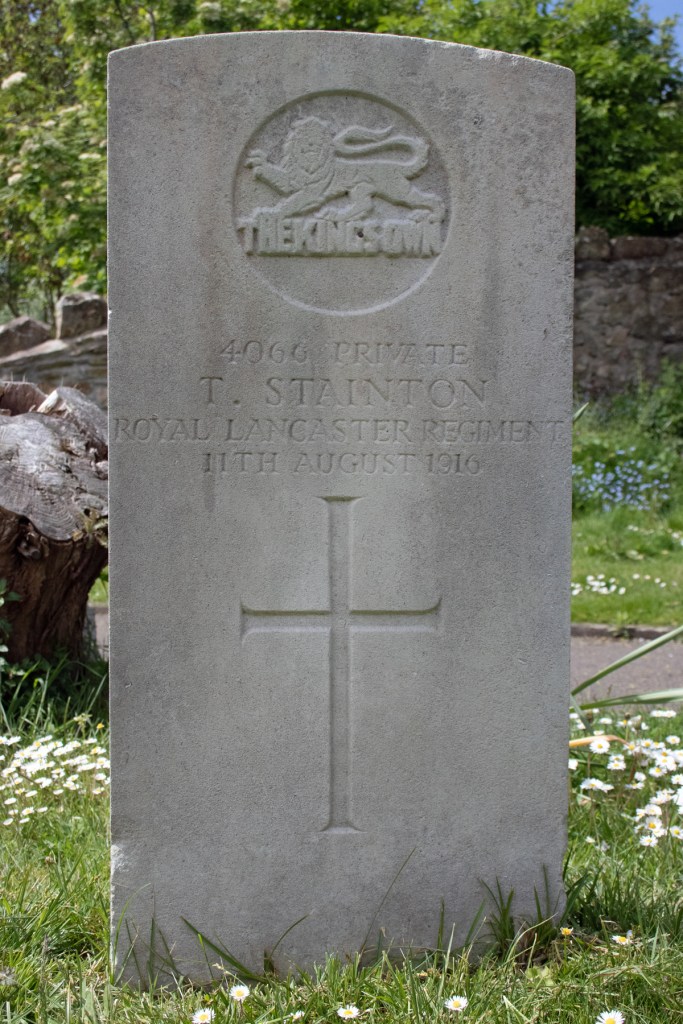
Private John Stainton

Private John Stainton

John Stainton was born in the Cumbrian village of Ambleside in January 1871. He was one of seven children to George and Mary Stainton, a labourer and his wife. John followed in his father’s footsteps as a labourer, as they took him to where the work was – by the time John was ten, the family were living in Barrow-in-Furness.

The 1911 census found John married to a woman called Mary. The couple wed in 1909 and were boarding with Maybrooke Cole, a fellow labourer, and his family.

The next record for John comes in the form of his enlistment papers. He joined up on 31st August 1914, but the document throws up a couple of anomalies.

To the question “Are you married?” John marked “No”. The fact that he didn’t confirm he was a widower presents more questions than answers.

The document also confirms that he has previous military experience. He served with 2nd Battalion King’s Own (Royal Lancaster Regiment), which fought in the Second Boer War, and was involved in Battle of Spion Kop in January 1900.

John re-enlisted in the same battalion on 31st August 1914, and remained part of a territorial force for the best part of a year. It was during this time that he married Rhoda Selina Cooper. She was born and brought up in Clevedon, Somerset, and it can only be assumed that John was stationed in the county at this time.

Private Stainton seemed to have a bit of a rebellious streak, and his service records identify three times when he was pulled up for dereliction of duty. In December 1914, he was admonished for overstaying his leave pass; in June 1915 he was reported for being absent from the base; a year later, he was admonished again, this time for losing a pair of handcuffs.

The battalion were sent to France in July 1915, and, in the end, Private Stainton served on the Western Front for just over a year. On 27th July 1916, he was sounded by shrapnel in the right shoulder, face and thigh, and was evacuated back to England for treatment. Admitted to the English General Hospital in Cambridge, sadly his wounds proved too much for him. Private Stainton died on 11th August 1916, at the age of 45 years old.

John Stainton’s body was brought back to his widow; he lies at rest in the picturesque churchyard of St Andrew’s in Clevedon, Somerset.


The Commonwealth War Grave for John Stainton incorrectly gives his name as T Stainton.