
Tag Archives: Mid Glamorgan

Private James Payne

Private James Payne

The early life of James Payne is a challenge to piece together. The first document that can be properly attributed to him is his marriage certificate from 27th May 1901.

This confirms that he was 21 years old, and working as a labourer. His father’s details are noticeable by their absence. The document also gives his wife’s name, Kate Bessie Warr, and information about her father – labourer Sydney Warr. James was also working as a labour at this point, and the two of them were living in Pulham, Dorset.

By the time of the 1911 census, the newlyweds had moved to the village of Yetminster. James was working as domestic gardener, and the couple had two children – Cyril and Louis. James’ place of birth is given just as Somerset, further clouding his past.

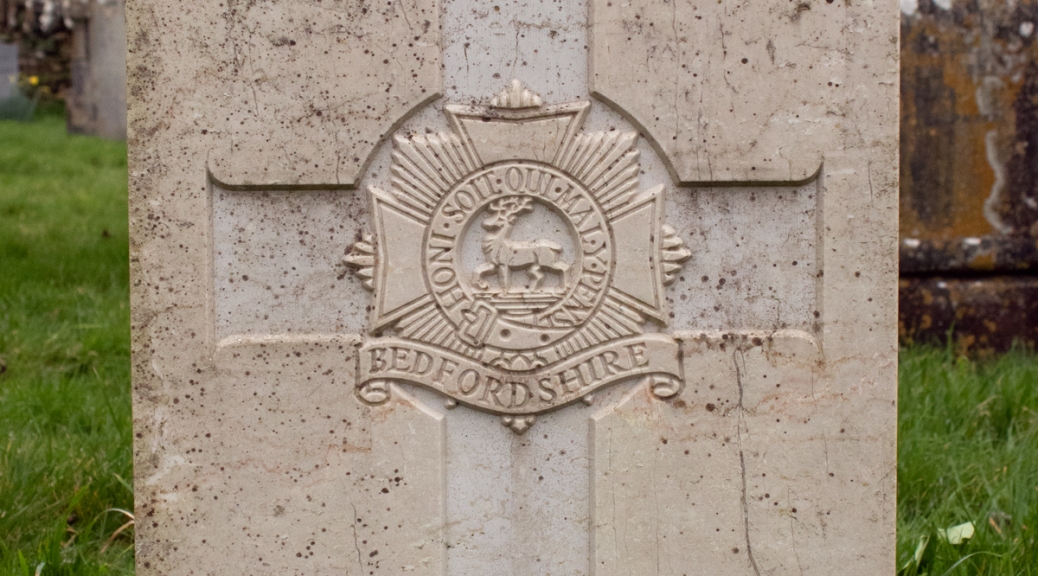
When war came to Europe, James stepped up to play his part. Full details of his time in the army are lost to time, but documents suggest that he had enlisted by October 1917 at the latest. Private Payne joined the Bedfordshire Regiment, and was attached to the 1st Battalion. His unit service on the Western Front throughout the conflict, although there is no evidence that James spent any times overseas himself.

Piecing the sparse number of documents together suggest that in March 1918, James was admitted to the 3rd Western General Hospital in Cardiff, Glamorganshire. He was suffering from nephritis and pneumonia, but it is unclear whether he was serving in Wales at the time, or was taken there for treatment. Either way, his condition was to prove too severe. Private Payne passed away on 20th March 1918: he was 38 years old.

James Payne’s body was taken back to Dorset for burial. He was laid to rest in the peaceful graveyard of St Andrew’s Church in his adopted home of Yetminster.

Sapper Frank Gilbert

Sapper Frank Gilbert

On Monday the body of a man was found.. neat Newton Bridge, commonly known as the “Skew” Bridge, having been killed by a passing train… The deceased was Frank Gilbert…

The inquest was held at the Globe Inn, Newton… by the Coroner for North Somerset (Dr S Craddock), who sat without a jury.

The first witness… said the previous morning he was walking along the railway when he saw the body of a man lying on the down side. The head was separated from the body…

PC Cornish said he found four cards in the pockets of the deceased’s coat. Two were National Insurance cards, and there was an unemployment book, the last payment being dated 15-8-21.

Written on the blotting paper of the book was the following:

“It is quite dark. You still take you neck oil, and my children outside waiting. Marry the man who gave you the watch. Don’t forget to have an extra one (Guinness) over my parting. It would be murder if I ever lived with you again.”

The man’s name, “Frank Gilbert, 44 Jubilee Road, Aberdare,” was on some of the cards. Deceased was wearing a discharged soldier’s badge.

Sarah Kate Gilbert, wife of the deceased, who lives at Bristol, said she had not known her husband’s address at Aberdare. They had been living apart since he went into the Army in 1915. She had, however, met him since that date.

Witness added that she saw him on Sunday night, and went on to say that she took out a summons for a maintenance order against him last February at Gloucester. He was then working as a carpenter in Cheltenham.

The Coroner: ‘Have you ever heard him threaten to commit suicide?’

‘Yes, sir.’ She added that he did so on Sunday night when she was with him at the bottom of Park Lane, Bath. “He was always threatening me when we lived together,” she stated, and also said she had a separation order in Bath in 1913. She had a letter from him on Saturday morning in which he said that when she got the letter he would be gone. In the letter was enclosed the ticket for his suit-case, and the key.

[The letter read] “I would never dream of making a home for you as you are worth only the Gloucester man. You have ruined my life, and you will be able to sleep with… for always now. I shall be gone.”

Witness said there was no reason for him to have made any such statements, as she had had nothing to do with any man except him. He was always using threats. When she left him on Sunday night she told him to try and get on and pull himself together.

The Coroner recorded a verdict that deceased committed suicide by placing himself in front of a passing train on the Midland Railway.

Somerset Guardian and Radstock Observer: Friday 2nd September 1921

Little additional concrete information is available for Frank Gilbert’s life. No marriage certificate remains for his wedding to Sarah, nor is there any evidence for the couple in the 1911 census.

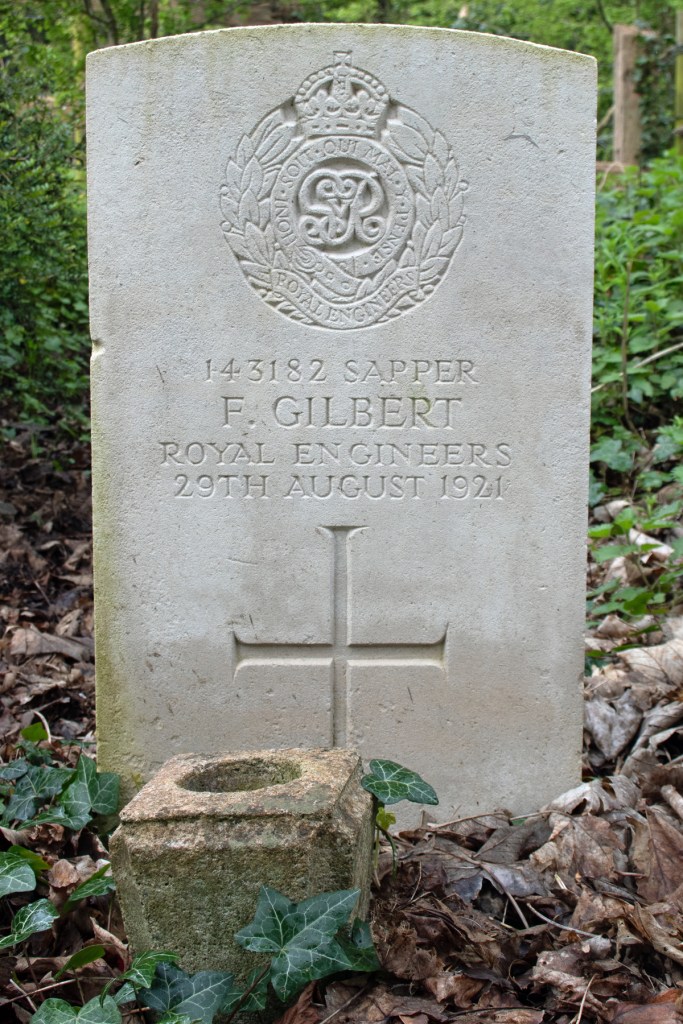
Frank’s service records no longer exist in their entirety, although his pension record give hints as to his service. He enlisted in the Royal Engineers as a Sapper on 20th November 1915, although he never saw any action overseas. He was medically discharged because of rheumatism on 11th November 1917. The document confirm he was born in 1883, and lived in Cheltenham after his discharge.

An additional newspaper report of the inquest confirmed that Sarah had two children, and that they lived with her parents in Bath. When asked by the Coroner if she intended to bury her husband’s remains, she replied that “she had no money to do it with.” [Bath Chronicle and Weekly Gazette: Saturday 3rd September 1921]

And so Frank Gilbert was laid to rest in the quiet graveyard of Holy Trinity Church in Newton St Loe, near Bath in Somerset. He was around 38 years of age when he took his life.


Serjeant Albert West

Serjeant Albert West

Albert Charles West was born in Aldershot, Hampshire, in 1870. The second of nine children, his father Charles was in the army, while his mother Hannah is listed on the 1871 census as a “Soldier’s Wife”.

By the time of the next census, ten years later, Charles had relocated the family to Wells in Somerset – Charles had been born just up the road in Shepton Mallet, so, in effect, he was bringing his family home. By this point, the Wests were a family of seven; Albert had an older sister, Eliza, and three younger siblings, Mary, Joseph and Earnest.

Albert seemed keen to make his own way in the world; by the 1891 census, he had relocated again, this time to South Wales, where he worked as a minor. He boarded with a grocer in the village of Llantwit Fardre. It would have been a bustling house, because Albert was living there with the grocer, his wife and four children and three other lodgers.

The following year, Albert enlisted in the 2nd Battalion Welsh Regiment. Posted to India, he served there for ten of his twelve years’ service.

After completing his enlistment, Albert moved back to Somerset and married Emily Sparrow in Wells. The couple moved back to South Wales for work, however, this time with Albert working in a mine in Llanwonno, ten miles up further up the Taff Valley from Llantwit Fardre.

When war broke out, Albert re-enlisted, this time joining the South Wales Borderers. Sadly, little documentation of his second time in the army remains. He is recorded as having served in the 51st (Graduating) Battalion, which was a training unit based in Suffolk; presumably his experience made him ideal to train others and enabled him to take the rank of Serjeant.

There is nothing to confirm how Serjeant West died. All that is know is that he passed on 9th July 1918. The lack of any media reports around his funeral suggests it is likely to have been illness, rather than injury, that took him. He was 48 years old.

Albert Charles West lies at rest in Wells Cemetery in Somerset.


Charles and Hannah had nine children in total. Two years before Albert passed, their youngest son – Alfred Augustus West – died suddenly and unexpectedly. Records confirm that he was working on the lines at Wells Railway Station, when his foot got caught in the points. Unable to free himself, he was hit by a train and killed.