Tag Archives: Royal Air Force

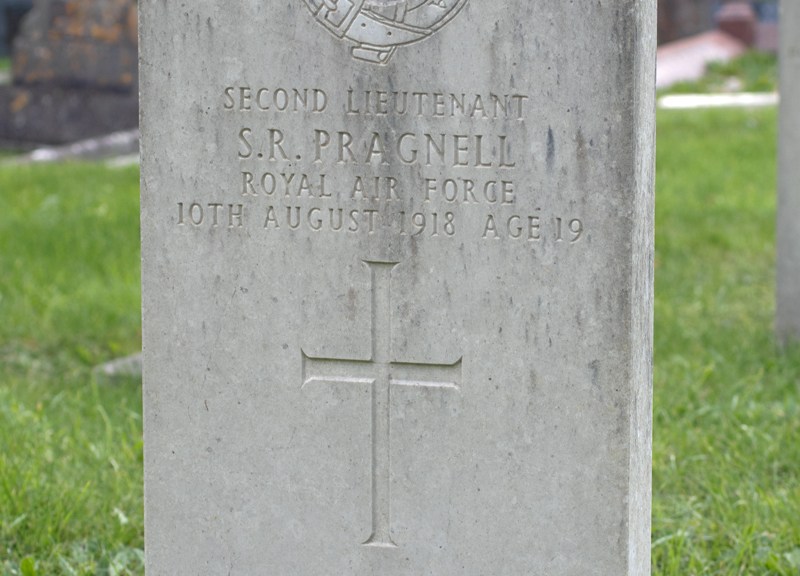
Second Lieutenant Sidney Pragnell

Second Lieutenant Sidney Pragnell

Sidney Ralph Pragnell was the eldest of two children of Edward and Ellen Pragnell. Edward grew up in Sherborne, before moving to London to work as a chef; he found employment as a cook in an officer’s mess, which took him and his wife first to Ireland – where Sidney was born – and then to the barracks at Aldershot.

By the time of the 1911 census, Edward had brought his family back to Dorset, and was running the Half Moon Hotel, opposite the Abbey in Sherborne. Sidney, aged 12, was still at school.

When war broke out, Sidney was eager to play his part, even though he was underage. An article in the local newspaper highlights his keenness and how he progressed.

…he was keen to serve his country and joined every local organisation his age would allow him to. He was an early member of the Sherborne VTC and Red Cross Detachment, and was actually the youngest member of the Volunteers to wear the uniform. Whilst still under age, he enlisted in the Royal Naval Division at the Crystal Palace and after a period of training was drafted as a qualified naval gunner to a merchant steamer carrying His Majesty’s mails and in this capacity went practically round the world. In February he joined the RNAS and after some air training in England went to France to an air station, where he passed all the tests with honours and gained the ‘wings’ of the qualified pilot. Lieutenant Pragnell then decided to go in for scouting and came back to England for advanced training in the special flying necessary for this qualification and it was whilst engaged in this that he met with the accident which resulted in his death.

Western Chronicle: Friday 16th August 1918.

The esteem in which Second Lieutenant Pragnell was held continues in the article, which quotes the condolence letter sent to his parents by his commander, Major Kelly.

It is with deep regret that I have to write you of the death of your son, Second-Lieutenant SR Pragnell. Your boy was one of the keenest young officers I have ever had under my command and was extremely popular with us all and his place will be extremely hard to fill.

The service can ill afford to lose officers of the type of which Lieutenant Pragnell was an excellent example and it seems such a pity this promising career was cut short when he had practically finished his training. May I convey the heartfelt sympathy of all officers and men in my command to you in this your hour of sorrow.

Western Chronical: Friday 16th August 1918.

What I find most interesting about this article is that the letter from Major Kelly detail how Edward and Ellen’s son died, and this this too is quoted by the newspaper.

Your son had been sent up to practice formation flying and was flying around the aerodrome at about 500 feet with his engine throttled down waiting for his instruction to ‘take off’. Whiles waiting your boy tried to turn when his machine had little forward speed. This caused him to ‘stall’ and spin and from this low altitude he had no chance to recover control and his machine fell to earth just on the edge of the aerodrome and was completely wrecked. A doctor was there within a minute, but your boy had been killed instantaneously.

Western Chronicle: Friday 16th August 1918.

Further research shows that the aerodrome Second Lieutenant Pragnell was training at was RAF Freiston in Lincolnshire, which had been designated Number 4 Fighting School with the specific task of training pilots for fighting scout squadrons. He had been flying a Sopwith Camel when he died.

Second Lieutenant Sidney Ralph Pragnell lies at rest in the cemetery of his Dorset home, Sherborne.

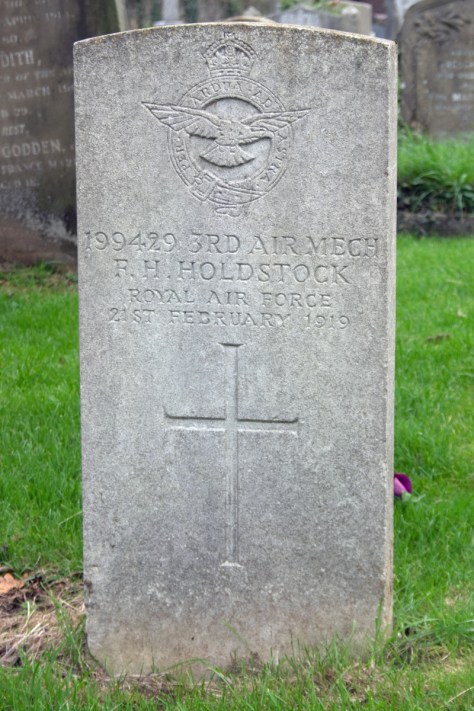
Air Mechanic Herbert Holdstock

Air Mechanic Herbert Holdstock

The year is 1897, and Edwin Holdstock has crammed a lot into his 38 years. Born in North Kent, he has travelled well, working as a grocer’s manager in south London. His first wife, Kate, gave him five beautiful children, four girls and a boy, before she died, aged only 35. Edwin married again, to Louisa, and they have already had their first child, a boy.

A new birth is on its way, though, and his third son – Herbert Frederick Victor Holdstock is born. They are living in Thornton Heath, Surrey.

The family up and move again, this time to Grimsbury, near Banbury, Oxfordshire. Edwin has new employment, as a superintendent for Kingsley Sewing Machines in the town.

Edwin appears to be an ambitious man; by the time of the 1911 census, he has moved the family from Oxfordshire back to Kent. He and Louisa have four children now and they live in Rainham, where Edwin works as a Political Agent.

Herbert was keen to make his own way in the world, however, and worked as an apprentice watchmaker and jeweller in both Rainham and nearby Sittingbourne.

He enlisted relatively late into the war; his service records show that Air Mechanic Holdstock started his Royal Air Force service on 20th June 1918. He was stationed in South London.

While there, he contracted pneumonia and was hospitalised. Within a week, Herbert had passed away. He was just 21 years old.

The local newspaper reported on his funeral:

Only so recently as November Mr EC Holsdtock of Orchard-street, Rainham, the Secretary of the Sittingbourne District War Pensions Committee, sustained a sad bereavement in the death of his wife [Louisa], who succumbed to an attack of influenza and pneumonia. Mr Holdstock has now suffered another bereavement in the death of his second son, Herbert Frederick Victor Holdstock, who died in the Royal Herbert Hospital, Woolwich… A little over eight months ago he joined the Royal Air Force, as a mechanic, as was stationed at Kidbrook, near Woolwich. Never robust, he contracted pneumonia, and after a week’s illness succumbed. He was a bright, cheery young man, and much liked.

East Kent Gazette: Saturday 1st March 1919.

Air Mechanic Herbert Holdstock lies at rest in the graveyard of St Margaret’s Church in Rainham, Kent.