Tag Archives: Royal Scots Fusiliers

Lieutenant Stanley Syvret

Lieutenant Stanley Syvret

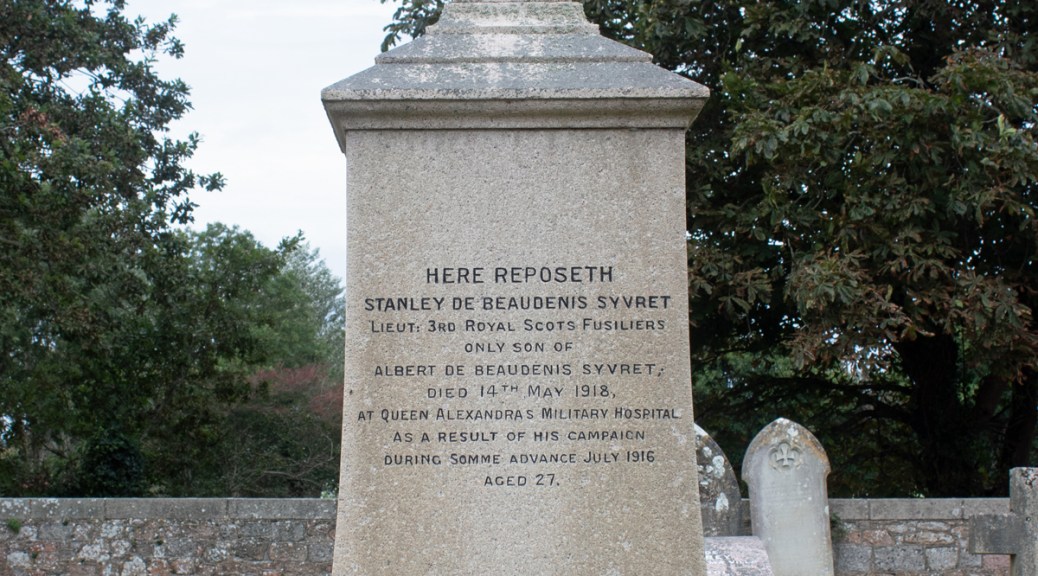
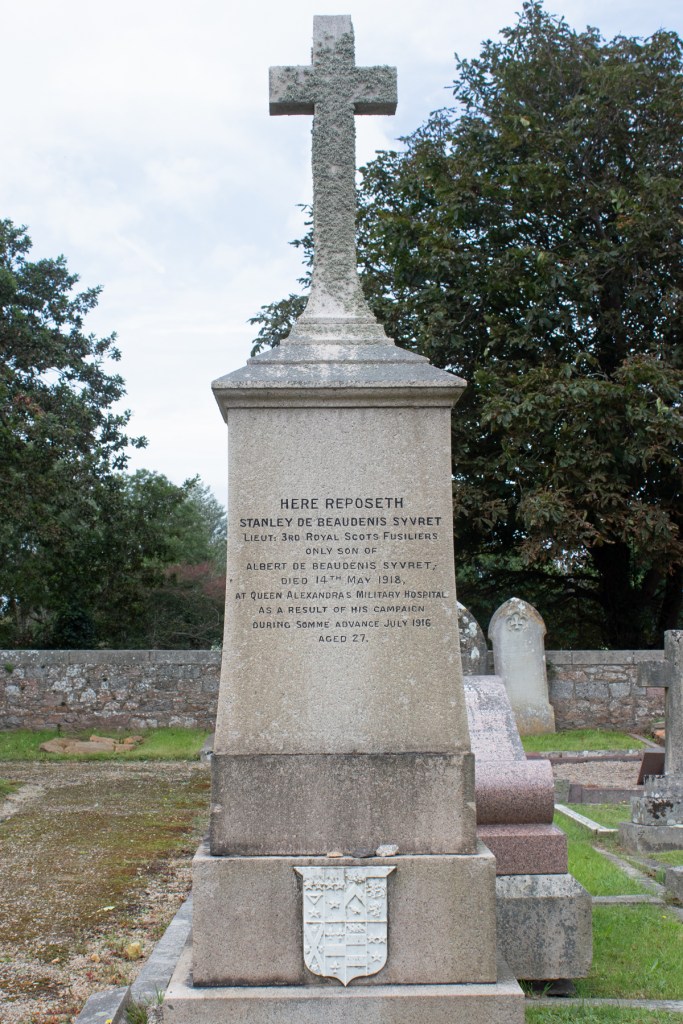
In the graveyard of St Lawrence Church in Jersey, stands an imposing monument. The dedication reads “Here reposeth Stanley de Beaudenis Syvret, Lieut. 3rd Royal Scots Fusiliers. Only son of Albert de Beaudenis Syvret. Died 14th May 1918 at Queen Alexandra’s Military Hospital as a result of his campaign during Somme Advance July 1916. Aged 27”.

Stanley de Beaudenis Syvret was born in South America in 1891. He was the only child of Anthony and Amy, both of whom were born in Jersey. Records for South America are not available, but by the time of the 1911 census, the family were living in Stamford Hill, London. Anthony was employed as an attendance officer for London County Council schools, while Stanley had found work as a clerk for a wool broker.

At this point, Stanley’s trail goes a bit hazy. The 3rd (Reserve) Battalion of the Royal Scots Fusiliers was based in Scotland for the whole of the conflict, so it is likely that he was transferred to that battalion after being injured.

There is little additional information for Lieutenant Syvret. He was brought back to Jersey after his death, and lies at rest in the churchyard close to his family home.


Private Robert Templeton

Private Robert Templeton

Robert Muckart Templeton was born in Glasgow, Scotland, in 1894. He was the fourth of five children to shipyard labourer William Templeton and his wife, Agnes.

There is little information on Robert’s early life: the family’s 1911 census records are lost, so it is not possible to identify what work he took on when he left school. It is, however, reasonable to assume that he joined his father in the shipyards.

When war broke out, Robert was one of the first to enlist. He joined the Royal Scots Fusiliers, and, as a Private, was assigned to the 8th (Service) Battalion. His troop was sent to Salisbury Plain, Wiltshire, for training, and he was camped at Codford St Mary.

Towards the end of October, the 8th Battalion was moving to Bristol, and it was at this point that the fates intervened for Private Templeton. Suffering from an acute bout of appendicitis, he was admitted to the Abbas and Templecombe hospital. The condition was to prove his undoing and, on 1st November 1914, he passed away. He was just 20 years of age.

A shipyard labourer’s wages were not going to be enough to transport a body halfway across the country, so the Templetons were left with little choice but to have their son buried close to where he died. Robert Muckart Templeton was laid to rest in the quiet graveyard of St Mary’s Church, in Templecombe, Somerset.


Editor’s note: My gratitude goes to Christine Scott, who was able to furnish me with details of Robert’s death.

Serjeant James Gillighan

Serjeant James Gillighan

Some lives are destined to remain shrouded in mystery, and James Gillighan’s is one of those to be lost to time.

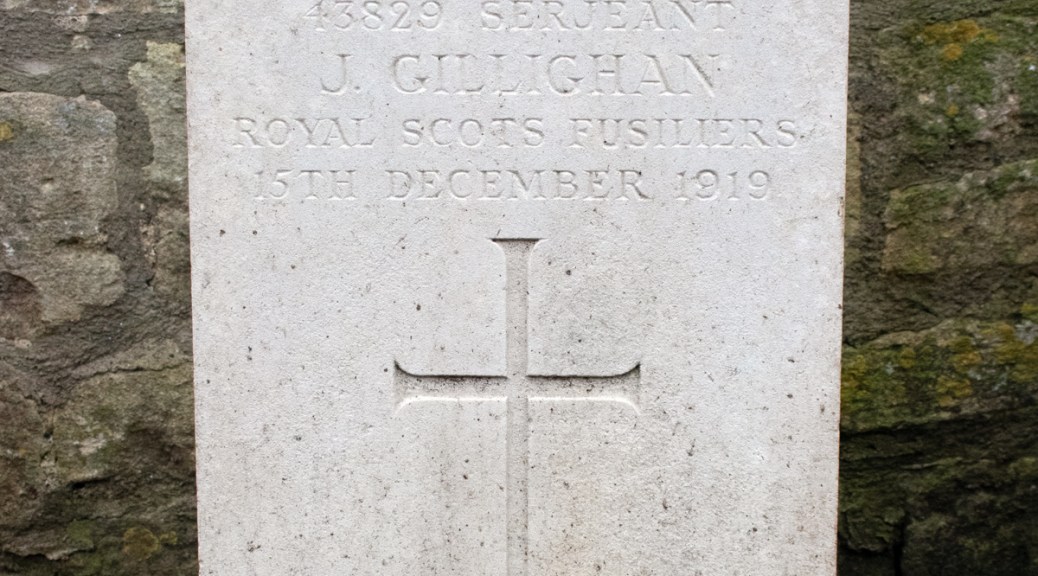
His headstone sits in the quiet Roman Catholic Cemetery in Bath, Somerset. It provides his regiment – the Royal Scots Fusiliers – and confirms that he was a Serjeant at the time of his death on 15th December 1919. The Commonwealth War Graves Commission adds that he served in the 2nd Battalion, but sadly James’ service records no longer exist.

The Army Register of Soldiers’ Effects notes that his next of kin was his brother, Matthew Gillighan, which suggests that James’ parents were not alive, nor that he was married. The document also notes that Serjeant Gillighan passed away in Bath War Hospital.

Another army document – the Service Medal and Award Roll – suggests that the service number on the headstone – 42839 – was actually James’ second number, given to him when he moved to the battalion depot. Tantalisingly, however, his previous regimental number – 15170 – sheds little more light to his service, other than the date he was sent to France – 15th September 1915.

Contemporary newspapers do not have any records for James’ passing, so it is likely to have been natural causes of some description – possibly an illness contracted while serving.

Sadly, there is little more detail that can be added to James’ life. He lies quietly, in a corner of the Bath cemetery, wrapped in mystery.


Private John Wride

Private John Wride

John Wride was born in 1891, one of eleven children to William and Kate Wride from Cheddar in Somerset. William stared as an agricultural labourer, but went on to become a market gardener, a trade at least four of his sons, John included, also went into.

Sadly, little of John’s life before the outbreak of war is documented. He enlisted on 12th February 1915, and was assigned to the Royal Scots Fusiliers. There is little information about whether he served abroad, although a number of battalions remained based in the UK.

When he enlisted, Private Wride was noted to have an enlarged thyroid and dental deficiencies. He seems to have suffered with his health during the conflict, and the medical report that accompanied his discharge from the army showed that he suffered from VDH – valvular disease of the heart – although the doctor did not attribute this to his military service.

This decision was appealed, and a subsequent report identified that John’s heart and kidney disease were in fact aggravated by his time in the army. He was medically discharged due to these conditions in February 1919.

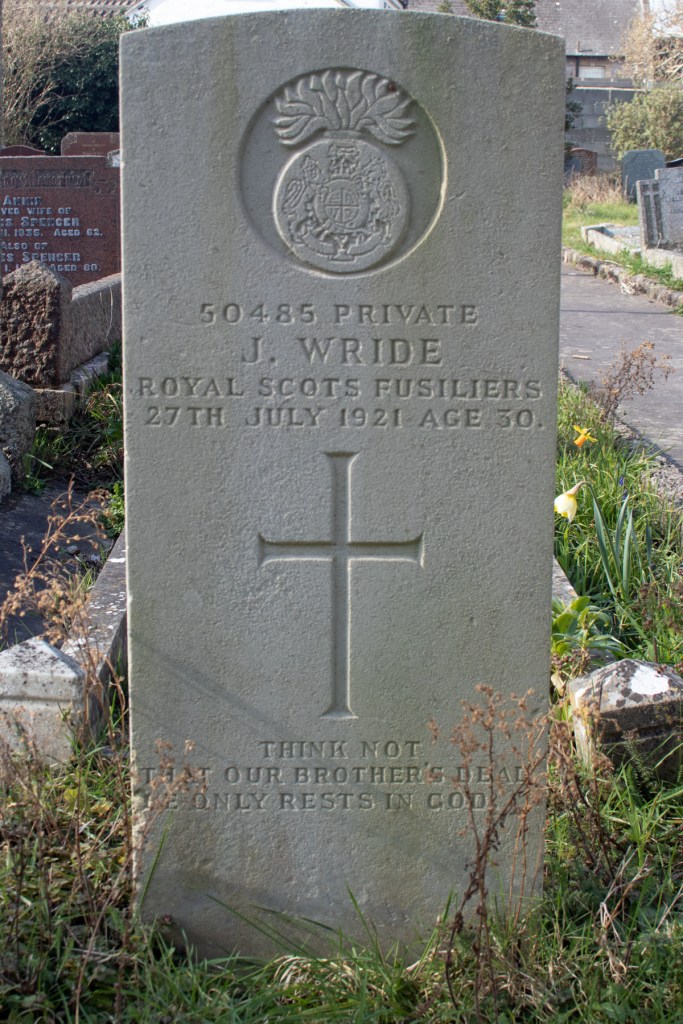
By the time of the 1921 census, taken in June that year, John was back home in Cheddar. He was living with his parents and two siblings, and seemed to be working alongside his father in the market garden business. Sadly, however, his heart condition was to prove fatal. He passed away on 27th July 1921, aged 30 years old.

John Wride lies at rest in the Baptist Burial Ground in his home town of Cheddar.