
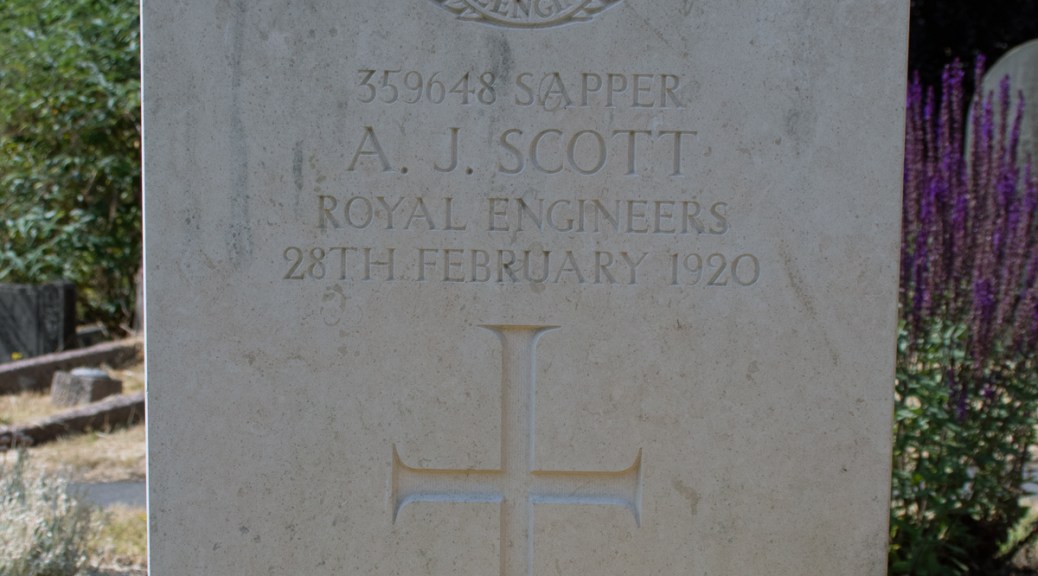

Abraham James Scott was born in Bathford, Somerset, in the spring of 1893. He was one of fourteen children to Abraham and Lucy Scott, and became known as James, to avoid any confusion with his father. Abraham was a shepherd, who travelled where work took him: both he and Lucy were from Wiltshire, but had moved to Somerset by the end of the 1880s. When James was just a babe-in-arms, the family had relocated to Gloucestershire, but by the time of the 1901 census, they were back in Wiltshire once more.
Abraham Sr died in 1910, at the age of just 41 years old. The following year’s census found the now widowed Lucy living in North Wraxhall, Wiltshire, with eight of her children. Abraham Jr is absent, and, indeed, does not appear on any of the 1911 censuses.
Lucy needed options and, on Christmas Day 1912, she married carter William Amblin in the village church. Abraham was, by this time, living in Bath and working as a carter.
When war came to Europe, Abraham felt the need to step up and play his part and, on 15th December 1915, he enlisted in the army. His service records show that he was 5ft 5ins (1.65m) tall and weighed 132lbs (59.9kg). He had a vaccination mark on his left arm which, according to the document’s section on ‘distinctive marks’, has a tendency to rupture.
Private Scott was mobilised in March 1916, and was assigned to the 1st/5th Gloucestershire Regiment. He soon found himself on the Western Front, and, having transferred to the 1st/4th Battalion, served at the Somme.
Abraham was in for a chequered time in Northern France. On 26th August 1916, he was injured when he received a gunshot wound to his scalp. He was admitted to the 1st Canadian General Hospital in Etaples, the moved to Rouen to recuperate. Private Scott rejoined his unit on 21st October 1916.
Just weeks later, however, Abraham was back in a hospital in Rouen, having fractured his ankle. After a couple of weeks in the 1st Australian General Hospital, the injury was deemed severe enough for him to be evacuated back to Britain for recuperation, and he was posted to Ballyvonare Camp in County Cork. Abraham returned to his unit in France in September 1917, nine months after his ankle injury.
On 1st March 1918, Abraham transferred to the Royal Engineers where, as a Sapper, he was attached to the Depot in Rouen. He remained there for more than a year, during which time he was admitted to hospital once more, this time with trench fever. Little additional information is available about this spell in hospital, other than that Lucy had written to the regiment thanking them for informing her of her son’s illness, and confirming a new address for her.
Sapper Scott’s health continued to suffer, however. In May 1919, he was admitted to a camp hospital, suffering from appendicitis. He was operated on, and medically evacuated to Britain for further treatment and recuperation. Abraham was admitted to the Bath War Hospital on 25th July 1919, and remained there for four months.
Abraham’s health seemed to improve, albeit slowly, and he was moved to the Pension’s Hospital in Bath on 27th November. The head wound, broken ankle and bout of trench fever appear to have taken their toll on his body which, by this point, seems to have been too weak to recover. On 28th February 1920, two months after being transferred to the Pension’s Hospital, he passed away there from a combination of appendicitis and pelvic cellulitis. He was just 26 years of age.
Abraham James Scott’s body did not have to travel far after this point. He was laid to rest in the sprawling Locksbrook Cemetery in his adopted home city of Bath.

 Death and Service