

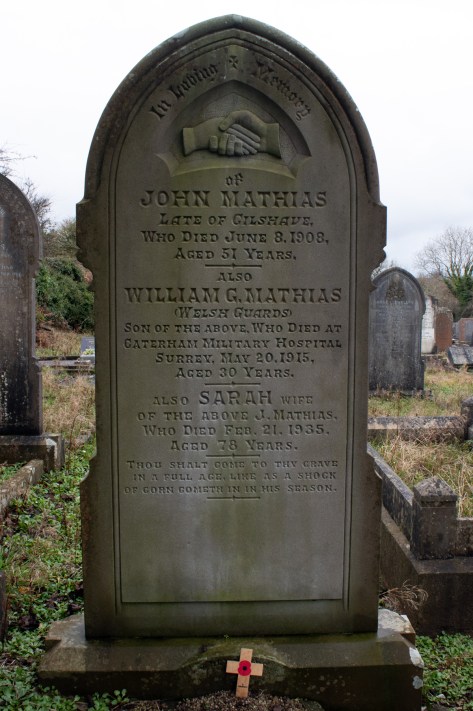
William George Mathias was born in the Pembrokeshire village of Littleston early in 1885. The oldest of five children, his parents were John and Sarah Mathias. John was a farm worker, but when he finished his schooling William found work as a rabbit trapper. This meant a move from home, and the 1901 census found him as a servant for the Evans family, in nearby Mathry.
Agricultural work was not employment that William wanted to dedicate his life to, and he soon found a new opportunity. He took a job as a police constable in Glamorganshire. There is little information about this part of his life, but the 1911 census recorded him as being one of 26 police officers boarding in the village of Gilfach Goch. Interestingly the census includes the annotation “The above are police quartered at the Ogmore Arms, Gilfach Goch, temporarily during the coal strike.”
The Miner’s Strike of 1910/11 resulted in the temporary closure of South Wales mines. Police were shipped in, but this only resulted in riots breaking out. In November 1910 disorder broke out in Tonypandy, Pontypridd and Gilfach Goch, amongst other locations. Nearly 80 police and more than 500 civilians were injured, although the exact number of miners wounded is unclear, as many refused to seek medical treatment for fear of being singled out.
As the strike moved into 1911, the army was called in, with four detachments of the Somerset Light Infantry being called into Penygraig, Llwynpia, Clydach Vale and Gilfach Goch. Stones were thrown by the rioters, and a number of William’s police colleagues were injured: thirteen of the Gilfach miners were arrested and prosecuted for their involvement in the unrest.
The decision to send troops in was contentious, and anger became directed at the then Home Secretary, Winston Churchill, for the decisions he took. Ultimately, the miners were defeated, their calls for better living conditions and higher wages went unanswered.
William continued in the police force until war broke out. His time in the army is lost to history, but it is clear that he enlisted in the Welsh Guards as a Private. Sent to Caterham, Surrey, for his training, his time serving King and Country was not to be a lengthy one. In May 1915 he was admitted to a military hospital, though the cause is not clear. He passed away on 20th May 1915: he was 30 years of age.
The body of William George Mathias was taken back to Pembrokeshire for burial. He was laid to rest in Fishguard’s Hernon Baptist Burial Ground.

(from findagrave.com)


 Death and Service