

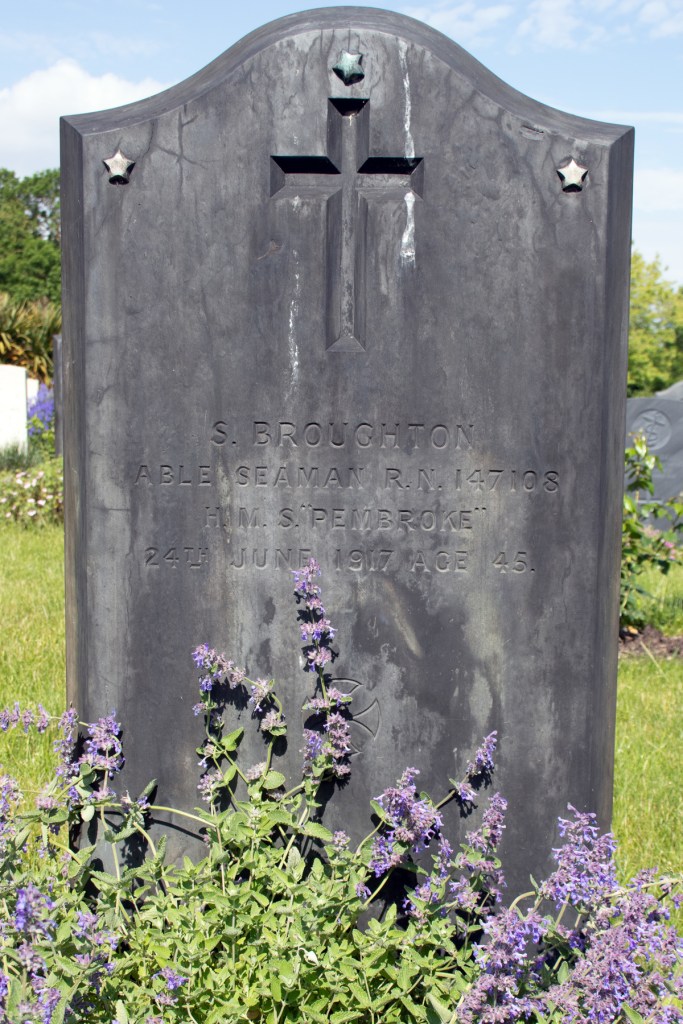
Sydney Broughton was born on 21st November 1872 in the Lincolnshire village of East Halton. The sixth of nine children – of whom eight were boys – his parents were William and Emma Broughton.
William was a boot an shoe dealer, and his older sons were destined to follow him into the business. Sydney, however, sought bigger and better things and, on 13th November 1888, he joined the Royal Navy. Being only 15 years of age, he wasn’t able to full enlist, and was taken on as a Boy 2nd Class.
Sydney was sent to Devonport, Devon, for his training. Assigned to the training vessel HMS Impregnable, she would become his home for just over two years. On 12th March 1890 he was promoted to Boy 1st Class and on his eighteenth birthday, he was formally enlisted in the Royal Navy.
Ordinary Seaman Broughton’s service records show that he was 5ft 4ins (1.63m) tall, with dark brown hair, light grey eyes and a fair complexion. He was also noted as having a slight scar under his right eye. Now of age, Sydney was moved to barracks at HMS Vivid, onshore at the heart of Devonport itself.
On 28th January 1891, Ordinary Seaman Broughton was given his first posting, on board the cruiser HMS Tauranga. He would remain there for only six months, however, as the ship was in the process of being transferred to the Australian Navy. His new assignment would be the survey sloop HMS Penguin, and she would be his home for the next two years.
Shortly before leaving Penguin, Sydney was promoted to the rank of Able Seaman. He spent the next nine months split between HMS Victory, the Royal Naval Dockyard in Portsmouth, and HMS Excellent, a base that was also connected to the dockyard.
On 26th January 1894 Able Seaman Broughton was posted to the cruiser HMS Galatea. He remained there for the rest of the year, including fourteen days spent in cells for an unknown offence that April. He then moved to the battleship HMS Edinburgh, with whose crew he would spend the next two years.
In September 1896, Sydney transferred to what would become his home base, HMS Pembroke, also known as the Royal Naval Dockyard in Chatham, Kent. Over the remaining six years of his twelve year contract, he would keep returning there, also spending time in the dockyard’s training base, HMS Wildfire.
On 10th February 1901, Able Seaman Broughton was imprisoned for 42 days for misappropriating mess funds, while based in the Dockyard. Surprisingly, the misdemeanour seems not too have impacted his career too adversely, however, and when his contract came up for renewal the following year, he voluntarily remained with the navy.
Sydney was on board the cruiser HMS Amphritite when his new term of service began. In March 1902 he was promoted to Leading Seaman and, over the next five years, he would go on to serve on a further five ships. In October 1907 he was reduced in rank to Able Seaman once more, although his service records don’t confirm whether this was through his own choice or not.
Over the next six years, Sydney would serve on three further ships. When was formally stood down to reserve status on 19th January 1913, his home was HMS Actaeon, the navy’s torpedo school in Chatham: he had been assigned there for nearly three years, and in the Royal Navy as a whole for more than 24 years.
When war broke out in the summer of 1914, Able Seaman Broughton was called back into action. He remained on solid ground, however, and split the next three years between HMS Pembroke and HMS Wildfire, places he knew well. Sydney’s health may have been a factor in his lack of seaworthiness: in the spring of 1917 he was admitted to the Royal Naval Hospital in Chatham, suffering from mouth cancer. The condition was to prove fatal: he passed away on 24th June 1917, at the age of 44 years old.
Sydney Broughton’s body was laid to rest in the naval section of Woodlands Cemetery in Gillingham, Kent, not far from his beloved dockyard.
Sydney’s next-of-kin was noted as being his wife, Edith Mary Broughton. There is no record of their marriage, but her details on his records correspond to an entry on the 1921 census.
The document recorded Edith living in Sittingbourne, Kent. 45 years and seven months old, she was sharing her home with her widowed mother, Harriett Pearce, and her two-year-old granddaughter, Edith May.
Further digging suggests that Edith had been a widow when she and Sydney exchanged vows: the 1911 census found her married to Herbert Busbridge, the couple having a daughter, Edith Nellie, who had been born in 1896.
Widowed twice, Edith Mary carried on as best she could: she passed away in the spring of 1963, at the age of 87.
 Death and Service