
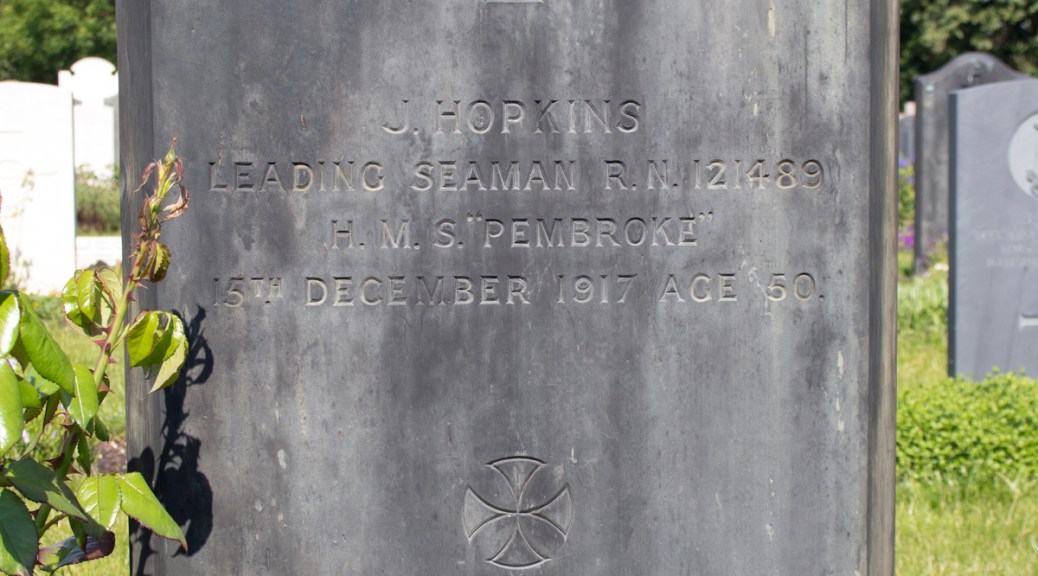
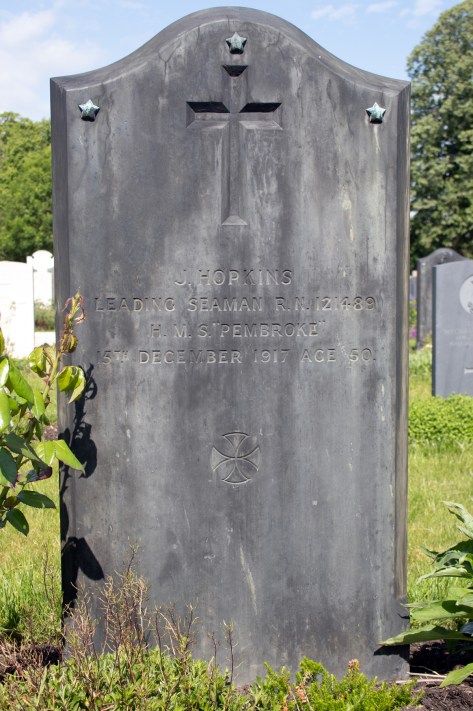
Joseph Hopkins was born in Ramsgate, Kent, on 27th May 1867. The third of seven children, his parents were commissioned sailor George Hopkins and his wife, Agnes.
Given his father’s job, Joseph seemed destined for a life at sea himself and, on 30th November 1882, he joined the Royal Navy as a Boy 2nd Class. Over the next couple of years, he learnt the tools of his trade, starting on the training ships HMS St Vincent and HMS Hector. During this time, he was promoted to Boy 1st Class.
On 1st January 1885, Joseph was assigned to the ironclad ship HMS Repulse. He remained on board for six months, during which time he came of age. Now an Ordinary Seaman, his service papers show that he was just 5ft 1in (1.55m) tall, with black hair, grey eyes and a pale complexion. He was also noted as having a scar on the left of his forehead.
Ordinary Seaman Hopkins’ contract was for ten years and over that decade he sailed the world, serving on eight ships. Less than a year after formally enlisting, he was promoted to Able Seaman, but his time in the navy was not without its problems.
Able Seaman Hopkins spent four separate periods of time – totalling 49 days – in the brig between 1886 and 1895. Details of his most of his offences have been lost to time. Given the last instance was an expired shore leave which also landed him with a find of £3 10s (around £580 today), it seems likely that he was a repeat offender.
When Able Seaman Hopkins’ contract expired, he immediately re-enlisted. He served for another ten year and, apart from one further bout in the cells in 1898, his record was incident free. In the summer of 1905, after more than two decades in the Royal Navy, he was formally stood down to reserve status.
Joseph’s trail goes cold for a while and it is only in the 1911 census that we pick him up again. At this point he was living with his younger brother in Kilburn, Middlesex, where he was employed as a warehouseman.
When war broke out, Joseph was called upon to play his part once more. He took up the rank of Able Seaman once again, but remained shore-based, serving at HMS Pembroke, the Royal Naval Dockyard in Chatham, Kent. He would spend the next three years at the dockyard, rising to Leading Seaman in March 1917.
By this point, however, Joseph’s health was beginning to decline. In December 1917 he was admitted to Chatham’s Royal Naval Hospital following a cerebral haemorrhage, but the condition would prove fatal. He passed away on 15th December, at the age of 50 years old.
The body of Joseph Hopkins was taken to Woodlands Cemetery in Gillingham, Kent, and he was laid to rest, not far from the base he had called home for so long.
 Death and Service