
Albert Edward Boorman was born on 21st November 1873 in Hadlow, Kent. He was the oldest of seven children, and one of four boys to James and Jane Boorman. James was a maltster’s labourer, but his eldest son sought a longer-term career.
On 5th January 1889, Albert enlisted in the Royal Navy. Due to his age, he took on the rank of Boy 2nd Class, and was sent to the training ships HMS Impregnable and HMS Lion, both based in Devonport, near Plymouth, Devon.
Over the next couple of years, Albert learnt the tools of his trade, rising to the rank of Boy 1st Class in December 1889. The following November he was assigned to HMS Calypso, a corvette, and it was during the eighteen months he spent with her that he came of age.
The now Ordinary Seaman Boorman’s service record show that, having turned eighteen, he was 5ft 7.5ins (1.71m) tall, with dark brown hair, grey eyes and a fresh complexion. He was noted as having a birth scar on his left shoulder.
Albert was obviously dedicated to his naval career and, on 2nd April 1892, he was promoted to Able Seaman. When he came of age, he enlisted for twelve years’ service and, during that time, he would serve on four ships. In between tours he returned to what would become his shore base, HMS Pembroke, the Royal Naval Dockyard in Chatham, Kent. His annual reviews reflected his commitment to the role: in December 1897 he was promoted to Leading Seaman, in January 1899 he gained the rank of Petty Officer 2nd Class, and in September 1900 he rose to Petty Officer 1st Class.
When his contract came to an end in November 1903, Albert immediately re-enlisted and would serve for another decade. In the summer of 1909 he was promoted to Acting Chief Petty Officer: the role was formalised a year later.
Away from his naval career, Albert had fallen in love. He married Eliza in 1909, and, while her husband was at sea, she set up home at 43 East Street, Gillingham, Kent.
In November 1913, after 22 years’ formal service, Chief Petty Officer Boorman was stood down to reserve status. This time away from the sea was not to last for long, however, and he was called upon once more when war was declared just nine months later. Albert resumed his previous role, but was primarily based back at HMS Pembroke.
On 7th March 1917, Chief Petty Officer Boorman was on board the gunboat HMS Spey, which was carrying out diving operations in the Thames Estuary. At 4 o’clock in the afternoon, in “bitterly cold and boisterous conditions” [Whitstable Times and Herne Bay Herald: Saturday 24th March 1917], the ship lost an anchor, and the decision was made to return to base at Sheerness, Kent. Another vessel, the HMS Belvedere, was close by and turned towards the Spey, and, despite trying to avoid a collision, the smaller ship was struck a glancing blow.
The Spey was 40 years old, and the impact sheered numerous rivets from the side. Water gushed in, and the gunboat sunk beneath the Thames within a matter of minutes. Some of the crew had managed to escape on a life raft, but it was not fitted with lights or flags. The boat drifted and was not found until five hours later, partially submerged: all on board had died.
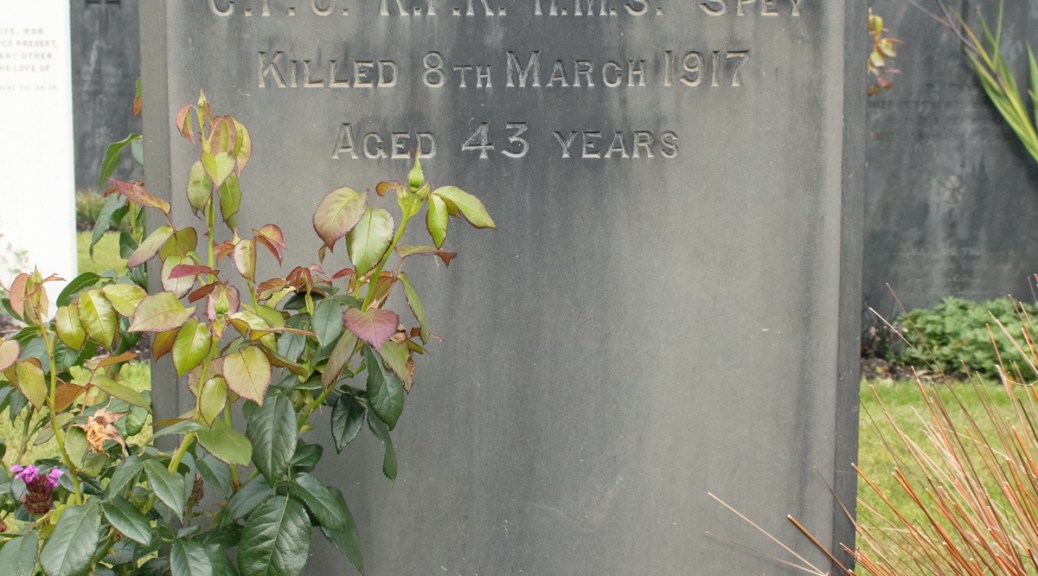
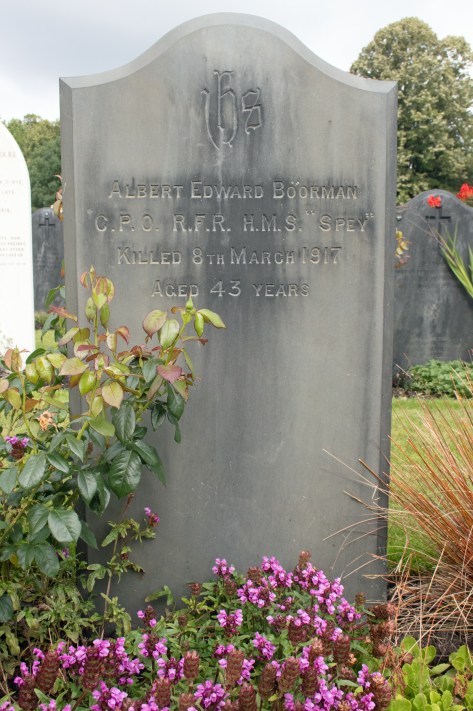
In total, twenty of the thirty-seven crew perished on that March afternoon, including Chief Petty Officer Boorman. He was 43 years of age.
The body of Albert Edward Boorman was retrieved. He was laid to rest in the naval section of Woodlands Cemetery, Gillingham, Kent, not far from where his widow still lived.
 Death and Service