
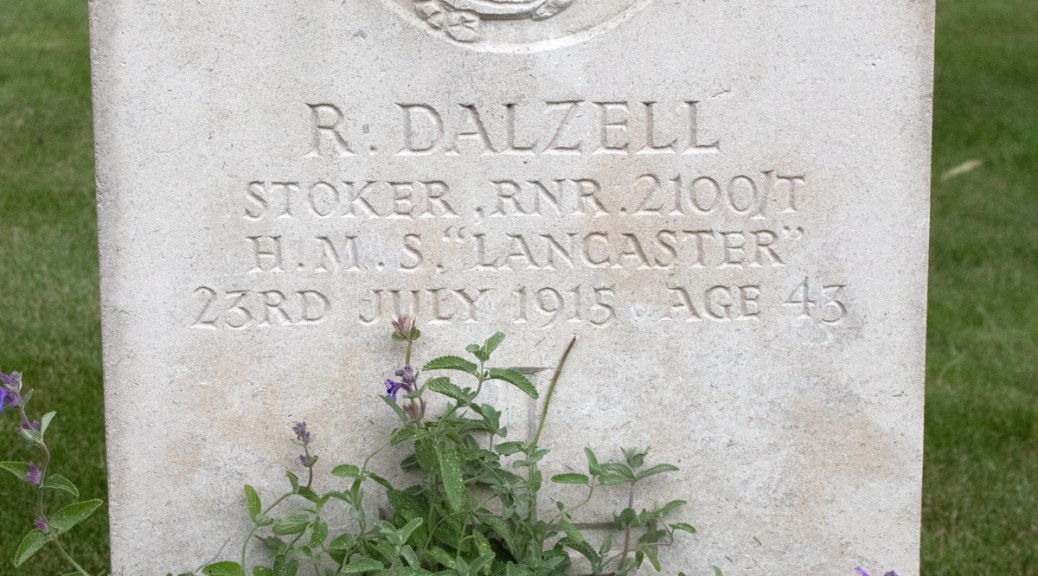
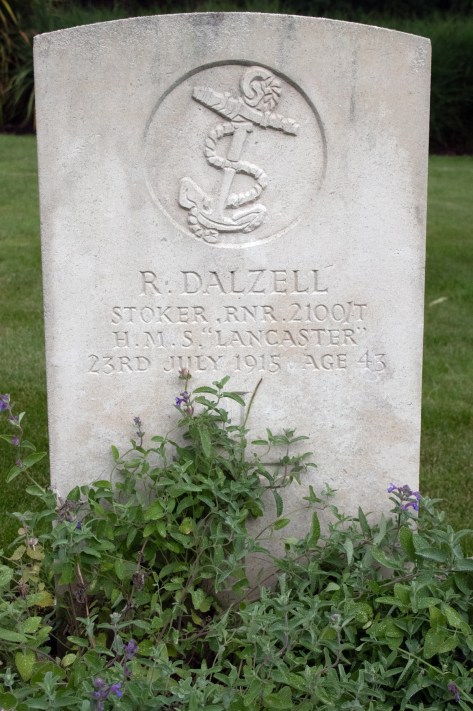
The early life of Robert Dalzell is a challenge to piece together. Born in Belfast, County Antrim, on 12th September 1874, his parents were William and Ellen Dalzell.
It is unclear what William was employed as, but it seems that Robert took up manual labour. The 1911 census recorded him as a plater’s helper, living on Ulverston Street in the Shankill area of Belfast. The census also sheds some light on his private life: he had been married to Matilda for eight years, and they had three children: Robert Jr, Mary and Elenor.
With a family to support, Robert needed a better paid, permanent career and, on the 22nd October 1904, he joined the Royal Naval Reserve as a stoker. His service papers show that he was 5ft 5.5ins (1.66m) tall, with blue eyes and a dark complexion. The document also confirms a number of tattoos: stars and a bracelet on his left forearm, and a mermaid and pineapple on his right.
Stoker Dalzell worked on ships traversing the Irish Sea to and from Liverpool. When war broke out, however, he was assigned to the armoured cruiser HMS Lancaster. She patrolled the North Sea and English Channel, and was involved in a number of skirmishes with enemy vessels.
An inquest relative to the tragic death of a naval stoker reservist, named Robert Dalzell, belonging to Belfast, was conducted… on Monday afternoon. Early on Friday afternoon the deceased was found lying in a pool of blood in the stokehold hatchway of the ship, beyond all medical aid, and passed away within a short time of the sad discovery.
Samuel Fisher, master-at-arms, identified the body… Deceased had been on the ship just over two months, and was forty years of age. The man’s conduct on board had been very good, and there were no service troubles… Prior to mobilisation the deceased had been employed in a private shipyard in Ireland. Witness last saw him alive on the ship on Friday morning, and a little later was informed that he had been found with his throat cut…
Stoker William George Hamshire said he only knew the deceased by sight. On Friday, about 1:30pm, witness found the deceased in No. 1 stokehold hatchway all alone, lying on his back, with his throat cut. The deceased was breathing, and a good deal of blood was coming from the wound. Witness called for assistance. [There was a razor] near the deceased’s right hand. The deceased was quite alone when witness found him The man was too far gone to speak. There was no sign of any struggle, and the wound had every appearance of being self-inflicted…
Stoker Thomas Gillan deposed that he had known Dalzell for eighteen years… Witness could give no reason for the tragedy. The deceased was a very quiet man, and had no home troubles so far as witness knew. Since Wednesday evening, however, the deceased had been a bit “moody,” and would not speak.
[Chatham, Rochester and Brompton Observer: Saturday 31st July 1915]
Other witnesses at the inquest confirmed that Robert had asked about upcoming leave, and whether he would get a railway pass to enable him to get home and see Matilda and the children: “He was all about getting home.”
The jury returned a verdict of “Suicide,” but were unable to confirm the state of Robert’s mind when he killed himself on 23rd July 1915.
The body of Robert Dalzell was laid to rest in the naval section of Woodlands Cemetery, Gillingham, Kent, not far from the Royal Naval Dockyard in Chatham, where Lancaster was moored at the time of his passing.

