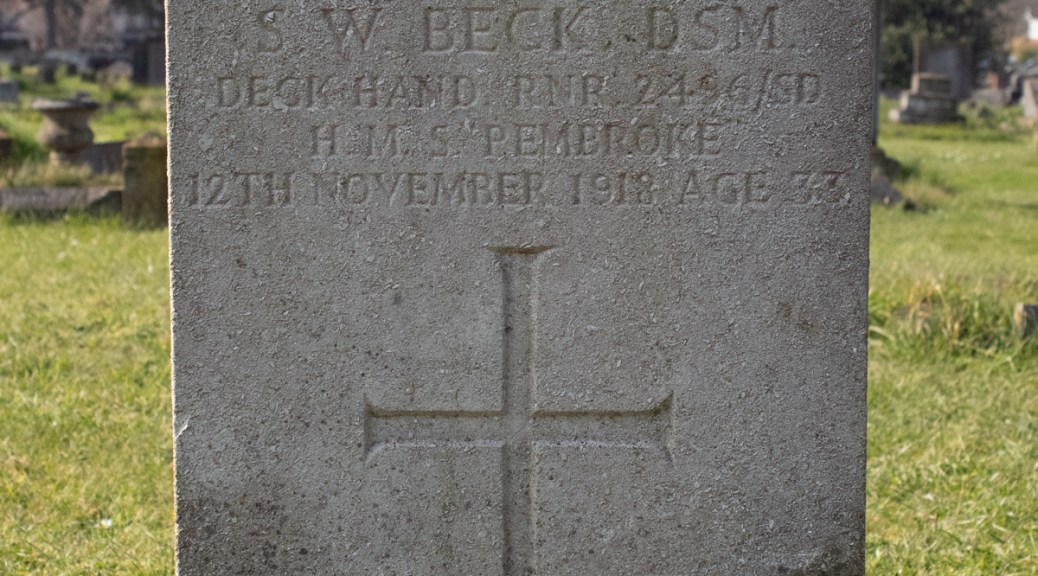
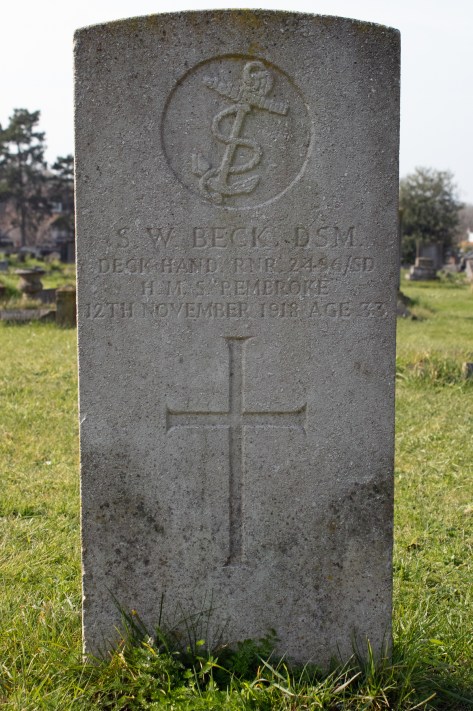
Sydney William Beck was born on the 6th April 1885 in Rochester, Kent. The seventh of nine children, his parents were Albert and Mary Beck. Albert was a bargeman, and this was a line of work into which his son would follow.
There is little concrete information about Sydney’s life. He is recorded as having married Janet Ellis on 16th April 1911, this being backed up by his later service records.
When war broke out, Sydney joined the Royal Naval Reserve as a Deck hand. His papers not that he was 5ft 9ins (1.65m) tall, with brown hair and a fresh complexion. He is also recorded as having a clasped hands tattoo on his right forearm.
The funeral took place, with naval honours… on Saturday of Chief Deck Hand Sydney Beck, DSM, who passed away in the Royal Naval Hospital on the 12th inst., from pneumonia. The deceased, who was 33 years of age, was formerly a barge captain… He was on the trawler Aisne, which took place in the battle with a German submarine off Iceland. It was for this engagement deceased was given the DSM.
[Chatham, Rochester and Brompton Observer: Saturday 30th November 1918]
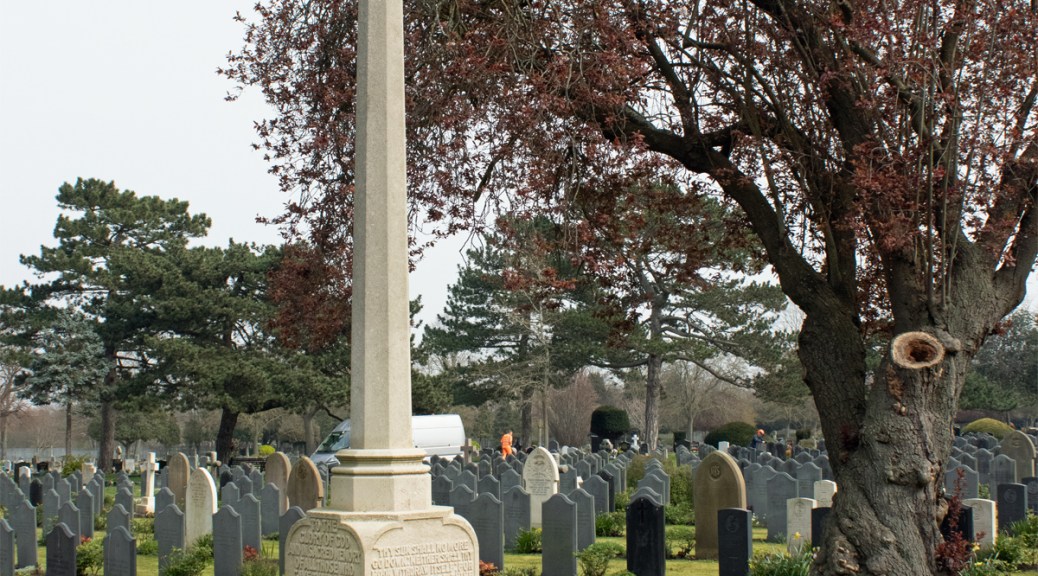
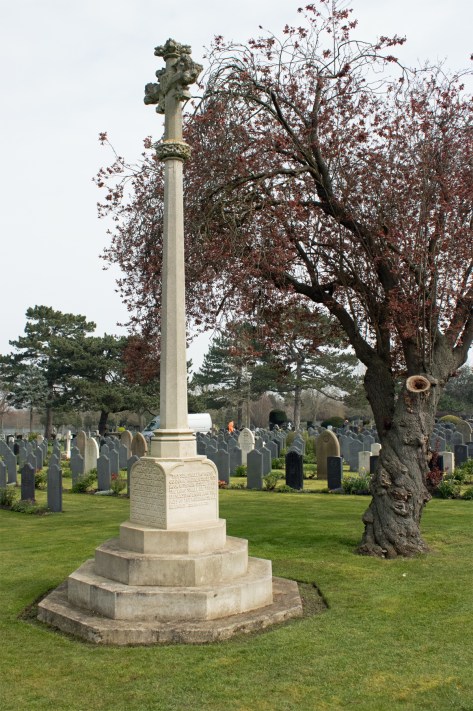
Sydney William Beck died on 12th November 1918, a day after the Armistice was signed, and a month after he was gazetted. His body was laid to rest in St Margaret’s Cemetery, Rochester, Kent.
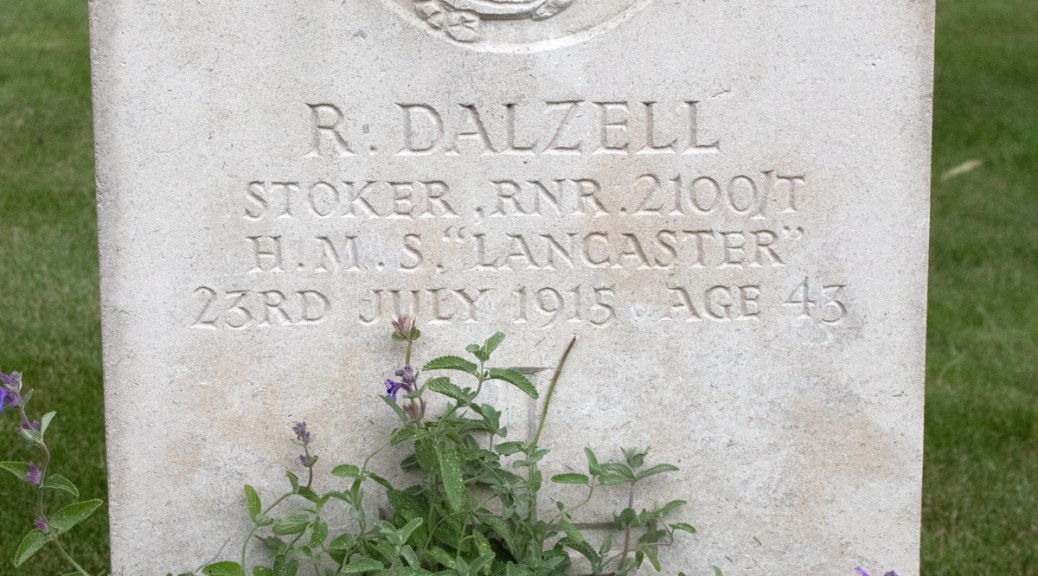
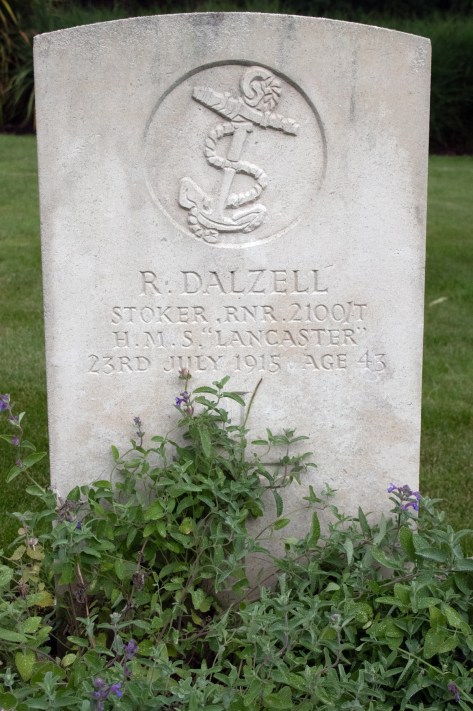
The early life of Robert Dalzell is a challenge to piece together. Born in Belfast, County Antrim, on 12th September 1874, his parents were William and Ellen Dalzell.
It is unclear what William was employed as, but it seems that Robert took up manual labour. The 1911 census recorded him as a plater’s helper, living on Ulverston Street in the Shankill area of Belfast. The census also sheds some light on his private life: he had been married to Matilda for eight years, and they had three children: Robert Jr, Mary and Elenor.
With a family to support, Robert needed a better paid, permanent career and, on the 22nd October 1904, he joined the Royal Naval Reserve as a stoker. His service papers show that he was 5ft 5.5ins (1.66m) tall, with blue eyes and a dark complexion. The document also confirms a number of tattoos: stars and a bracelet on his left forearm, and a mermaid and pineapple on his right.
Stoker Dalzell worked on ships traversing the Irish Sea to and from Liverpool. When war broke out, however, he was assigned to the armoured cruiser HMS Lancaster. She patrolled the North Sea and English Channel, and was involved in a number of skirmishes with enemy vessels.
An inquest relative to the tragic death of a naval stoker reservist, named Robert Dalzell, belonging to Belfast, was conducted… on Monday afternoon. Early on Friday afternoon the deceased was found lying in a pool of blood in the stokehold hatchway of the ship, beyond all medical aid, and passed away within a short time of the sad discovery.
Samuel Fisher, master-at-arms, identified the body… Deceased had been on the ship just over two months, and was forty years of age. The man’s conduct on board had been very good, and there were no service troubles… Prior to mobilisation the deceased had been employed in a private shipyard in Ireland. Witness last saw him alive on the ship on Friday morning, and a little later was informed that he had been found with his throat cut…
Stoker William George Hamshire said he only knew the deceased by sight. On Friday, about 1:30pm, witness found the deceased in No. 1 stokehold hatchway all alone, lying on his back, with his throat cut. The deceased was breathing, and a good deal of blood was coming from the wound. Witness called for assistance. [There was a razor] near the deceased’s right hand. The deceased was quite alone when witness found him The man was too far gone to speak. There was no sign of any struggle, and the wound had every appearance of being self-inflicted…
Stoker Thomas Gillan deposed that he had known Dalzell for eighteen years… Witness could give no reason for the tragedy. The deceased was a very quiet man, and had no home troubles so far as witness knew. Since Wednesday evening, however, the deceased had been a bit “moody,” and would not speak.
[Chatham, Rochester and Brompton Observer: Saturday 31st July 1915]
Other witnesses at the inquest confirmed that Robert had asked about upcoming leave, and whether he would get a railway pass to enable him to get home and see Matilda and the children: “He was all about getting home.”
The jury returned a verdict of “Suicide,” but were unable to confirm the state of Robert’s mind when he killed himself on 23rd July 1915.
The body of Robert Dalzell was laid to rest in the naval section of Woodlands Cemetery, Gillingham, Kent, not far from the Royal Naval Dockyard in Chatham, where Lancaster was moored at the time of his passing.
Thomas Roland Wilson was born on 2nd December 1871 in Hythe, Kent. His parents were Thomas and Sarah, but there is little information available about his early life.
The 1881 census recorded Thomas as living with his uncle and aunt in Deptford, Kent. Ten years later, he was living with his parents in Finchley, Middlesex. Thomas Sr was living on his own means, while his son, now 20 years of age, was a mercantile mariner.
On 18th November 1895, Thomas Jr was awarded a certificate of competency as being able to be a master of his own vessel. Five years later, he married Charlotte Chichester. She was the daughter of a master mariner, and the couple appeared to settle in her home town of Braunton, Devon.
When war broke out, Thomas was assigned to the Royal Naval Reserve. Details of his time during the conflict are hazy, but, by 1917, he was in charge of HMS Yacht Vagrant. Built in Jarrow, she had been hired by the Admiralty at the start of the war to act as an anti-submarine vessel, with Captain Wilson leading the crew.
Little further information is available about Thomas’ life, and while the Commonwealth War Graves Commission and his headstone give his rank as Lieutenant Commander, other documents note he was a Captain.
The next available record for him relates to his passing:
The regretted death has occurred of Capt. Wilson, in his 47th year, at Fern Lea, Braunton, the residence of his mother-in-law, Mrs Chichester.
[North Devon Journal: Thursday 18th October 1917]
No cause of death is evident, but Thomas Roland Wilson passed away on 17th October 1917. He was laid to rest in the graveyard of St Brannock’s Church in Braunton, Devon.
The funeral of John William Venney (27), a trimmer in the minesweeping section of the RNR, who was one of the victims in the Chatham air raid, took place on Saturday afternoon with full naval honours. A contingent of men from the minesweepers formed an escort, and with the body resting on a gun-carriage, covered by the Union Jack, the cortege attracted a lot of sympathetic interest as is proceeded from deceased’s home, at No. 40 Elliston-street. A large number of people assembled at the cemetery, and, after the body had been committed to the grave, the naval firing party paid the last honours to their comrade. Deceased was one of a number of Grimsby men who were accommodated at Chatham. Several of them were killed but all, with the exception of Venney, were buried at Chatham.
[Grimsby News: Friday 14th September 1917]
John William Venney was born on 6th July 1890 in Grimsby, Lincolnshire. The oldest of eight children, of which five survived childhood, his parents were William and Ann Venney. William was a sailor, and, when he finished his schooling, John also went to sea, taking work as a ship’s fireman.
In 1914, John married Florence Johnson. There is little information about her life: she was born in Lincoln, Lincolnshire, in the summer of 1892, but there is no further documentation for her. The couple went on to have a daughter, Ivy, in October 1916.
By this point, war was raging across Europe, and John would be called upon to play his part. Assigned to the Royal Naval Reserve as a Trimmer, his service papers show that he was 5ft 6ins (1.67m) tall, with blue eyes and a sallow complexion.
Formally enlisted on 13th June 1917, Trimmer Venney spent the next three months at the Royal Navy’s shore bases in Chatham (HMS Pembroke) and Sheerness (HMS Actaeon), Kent. Pembroke was a particularly busy and overcrowded place at this point in the war, and John found himself billeted in temporary accommodation in the Drill Hall.
On the night of the 3rd September 1917, the German Air Force carried out a bombing raid on the North Kent coast. Chatham found itself in the firing line, and the Drill Hall received two direct hits. Dozens of sleeping men died in the explosions that followed, Trimmer Venney among them. He was 27 years of age.
The body of John William Venney was taken back to Lincolnshire for burial. He was laid to rest in Cleethorpes Cemetery.
[Note: the photo above is of the memorial to the Chatham Air Raid victims, close to the mass grave for those whose bodies were not identified, in Woodlands Cemetery, Gillingham, Kent.]
The loss of another Gorleston man in the service of King and Country is recorded this week in the death of Chief-Engineer John Edmund Raven, RNR, of 46, John-road, Gorleston, who was among the victims of the air raid at Chatham on September 3rd. Chief-Engineer Raven, who was 43 years of age, had been in the Service nearly three years, and was sailing from this port. Some seven weeks ago he was taken ill and went to Chatham to undergo an operation, following which he was allowed home for a few days and returned to Chatham Naval Barracks on the sick list, where he was on the night of the raid. He was very popular with his comrades at the Naval Base at Gorleston, and his loss is much regretted by the crew of his ship. To his widow and two children every sympathy has been extended in this heavy blow which follows hard on the loss a few weeks ago of her daughter after a brief illness.
[Yarmouth Mercury: Saturday 15th September 1917]
John Edmund Raven was born on 28th December 1872 in Caister, Norfolk. The middle of six children, he was the youngest of three sons to Robert and Ann Raven. Robert was a farm labourer-turned-fisherman, and, after his untimely death in 1883, it was the sea to which his son turned to support his widowed mother.
In the autumn of 1902, John married Eliza Casey. A milkman’s daughter from Gorleston, Norfolk, she was employed as a domestic servant when the couple exchanged vows. They set up home at 46 John Road, Gorleston, and went on to have three children: Elsie (who would pass shortly before her father), Gladys and Jack.
Little further information is available about John’s life. As the newspaper report suggests, he joined the Royal Naval Reserve as an Engineman towards the end of 1914, and was based out of HMS Pembroke, the Royal Naval Dockyard in Chatham, Kent.
On the night of the 3rd September 1917, Engineman Raven was billeted in temporary accommodation set up in the dockyard’s Drill Hall. That night, an audacious raid by German bombers landed two explosives directly on the building, shattering its glass roof, and killing dozens of the men sleeping within. John was one of those to be killed. Contrary to what the newspaper reported, he was actually 45 years of age.
The body of John Edmund Raven was taken back to Norfolk for burial. He was laid in the family plot, reunited with his daughter, Elsie, far too soon.
[Note: the photo above is of the memorial to the Chatham Air Raid victims, close to the mass grave for those whose bodies were not identified, in Woodlands Cemetery, Gillingham, Kent.]
George William Rae was born on 7th February 1883 in South Shields, Country Durham. The youngest of five children, he was one of four sons to Henry and Elizabeth Rae. Henry was a boatman, and it seemed inevitable that George would follow in his father’s footsteps.
There are big gaps in George’s timeline: the 1891 census found him living with his aunt and uncle. The next record for him confirms his marriage to Mary Elizabeth Smith in January 1904. There is little information about her, but the couple had five children, three of whom died before they reached their first birthday.
Tragedy followed tragedy: George’s father died in 1908, and his mother passed the following year. Mary died shortly after the birth of her and George’s last child, also named George, in 1911. The census taken that year recorded George Sr as a fireman aboard the coal hulk Haytian, which was moored in Portland Harbour, Dorset. He was one of the vessel’s sixteen crew members.
Now a widower, George had two children to support. In the summer of 1913, he married a second time, to Elizabeth Flood. Again, there is little information available about her, but the couple went on to have a child, daughter Emily, who was born in the summer of 1914.
Conflict was closing in on Europe by this point, and on 24th March 1916, George formally joined the Royal Naval Reserve. His service record shows that he was 5ft 4ins (1.63m) tall, with blue eyes and a fair complexion. He was also noted as having a tattoo of a woman and two flags across his chest.
Engineman Rae was assigned to the gunboat-turned-minesweeper HMS Halcyon. She remained his home for the next eighteen months, patrolling off the coast of East Anglia. By the summer of 1917, George became shore-based, initially at HMS Actaeon in Portsmouth, Hampshire, then at HMS Pembroke, the Royal Naval Dockyard in Chatham, Kent.
Pembroke was a busy and overcrowded place at this point in the war. The battleship HMS Vanguard had sunk, and its replacement crew – who were stationed in Chatham – were left in limbo while new postings were found for them. The base also suffered an outbreak of meningitis, and temporary accommodation was set up to space out the servicemen and, hopefully, slow the spread of the disease. Engineman Rae found himself in one of these speedily-created barracks in the dockyard’s Drill Hall.
On the night of the 3rd September 1917, four German aircraft carried out a daring raid on the North Kent coast. Chatham came under fire, and two explosives landed a direct hit on the Drill Hall. Dozens of men were killed while they were sleeping, and many more – including Engineman Rae – were injured.
George was taken to the Royal Naval Hospital in Chatham for treatment, but his wounds would ultimately prove fatal. He succumbed to them on 11th September 1917, at the age of 34 years old.
The body of George William Rae was taken back to County Durham for burial. He was laid to rest in South Shields’ Harton Cemetery.
Tragedy would continue to haunt the Rae family. Elizabeth died a year after her husband, leaving three children – two from George’s first marriage, and one from his second – orphans. Sadly, there is little additional informational about what happened to them – none appear in the 1921 census.
[Note: the photo above is of the memorial to the Chatham Air Raid victims, close to the mass grave for those whose bodies were not identified, in Woodlands Cemetery, Gillingham, Kent.]
Alfred George Moss was born in West Ham, Essex, on 14th February 1885. One of eight children, his parents were John and Sarah Moss. John was a leather worker, but Alfred initially found work as a butcher’s assistant when he completed his schooling.
Butchery wasn’t the career that Alfred sought, however, and, on 12th November 1903, he enlisted in the Royal Navy as a Stoker 2nd Class. His service papers note that he was 5ft 9ins (1.75m) tall, with brown hair, hazel eyes and a fresh complexion. He was also recorded as having a scar on both knees.
Stoker Moss was sent to HMS Acheron, a training ship based on the Thames Estuary, for his initial service. He stayed there until July 1904, when he was given his first sea-going assignment, on board the cruiser HMS Terpsichore. She would remain his home for the next eighteen months, during which he was promoted to Stoker 1st Class.
Alfred seems to have been a steady worker, his annual reviews noting a very good character. In November 1908, having come to the end of his five-year contract, he was stood down to reserve status. He had served on four vessels and, when not at sea, HMS Pembroke, the Royal Naval Dockyard in Chatham, Kent, became his home from home.
Alfred is missing from the 1911 census, but turns up on 21st December 1913. On that day he married Ellen Lipscombe in All Saints’ Church, West Ham. Nellie, as she was known, was the oldest of seven children to plasterer Tomas Lipscombe. The couple set up home on Grafton Road, Plaistow, and went on to have a son, Thomas, the year after exchanging vows.
When war was declared, Alfred was called back into service. He returned to Pembroke, and spent the next year split between there and HMS Victory, the Royal Naval Dockyard in Portsmouth, Hampshire. In the summer of 1915, Stoker 1st Class Moss was assigned to the cruiser HMS Europa. For the next two years, he would be based in the Eastern Mediterranean, supporting the troops in and around the Gallipoli peninsula.
By the summer of 1917, Alfred was back at Pembroke, which, by this point in the war, was a busy and overcrowded place. The sinking of HMS Vanguard meant that her replacement crew were stuck in port waiting to be reassigned, and an outbreak of meningitis demanded more space to slow or stop its spread. Stoker 1st Class Moss found himself barracked in overflow accommodation set up in the dockyard’s Drill Hall.
On the night of the 3rd September 1917, German bombers launched an audacious raid on the North Kent Coast. Two bombs landed on the Drill Hall, shattering its glass roof, and killing dozens of sleeping servicemen beneath. Stoker 1st Class Moss was one of those who lost his life: he was 32 years of age.
The body of Alfred George Moss was taken back to Essex for burial. He was laid to rest in West Ham Cemetery, not far from where his grieving widow and young son were living.
[Note: the photo above is of the memorial to the Chatham Air Raid victims, close to the mass grave for those whose bodies were not identified, in Woodlands Cemetery, Gillingham, Kent.]
Neil Moore was born on 17th April 1882 in Glasgow, Lanarkshire. One of twelve children, he was the second son to John and Jane Moore. John was a cabinetmaker and, according to the 1891 census, the family lived in rooms at 13 Melville Street in the city’s Govan district.
Although little is known about Neil’s early life, his enlistment in the Royal Naval Reserve on 26th July 1904 offers the first clear insight into the young man he had become. His service papers describe him as twenty-two years old, 5 ft 4 in (1.63 m) tall, with grey eyes and fair hair.
Over the next decade, Stoker Moore travelled the world, taking in Canada and South America. There were times when he was out of work – he was recorded as seeking a job over the winter of 1912 – but generally his employment appears to have been steady.
Intriguingly, after a stint on the SS Sardinian, Neil left the Royal Naval Reserve on 17th November 1913. He was re-engaged on 17th December, but is then reported as having deserted just three days later. He was then recorded as being assigned to HMS Wildfire – a shore base in Northwood, Middlesex – on 3rd February 1914.
It is possible that it was around this time that Neil got married. His wife was called Elizabeth, but there is little further information about her.
When war broke out, Stoker Moore appears to have been formally mobilised once more. Over the next three years, he served on half-a-dozen vessels, before finally being attached to HMS Pembroke, the Royal Naval Dockyard in Chatham, Kent, in the spring of 1917.
Over the course of that summer, Pembroke was hit by two significant challenges. The battleship HMS Vanguard was sunk in Scapa Flow, leaving its planned replacement crew stuck in the Kent dockyard with nowhere to go. At the same time, a bout of spotted fever broke out and more space was needed to slow the transmission of the contagious disease.
Pembroke’s Drill Hall was brought into use as temporary accommodation, and this is where, in September 1917, Stoker Moore found himself billeted.
On the night of the 3rd September, the German air force carried out an audacious raid on North Kent. Four aircraft bombed Chatham, and two devices landed direct hits on the Drill Hall. The glass roof shattered, raining shards onto the sleeping men below. Stoker Moore was badly injured, and he was transported to the town’s Royal Naval Hospital for treatment. Sadly, this would prove ineffective, and Neil died from his injuries on 8th September 1917. He was 35 years of age.
The body of Neil Moore was taken back to Scotland for burial. He was laid to rest in St Kentigern’s Roman Catholic Cemetery, to the north of the city centre.
[Note: the photo above is of the memorial to the Chatham Air Raid victims, close to the mass grave for those whose bodies were not identified, in Woodlands Cemetery, Gillingham, Kent.]
Samuel Hadley was born in Bilston, Staffordshire, on 1st July 1892. The fifth of six children, his parents were Edward and Mary Hadley. Edward worked in the local iron works and, the family lived on Cross Street, to the south of the town centre.
Opportunities awaited elsewhere, however, and by the time of the 1911 census, the Hadley family had moved to Stockton-on-Tees, County Durham. Iron foundries were a key industry in the area, and census found four members of the household – Samuel, his two older brothers, Edward Jr and Matthew, and father Edward Sr – all employed at the Bowesfield Steel Works. The house at 28 Grove Street was crowded, with Thomas Green, another foundry worker, also boarding there.
When war broke out, all three brothers enlisted. Samuel joined the Royal Naval Reserve on 15th January 1915, and was sent to HMS Pembroke, the Royal Naval Dockyard in Chatham, Kent, for his training. His papers show that he was a little under 5ft 9ins (1.75m) tall, with brown eyes and a fair complexion. He had a scar on his left leg following an operation for varicose veins.
Over the next two years, Stoker Hadley served on three vessels – the depot ships HMS Tyne, HMS Crescent and HMS Royal Arthur. All three served in Scottish waters, and Samuel spent time in the Firth of Forth and Scapa Flow. By the summer of 1917, however, he was back in Kent, billeted at HMS Pembroke while he awaited his next posting.
Chatham Dockyard was a bustling and packed place at that point in the war. The battleship HMS Vanguard had been sunk, and its replacement crew were stuck at Pembroke while the authorities organised alternative attachments. There was also an outbreak of spotted fever, and the precautions were taken to space out the crowded barracks. Stoker Hadley found himself billeted in temporary accommodation in the base’s Drill Hall.
On the 3rd September 1917, the first night air raid carried out by the German Air Force bombarded Chatham. Two bombs landed squarely on the Drill Hall, and Stoker Hadley was among the dozens of sleeping men to be killed. He was just 25 years of age.
The body of Samuel Hadley was taken back to Stockton-on-Tees for burial. He was laid to rest in the town’s Oxbridge Lane Cemetery.
Samuel’s older brother Matthew chose the army when he enlisted. A Private in the Argyll & Sutherland Highlanders, he was attached to the 11th Battalion. By the spring of 1917, he was caught up in the Arras Offensive. He was killed on the opening day of the First Battle of the Scarpe. Private was 27 years of age, and is commemorated Arras Memorial.
[Note: the photo above is of the memorial to the Chatham Air Raid victims, close to the mass grave for those whose bodies were not identified, in Woodlands Cemetery, Gillingham, Kent.]
Alfred Eldred Gladwell was born in Clacton-on-Sea, Essex, on 15th November 1885. The oldest of three children, his parents were Eldred and Emma. Eldred was a bricklayer, and his son followed him into that trade.
Away from labouring, Alfred also took time to join the Royal Naval Reserve. He enlisted on the 8th January 1910, his service papers showing the young man he had become. He was noted as being 5ft 11.5ins (1.82m) tall, with blue eyes and a fair complexion. He was also noted as having a scar on his left leg.
Alfred’s time at sea was focused on the Essex coast, with trips to Colchester, Brightlingsea, and across the Thames to Chatham, Kent. By the time that war was declared in 1914, he had risen to the rank of Leading Seaman and, being on reserve status, he was called into action when hostilities commenced.
Leading Seaman Gladwell was sent to HMS Pembroke – the Royal Naval Dockyard in Chatham – and this would remain his base during the conflict. In February 1915, he was assigned to the SS Palma, which served off the Spanish coast. By the summer of 1917, however, Alfred was back at Pembroke to await his next posting.
The dockyard was overly busy that summer, with a replacement crew for HMS Vanguard waiting to be reassigned following its sinking and an outbreak of meningitis to contend with. Leading Seaman Gladwell was billeted in temporary accommodation that had been set up in the dockyard’s Drill Hall.
On the night of 3rd September 1917, Chatham suddenly found itself in the firing line as a wave of German aircraft bombed the town. The Drill Hall received direct hits from two bombs, and Leading Seaman Gladwell was one of dozens of men to be killed. He was 31 years of age.
The body of Alfred Eldred Gladwell was taken back to Essex for burial. He was laid to rest in Clacton Cemetery, not far from where his family was still living.
[Note: the photo above is of the memorial to the Chatham Air Raid victims, close to the mass grave for those whose bodies were not identified, in Woodlands Cemetery, Gillingham, Kent.]