
Thomas Patrick Perwick was born in Balfour, a town on New Zealand’s South Island, on 19th August 1889. There is little information available about his early life, but his parents were Australian Alfred Perwick and his Irish-born wife, Catherine.
When Thomas completed his schooling, he took up agricultural work, and was working as a farmer when he received the call up to join the New Zealand Expeditionary Force.
Private Perwick’s service records show that he enlisted on the 18th October 1916. Standing 5ft 10ins (1.78m) tall, he weighed 11st (69.9kg). His medical report shows that he had light brown hair, blue eyes and a fair complexion. The papers also note Thomas’ religion as Roman Catholic.
Sent to Trentham for training, Private Perwick would be assigned to the New Zealand Otago Regiment. His unit left Wellington on 15th February 1917, making the ten-week voyage to Britain. Thomas disembarked in Devonport, Devon, on 2nd May, and was marched in to camp in Sling, Wiltshire, the same day.
Private Perwick was attached to the 2nd Battalion, and was sent to France on 9th June. Straight into the fray, his unit fought at Messines, but was wounded in the head and arm during fighting at Passchendaele. Medically evacuated to Britain for treatment, he was admitted to hospital in Brockenhurst, Hampshire, before being moved back to the Wiltshire ANZAC camps at Sling and Tidworth.
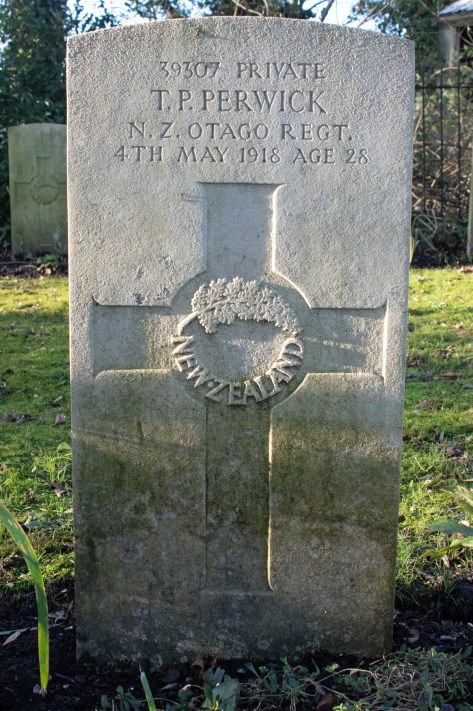
Thomas was discharged to duty on 7th January 1918, but was not out of the woods. He fell ill with mumps, and was sent to the No. 3 New Zealand General Hospital in Codford, Wiltshire, for treatment. While admitted, he contracted tuberculosis, and, over the next four months, his health deteriorated. Private Perwick’s body finally succumbed on 4th May 1918: he was 28 years of age.
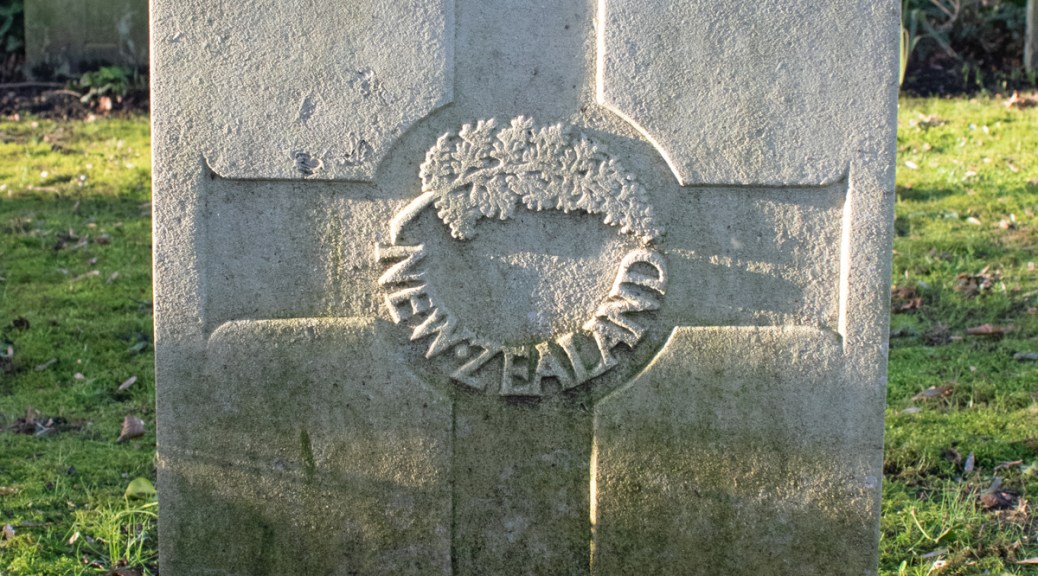
Thousands of miles from his home, Thomas Patrick Perwick was laid to rest in the graveyard extension of St Mary’s Church, Codford, not far from the hospital in which he had breathed his last.
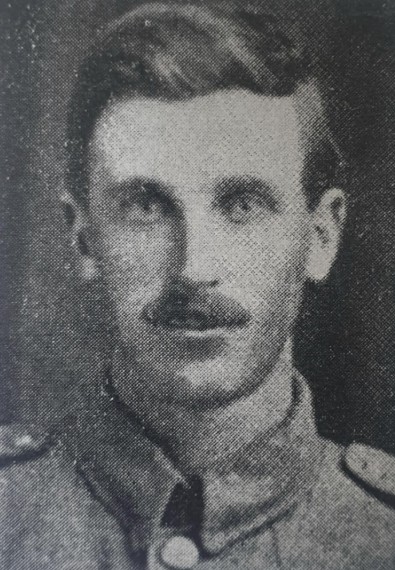
(from findagrave.com)
 Death and Service