Category Archives: New Zealand

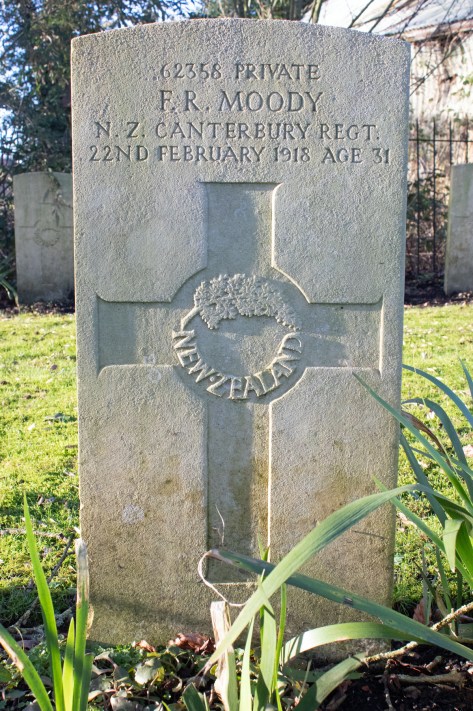
Private Francis Moody

Private Francis Moody

Francis Robert Moody was born on 8th September 1876, in the town of Kihikihi, on New Zealand’s North Island. There is little information about his early life, but his parents were Hampshire-born Francis Moody and his Irish wife, Mary.

When he completed his schooling, Francis Jr found work as a carter. When war broke out, however, he was called upon to play his part, enlisting in the New Zealand Canterbury Regiment on 18th June 1917. His service papers show that he was 5ft 10ins (1.77m) tall, and weighed 140lbs (63.5kg). A Roman Catholic by birth, he had brown hair, blue eyes and a medium complexion.

Private Moody’s unit left New Zealand on 13th October 1917, making the two-month voyage to Britain on board the HT Corinthic. Francis disembarked in Liverpool, Lancashire, before being marched into camp in Sling, Wiltshire.

Over the next month, Private Moody received further training, but by this point, and following the lengthy journey, his health was beginning to suffer. He was admitted to the No. 3 New Zealand General Hospital in Codford, Wiltshire, on 30th January 1918, suffering from bronchitis.

Francis’ health continued to deteriorate, and he developed tuberculosis. The condition would prove fatal, and he passed away on 22nd February 1918, at the age of 41.

Thousands of miles from home, Francis Robert Moody was laid to rest alongside his colleagues in the graveyard extension of St Mary’s Church, Codford.


Private Francis Moody
(from findagrave.com)

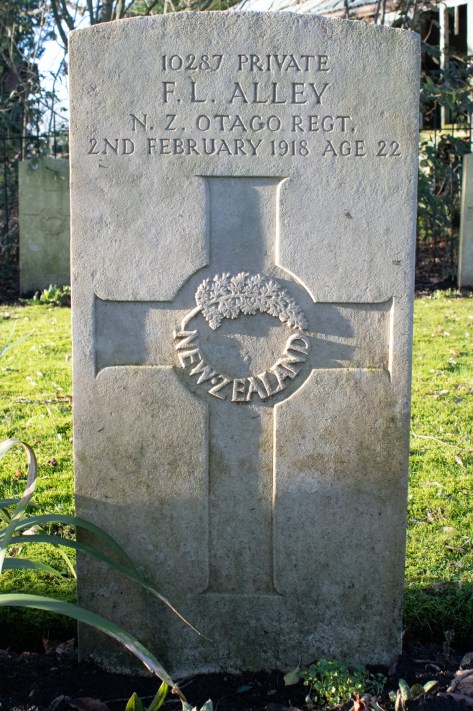
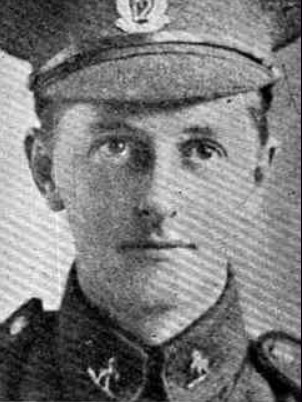
Private Francis Alley

Private Francis Alley

Francis Lignori Alley was born in Hikutaia, on New Zealand’s North Island, on 18th February 1896. There is little information about his early life, but it is clear that he was one of six children to John and Elizabeth Alley.

By the time he had completed his schooling, the Alley family had moved to the port town of Gisborne. Francis found work as a warehouseman in for Macky Logan Caldwell Ltd. When war broke out, however, he was called upon to play his part.

On 11th January 1916, Francis enlisted in the New Zealand Otago Regiment. His service records show that he was 5ft 8.5ins (1.74m) tall, and weighed just 90lbs (40.8kg). A practicing Roman Catholic, he had brown hair, grey eyes and a fair complexion. His papers also noted an operation scar in his groin.

Private Alley’s unit left New Zealand in the spring of 1916. After a month’s stop in Suez, they arrived in Southampton, Hampshire, on 7th August, and were marched to their camp in Sling, Wiltshire. Within a matter of days, however, Francis found himself on the Western Front, and would remain there for the next month.

On 9th June 1917, during the Battle of Messines, Francis was wounded. Initially treated on site, he was medically evacuated to Rouen, then Britain for treatment to gun shot wounds to his face and eye. He spent the next few months being treated and recuperating, hit service papers stating that he re-joined his unit in Étaples on 8th August. That autumn, he was given leave, but while back in Britain, he fell ill, and was admitted to the venereal section of the No. 3 New Zealand General Hospital in Codford, Wiltshire.

Private Alley was discharged on 7th November 1917, and remained at the camp in Codford. On Boxing Day, he was admitted back to hospital again, suffering from septicaemia: the condition was to prove fatal, and he passed away on 2nd February 1918. He was just 21 years old.

The body of Francis Lignori Alley was laid to rest in the graveyard extension of St Mary’s Church, Codford, not far from the camp he had been based at.


Private Francis Alley
(from findagrave.com)

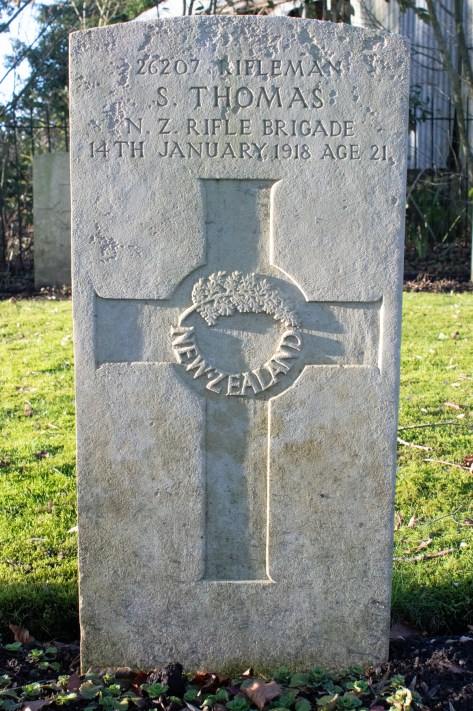
Rifleman Samuel Thomas

Rifleman Samuel Thomas

Samuel Thomas was born in Pukehinau, New Zealand, on 17th February 1896. There is little concrete information about his early life, but his parents were Isaac and Annie Thomas, and he was one of at least two children to them.

When he finished his schooling, Samuel found work as a teamster, or wagon driver. When was broke out, however, he was called upon to play his part, and he enlisted on 30th May 1916, joining the New Zealand Rifle Brigade. His service record shows that he was 5ft 10ins (1.77m) tall and weighed 147lbs (66.7kg). He had light brown hair, grey eyes and a fair complexion; a round scar on the front of his left shin was also recorded.

Deemed fit for service, Rifleman Thomas spent the next four months training. On 25th September 1916, his unit departed from Wellington for the two month voyage to Britain. During the journey, he had fallen ill, and, on disembarking in Devonport, Devon, he was admitted to a hospital with influenza.

When he was well enough, Samuel was moved to hospital in Codford, Wiltshire, eventually joining his unit in a camp at Sling on 15th January 1917. His time there was brief, however, and he was admitted back to the Codford hospital just three weeks later. It would not be until July that he was well enough to be sent to France.

From Étaples, Rifleman Thomas was sent to the front line. Within a matter of weeks, he had been wounded by shrapnel, which had caught his right side and his neck. He was medically evacuated to Britain for treatment, and was admitted to the No. 2 New Zealand General Hospital in Walton-on-Thames, Surrey.

Samuel would spend the next three months recuperating, initially in Hornchurch, Essex, then in Codford. During this time, love blossomed and, on 18th November 1917, he married Gertrude Berry, a horse dealer’s daughter from Plaistow, Essex. It is unclear how or when the couple had met: she may have been working at the hospital where he was being treated.

At the end of December 1917, he was back in hospital again, however, suffering from a bout of bronchitis. His condition would worsen, and he passed away on 16th January 1918, from the rupture of an abscess in his throat. He was 21 years of age.

The body of Samuel Thomas was laid to rest in the graveyard extension of St Mary’s Church, Codford, not far from the hospital in which he had passed.


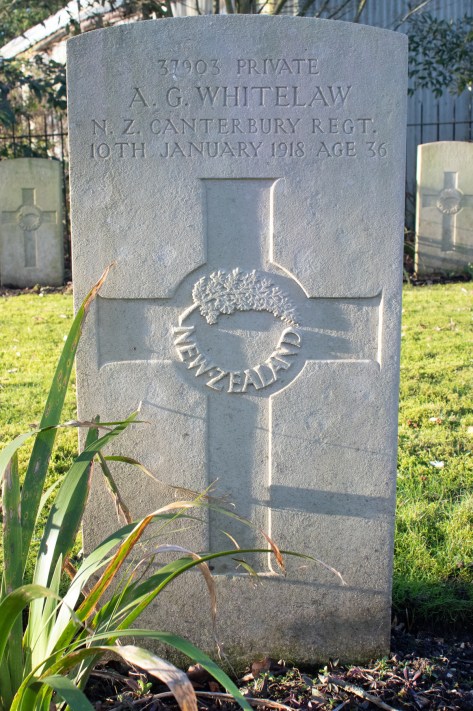
Private Alexander Whitelaw

Private Alexander Whitelaw

Alexander George Whitelaw was born in 1879 in the town of Ashburton on New Zealand’s South Island. One of ten children, his parents were Scottish immigrants Peter and Agnes Whitelaw.

There is little information about Alexander’s early life: his father died in 1912, with his mother passing just two years later. By the autumn of 1916, he was working as a general labourer, but the world was at war, and he stepped up to play his part.

Alexander enlisted on the 4th October 1916, knocking five years off his date of birth to ensure he was accepted. His papers also show other discrepancies, as he noted both of his parents being having been born in New Zealand. As a Private, he was assigned to the New Zealand Canterbury Regiment, his service papers showing the man he had become. A Presbyterian, he stood 5ft 11ins (1.8m) tall, and weighed 154lbs (69.9kg). He had cark hair and a dark complexion. His eyes were blue, but he suffered some colour blindness, confusing reds and blues.

Private Whitelaw’s unit – the New Zealand Canterbury Regiment – left home on the 19th January 1917, and embarked for Europe. His movements from this point on aren’t entirely clear, although by the start of 1918, he had been medically evacuated to the No. 3 New Zealand General Hospital in Codford, Wiltshire, suffering from pleurisy. The condition was to get the better of Alexander: he passed away on 10th January 1918, at the age of 38 years old.

Thousands of miles from his family home, the body of Alexander George Whitelaw was instead laid to rest in the extension to St Mary’s Churchyard, Codford.


Private Arthur Holmes

Private Arthur Holmes

In the extension to St Mary’s Churchyard in Codford, Wiltshire, is the grave of Private A Holmes of the NZ Maori Battalion. Much of his life has been lost to time, but his military records give some glimpses into his time in the army.

Arthur Holmes was born on 22nd June 1884 in Auckland, New Zealand. His service papers show that he was working as a labourer in the Waihara region of North Island when he joined up, and gave his next-of-kin as his sister Mrs E Dixon (although this was later amended to his half-brother William Marshall-Muir).

By the time he joined the army on the 9th December 1915, he was 5ft 5ins (1.65m) tall, and weighed 10st 5lbs (65.8kg). He was described as having had brown hair, grey eyes and a fair complexion. The medical record also noted that two toenails on his right foot had been ‘chopped off in childhood’.

Private Holmes’ unit set off for Europe in the spring of 1916 and, after a three week pause in Suez, Egypt, he arrived in Étaples, France, on 9th June.

Arthur’s time in the army seems to have been beset by illness, with hospital admissions in June, July and August 1916. He seems to have spent eighteen months in France, and fought at the Somme and Messines Ridge.

At the end of 1917, after another short spell in hospital, Private Holmes was given leave in Britain, but was again admitted to a medical unit, having come down with bronchitis. Initially hospitalised in Surrey, by 19th December he had been moved to the No. 3 New Zealand General Hospital in Codford, Wiltshire. By this point, however, his health had been severely impacted, and he passed away on 28th December 1917, at the age of 33 years old.

The body of Arthur Holmes was laid to rest in the graveyard extension of St Mary’s Church, Codford.


Private Thomas Kearse

Private Thomas Kearse

Thomas Walker Kearse was born in Westport, New Zealand, on 15th December 1891. One of seven children, his parents were British emigrant Thomas Kearse and his local-born wife, Rosanna.

There is little information available about Thomas’ early life. He found work as a general labourer when he finished his schooling, by which time his mother had passed away. By his mid-20s, he had relocated to Kaikohe, on North Island.

When war broke out, Thomas stepped up to play his part. He enlisted in Trentham on 16th February 1915, and was assigned to the New Zealand Canterbury Regiment. Private Kearse’s medical examination noted that he was just over 5ft 6ins (1.68m) tall, and weighed 139lbs (63kg). He had light hair, blue-grey eyes and a fair complexion. He was also noted as having a scar on his right shin.

Private Kearse would be in the army for two-and-a-half years, but would experience enough warfare for a lifetime. On leaving New Zealand his unit made for the Dardanelles, arriving there on 16th August 1915. He was wounded early on, and medically evacuated to Malta. His injuries would need further treatment, however, and he was shipped to Britain, and sent to hospital in Birmingham.

Thomas spent time recuperating at a base in Hornchurch, Essex, and it would seem that, while here, he met Catherine Goodwin. A romance started, but Thomas was sent to re-join his unit, who were barracked in Egypt. Within a month, however, he was on the move again, arriving in France in April 1916. While there, he went absent without leave for two days, and forfeited a month’s pay as a result.

In October, Private Kearse was wounded in the head and arm by gunfire, and, after initial treatment in Rouen, he was medically evacuated to Britain. Admitted to the 3rd Southern General Hospital in Oxford, he would remain here for the next month. He was then sent to the ANZAC base in Codford, Wiltshire, again to recuperate, but, while there, he was admitted to the camp’s venereal unit for a fortnight.

Discharged again, his condition had not cleared up: Thomas was back in hospital on 5th December 1916, and he spent a further two weeks admitted.

On his latest discharge, Private Kearse was marched to Sling Camp, near Bulford, where he took up a role as cook. He would remain there for the next four months and, during this time, he and Catherine exchanged vows. She had given birth to a daughter, Ivy, the previous October, and this helped formalise their family unit.

Over the next few months, Thomas’ life repeated itself. He was admitted to hospital in Codford again in June 1917, and went AWOL for 26 hours on 27th/28th July (for which he was docked four days’ pay). Discharged from hospital on 4th September, he was marched back to the Sling Camp.

Within six weeks, however, he was sent back to hospital in Codford, this time suffering from pneumonia. This time, Thomas would not be as fortunate. The lung condition got the better of his, and he passed away on 25th October 1917, at the age of 25 years old.

The body of Thomas Walker Kearse was laid to rest in the ANZAC extension to St Mary’s Churchyard in Codford, not far from the hospital he had visited so many times.


Private Walter Bourke

Private Walter Bourke

Walter Edward Bourke was born in Whangarei, New Zealand, on 6th May 1885. The fifth of six children, his parents were Patrick and Elizabeth Bourke, who had emigrated from Ireland in the 1870s.

Patrick died in 1911, at the age of 65. Walter, by this point, was working as a chamber hand in a freezing works. When war broke out, however, he was compelled to step up and serve his country. He enlisted on 22nd January 1917, and was assigned to the New Zealand Auckland Regiment.

Trained at Trentham, Private Bourke’s unit set sail for Europe on 12th June 1917. The voyage from Wellington to Devonport would take two months and, from there Walter was marched into a camp in Sling, near Bulford, Wiltshire.

Within a matter of weeks, Walter fell ill. He was sent to the No. 3 New Zealand Hospital near Codford, Wiltshire, but his condition worsened significantly over the next month. His treatment would prove fruitless, and Private Bourke passed away on 25th October 1917: he was 32 years of age.

Thousands of miles from family, Walter Edward Bourke was laid to rest in the extension to St Mary’s Church graveyard, not far from the hospital in which he had passed.


Corporal Charles Ziesler

Corporal Charles Ziesler

Charles Frederick Wilhelm Ziesler was born on 12th February 1877 in Timaru on New Zealand’s South Island. The oldest of nine children, his parents were Norwegian-born Johan Ziesler, and his New Zealand wife, Lucy.

Little information is available about Charles’ early life, but it is clear that he found work as a clerk when he finished his schooling. By the time of the 1899 electoral role, he had set up home at 258 Hereford Street in the Canterbury area of Christchurch.

Things were to change, however, and Charles emigrated to Australia. Taking up a job as a fire adjuster for an insurance company, he settled in the Subiaco suburb of Perth. In 1909 he married Martha Grimwood: the couple went on to have three children, and lived in a house at 97 Park Street.

When war broke out, despite his age, Charles stepped up to serve the Empire. He enlisted in the Australian Imperial Force on 12th November 1915, and was initially attached to the 35th Depot. His service papers show that he was 5ft 11ins (1.8m) tall and weighed 182lbs (82.6kg). He was recorded as having brown hair, blue eyes and a fair complexion.

After several weeks’ training, Private Ziesler’s unit left Australia for the battlefields of Europe. Arriving in Suez, Egypt, on 11th March 1916, he would receive further instruction there over the next couple of months. While many of the ANZAC battalions then set sail for the Dardanelles, the 35th Training Battalion, of which Charles was now a part, headed for Britain.

Private Ziesler arrived in Plymouth, Devon, on 16th June, and was marched into Rollestone Camp in Wiltshire. His preparation continued, and, in August, he was promoted to the rank of Corporal. Charles’ service records suggest that he did not serve on the Western Front, instead remaining attached to the Training Battalions based around Salisbury Plain, in Tidworth and Codford.

By the summer of 1918, Corporal Ziesler had been in Britain for two years and had been promoted to the rank of Acting Sergeant in the 51st Battalion of the Australian Infantry. In June he fell ill, and was admitted to the No 3 New Zealand General Hospital in Codford, suffering from bronchopneumonia. The condition was to prove his undoing: he passed away on 26th June 1918, at the age of 41 years old.

Thousands of miles from home, the body of Charles Frederick Wilhelm Ziesler was laid to rest in the ANZAC extension to the graveyard of St Mary’s Church, Codford, Wiltshire.


Charles’ belongings were returned to his widow: these included his clothing (a leather vest, fur vest, boots, puttees, cap, breeches, underpants and singlets) and more personal items (pipes, coins, photo albums, letters).

Martha may have taken comfort from a detailed letter she received about her late husband’s funeral. “The late Sergeant Ziesler was held in a very high esteem by all ranks in the Unit, and always proved himself a keen soldier, a true and sympathetic comrade and a friend in need and deed. His loss to the Unit is very keenly felt.”

(The CWGC records record the last full rank Charles held: as he held the role of Acting Sergeant, he is noted at the level below, Corporal.)


Corporal Charles Ziesler
(from findagrave.com)

Rifleman William McMullan

Rifleman William McMullan

William McMullan was born in Okaihau, on New Zealand’s North Island, on 10th May 1896. One of three children, his parents were James and Rose McMullan.

There is little concrete information about William’s early life. By the beginning of 1916, he was working as a bushman and volunteering for the local militia. The First World War provided an opportunity to put his skills to use, and he enlisted in the New Zealand Rifle Brigade on 15th January 1916.

Rifleman McMullan’s service records show that, at 19 years and 8 months of age, he was 6ft (1.83m) tall and weighed 12st 6lbs (79kg). A Roman Catholic, he had brown hair, blue-grey eyes and a medium-dark complexion.

William left New Zealand in May 1916, bound for Britain. The journey took ten weeks and, after disembarking in Devonport, Devon, his unit marched to Sling Camp, near Bulford, Wiltshire, arriving there on 29th July. Just a few weeks later, however, Rifleman McMullan was on the move again, and he found himself on the Western Front towards the end of September.

On 16th November 1916, while fighting at the Somme, Rifleman McMullan received a gunshot wound to his thigh. A blighty wound, it saw him medically evacuated to Britain for treatment, and he was admitted to the No. 1 New Zealand General Hospital in Brockenhurst, Hampshire. A few weeks later, he was moved to Codford, Wiltshire, for recuperation at the No. 3 NZ General Hospital.

William would spend the next few weeks in Wiltshire, but after initially being discharged from hospital, he was re-admitted on 25th January 1917. He had contracted broncho-pneumonia, and this would be the condition to which he would succumb. Private McMullan passed away on 13th February, at the age of just 20 years old.

Thousands of miles away from home, William McMullan was laid to rest in the ANZAC extension to St Mary’s Churchyard in Codford, close to the camp he had most recently called home.


Private Job Jefferies

Private Job Jefferies

Job Jefferies was born on 12th October 1889 in the city of Timaru, on New Zealand’s South Island. The sixth of ten children, his parents were William and Ada Jefferies.

There is little information available about Job’s early life, but by the time war broke out, he had moved to Kongahu, at the northern tip of South Island. He was working as a labourer, and was employed by the Public Works Department.

Job was quick to step up and serve his country. He enlisted in the New Zealand Infantry on 12th February 1915, and was assigned to the Canterbury Regiment. His service records confirm that he was 5ft 10.75ins (1.79m) tall, and weighed 170lbs (77.1kg).

Private Jefferies left New Zealand in the summer of 1915, and his service record makes for grim reading.

On 9th August 1915, Job’s unit arrived in the Dardanelles, and he was firmly entrenched in the fighting at Gallipoli. Wounded on 5th September, he was initially treated at a casualty clearing station, before being medically evacuated first to Malta, then to Britain. He was admitted to the No. 2 Western General Hospital in Manchester, Lancashire, and would spend the next seven months there.

On 12th May 1916, Private Jefferies was on the move, leaving his base in Hornchurch, Essex, for the Western Front. He re-joined his unit on 7th July, but just nine days later was wounded at the Somme. Medically evacuated to Britain again, he spent the next couple of months being moved between hospitals. Discharged back to base in Hornchurch, Essex at the end of September, he would spend the next four months recuperating once more.

By February 1917, it would seem that Private Jefferies had been moved to Sling Camp near Bulford, Wiltshire. While there, he fell ill, and was admitted to the No. 3 New Zealand General Hospital in nearby Codford. He was suffering from pneumonia, and this time his body could take no more. Job passed away on 7th February 1917: he was 27 years of age.

Job Jefferies was laid to rest alongside his fellow soldiers in the ANZAC extension to St Mary’s Churchyard, Codford.


Private Job Jefferies
(from findagrave.co.uk)