Frank Rice Reid was born on 1st September 1898 in Toronto, Canada. One of four children, his parents were Nova Scotians George and Annie Reid. George was a commercial traveller, and the family had moved back to Nova Scotia by the time of Frank’s youngest sibling’s birth in 1910.
When Frank finished his schooling, he found work as a clerk, but was drawn to the excitement of flight and, soon became an aviation cadet. War was raging across Europe by this point, and, on 9th October 1917, he enlisted in the Royal Flying Corps. At 19 years and one month old, his service papers show that he was 5ft 7ins (1.7m) tall.
By the spring of 1918, Frank was in Britain, and had been a commission to Second Lieutenant. Assigned to the newly-formed Royal Air Force’s No. 1 Training School in Beaulieu, Hampshire, within a matter of months he was working as an instructor, flying Sopwith Camels.
On the morning of the 30th September 1918, Second Lieutenant Reid was flying his aircraft, when it crashed into the ground and he was killed. He had not long turned 20 years of age. The report of the incident noted that “the cause of the accident was an error of judgement on the part of the pilot in doing a half-roll too near the ground and not having enough height to come out of the dive.”
The body of Frank Rice Reid was laid to rest in the graveyard of St Paul’s Church, East Boldre, not far from the base he had called home.
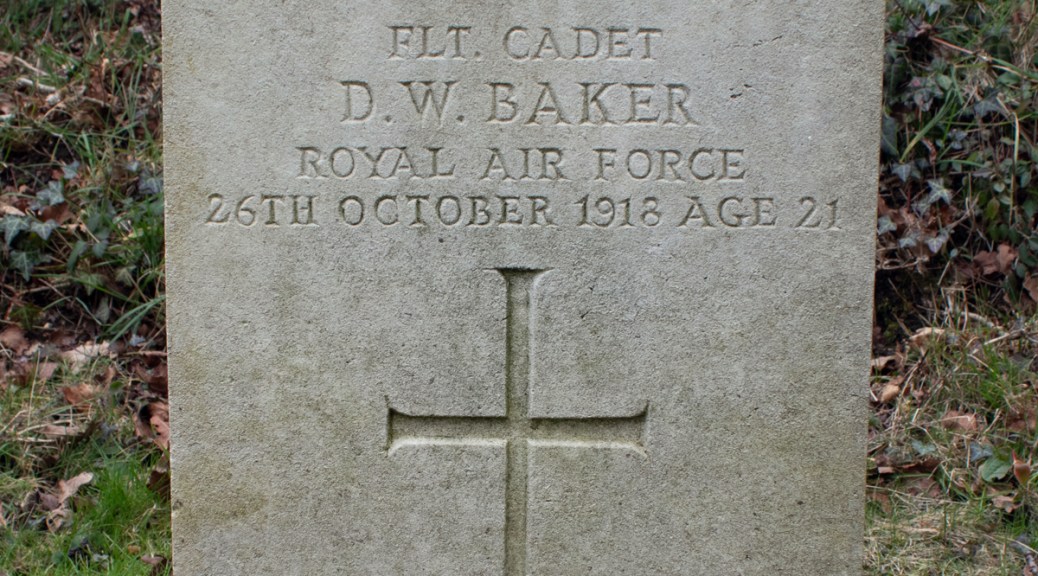
Douglas Walter Baker was born in Newbury, Berkshire, in 1898. One of seven children, his parents were Henry and Rosa Baker. Henry was a commercial traveller for a cornmeal, cake and flour merchants, and the family lived at 91 Crescent Road, Reading at the time of the 1901 census, then at 196 King’s Road, Reading, ten years later.
There is little concrete information about Douglas’ early life. When war broke out, he enlisted in the 4th Battalion of the Royal Berkshire Regiment, later documents seeming to suggest that he had added three years to his age to enable him to do so. His unit served in France from April 1915, but, as his army service records have been lost, it’s unclear when or if Private Baker went with them.
Douglas seemed to want more, though, and, on 18th December 1915, he transferred to the Royal Flying Corps. Given the rank of Air Mechanic 2nd Class, he was attached to No. 1 Aircraft Repair Depot. By March 1917, he had been promoted to Air Mechanic 1st Class. Again, however, he sought more and, just a few months after the Royal Air Force was formed, he started flying lessons.
The now Flight Cadet Baker had transferred to 29 Training Depot Station in Hampshire. Based at an aerodrome near Beaulieu, Douglas was taught in a Sopwith Camel. Two months into his instruction, he was undertaking a routine flight, when his aircraft got into a spin he was unable to get out of. The machine fell to the ground, and Douglas was killed instantly.
A report of the incident noted that: “the cause of the accident was in our opinion due to the machine spinning to the ground from about 500ft. The reason the pilot could not regain control of the machine is unknown.” [Royal Air Force Casualty Card]
Douglas Walter Baker was just 20 years of age when he died on 26th October 1918. His body was taken to the graveyard of St Paul’s Church, East Boldre, not far from the air base at which he had been billeted.
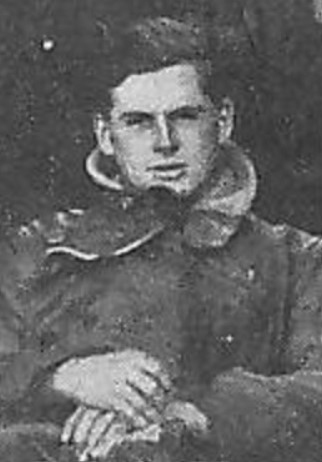
Flight Cadet Douglas Baker (from findagrave.com)
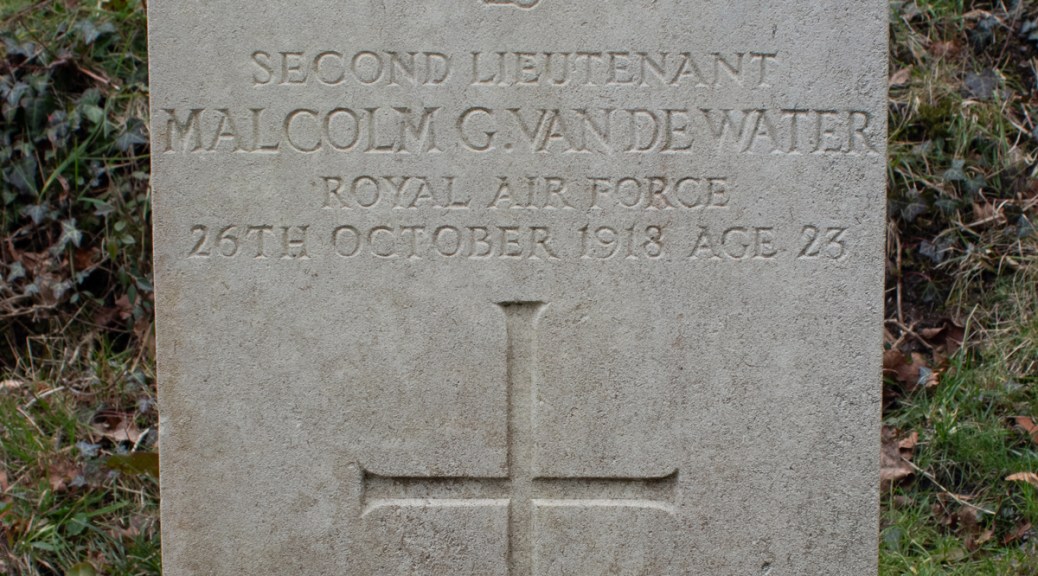
The life of a WW1 pilot was notoriously dangerous. On the same day of Douglas’ death, and at the same airfield, fellow pilot Second Lieutenant Malcolm Vande Water lost his life in a separate incident.
Malcolm Gifford Boggs was born on 14th August 1894 in Brooklyn, New York. The second of four children, his parents were Seth and Anna Boggs. Seth died in 1905, and Anna married again, to widower lawyer Charles Vande Water: her children took his name.
The next record for Malcolm is that of his Royal Flying Corps service records. Interestingly, they note that he enlisted on 10th September 1917, and did so in Toronto, Canada. While the United States had entered the First World War by this point, it may have been easier for him to join via a colonial route.
Malcolm’s papers show that he was 5ft 11ins (1.81cm) tall, and was a student aviator at the time he joined up. He was recorded as being an Air Mechanic 3rd Class, but that came to an end when, on 2nd February 1918, he was accepted for a commission.
Second Lieutenant Vande Water was attached to the 29th Training Depot Station in Hampshire. There is little information about his time there, but a later American newspaper provided details of what happened to him:
Intelligence reaching relatives of Lieutenant Malcolm G Vande Water, of the Royal flying corps, a former Passaic newspaper man, is that he was killed in a fall while testing a new airplane at the British airdrome in Beaulieu, France. Wande Water was the first member of the Pica club to pay the supreme sacrifice. He was on leave in England, after six months’ active service at the front, having operated a machine across the English channel to France on the day before his fatal fall. His machine gun shot off a propellor blade while he was flying 100 feet in the air and the airplane dove to the earth.
[The Morning Call: 17th December 1918]
The accuracy of the information included in the article is variable to say the least. Malcolm may have enlisted in the Royal Flying Corps, but, by the time of the accident on 26th October 1918, that had become the Royal Air Force. The Beaulieu aerodrome mentioned was in Hampshire, not France. The RAF’s records for the incident do confirm, however, that the propellor of his Sopwith Camel was indeed shot through, causing the aircraft to fall to the ground.
Second Lieutenant Vande Water was taken to the Forest Park New Zealand General Hospital in Brockenhurst, Hampshire, for treatment, but his injuries would prove too severe. He died later that day, at the age of 24 years old.
The body of Malcolm Gifford Vande Water was laid to rest in the graveyard of St Paul’s Church in East Boldre, Hampshire, not far from the base he had called home.
The life of a WW1 pilot was notoriously dangerous. On the same day of Malcolm’s death, and at the same airfield, Flight Cadet Douglas Baker was also killed, in a separate incident.
Edward Percival Augustus Topley was born on 6th November 1899 in Woolwich, Kent. He was the third of seven children to Percival and Sarah Topley. Percival was a grocer, and the 1901 census found the family living at 64 Eglinton Road, Plumstead.
Details about Edward’s early life are sketchy. There is a record of him learning to fly at the Cambridge School of Flying, and gaining his wings on 4th November 1917. “…he went through a course at the Royal Naval College, Greenwich. From there he was sent to Beaulieu Aerodrome, Hants…” [Kentish Independent: Friday 15th November 1918]
Edward rose to the rank of Second Lieutenant when the Royal Flying Corps and Royal Naval Air Service merged to become the Royal Air Force on 1st April 1918. Attached to the 29th Depot Training Station, he seems to have built up a fair amount of flying experience.
On 30th October 1918, Second Lieutenant Topley was flying his Sopwith Camel, when the engine stalled, and the aircraft crashed to the ground. Edward was killed instantly. He was a week shy of his nineteenth birthday.
The body of Edward Percival Augustus Topley – “a very promising young officer, and loved by all who knew him” [Kentish Independent: Friday 15th November 1918] – was taken to St Paul’s Church, East Boldre, not far from the base he had begun to call home, and laid to rest.
Second Lieutenant Edward Topley (from britishnewspaperarchive.co.uk)
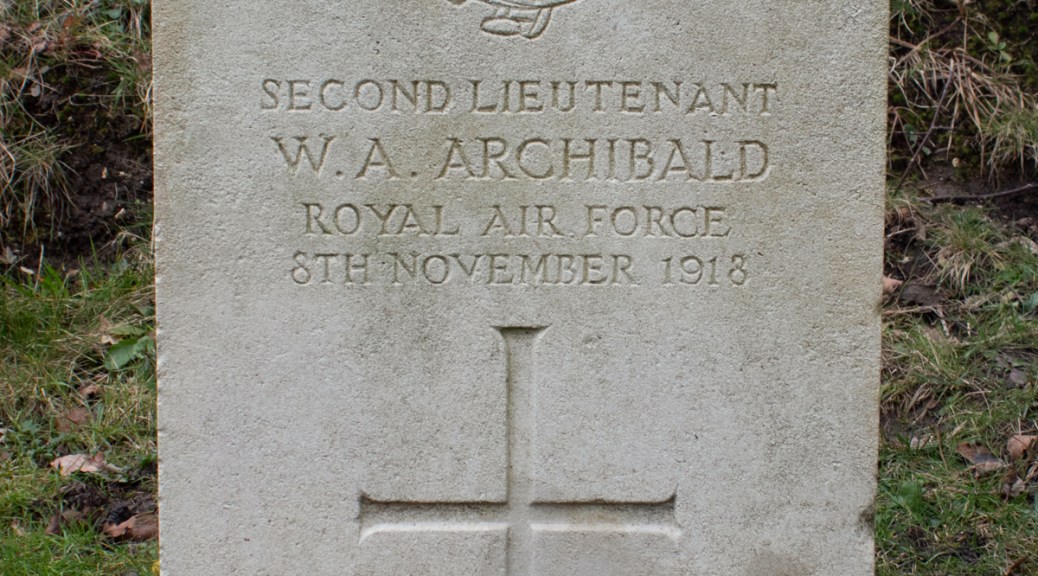
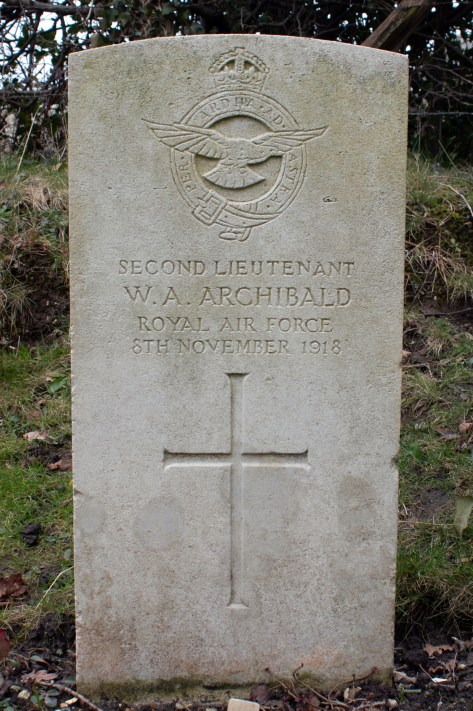
Wesley Alexander Archibald was born in Flatlands, New Brunswick, Canada, on 19th October 1894. The oldest of ten children, his parents were Scottish-born couple James and Jane Archibald. It is unclear what employment James was in, but when he completed his schooling, Wesley found work as a telegraph operator.
When not working, Wesley was an active member of the Irish Fusiliers of Canada, and, by the time was broke out, he had been with the 11th Regiment for a year.
Wesley enlisted in the Canadian Expeditionary Force on 29th November 1915. His service records show that he was 5ft 6.5ins (1.69m) tall, with black hair, brown eyes and a fresh complexion. He was also noted as having a large scar on the outer side of his right thigh.
Private Archibald’s initial training was completed on home soil. His unit – the 121st Battalion – left Halifax on 14th August 1916, and arrived in Liverpool, Lancashire, ten days later. His dedication to the role was clear: his unit moved to Bramshott, Surrey, and he had been promoted to Corporal by the time he arrived there, and Sergeant just two months later.
In January 1917, Wesley was assigned to the 7th Battalion of the Canadian Expeditionary Force and sent to the Front Line. Over the next few months, his unit saw some fierce fighting at Arras, Vimy and Hill 70. On 9th July Sergeant Archibald was awarded the Military Medal for his actions.
By the end of 1917, Wesley was seeking more adventure, and, on 10th December, he transferred to the Royal Flying Corps. Attached to the 29th Training Depot Station, he was based near Beaulieu in Hampshire when the Royal Air Force was created. Over the next year he learnt his new trade and, on 7th November 1918, he was appointed Second Lieutenant.
The following day, Wesley was preparing for a flight in his Sopwith Dolphin. The aircraft took off, but the engine stalled, and the plane crashed. Second Lieutenant Archibald was killed instantly. He was 24 years of age.
The body of William Alexander Archibald was laid to rest in the graveyard of St Paul’s Church in East Boldre, not far for the airfield he had called home.
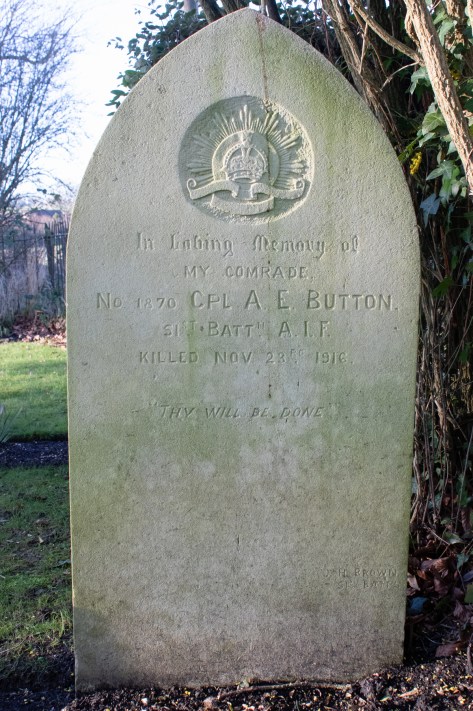
The early life of Albert James Button is a challenge to piece together. Born in Melbourne, Australia, in 1892, his father was also called Albert. When he finished his schooling, he found work as a hotel clerk, settling at 58 Stirling Street, Fremantle. He married a woman called Gladys, and, in his free time, he volunteered in the local militia.
When war broke out, Albert stepped up to play his part. He enlisted in the Australian Imperial Force on 9th December 1915, his service papers confirming that he was 5ft 8ins (1.72m) tall and weighed 129lbs (58.5kg). He was noted as having fair hair, blue eyes and a fresh complexion: he also had two vaccination marks on his left arm, and a mole on the right side of his neck.
Private Button spent the first half of 1916 training. His voluntary experience put him in good stead, and, he was promoted to Sergeant on 28th March. Towards the end of July, his unit – the 44th Battalion – left Fremantle for Britain, and he arrived in Plymouth, Devon, some two months later.
Sergeant Button was billeted at the ANZAC camp in Codford, Wiltshire. For a unknown reason, when he arrived at the base on 19th September, he was demoted to the rank of Corporal – it is unclear whether or not this was his choice. At this point, he was transferred to the 51st Battalion.
While in Wiltshire, Albert’s training continued. A local newspaper described what happened next:
Mr FAP Sylvester held an inquest at Codford, on Saturday, relative to the death of Corporal Albert James Button, 23, of the Australian Imperial Forces. The deceased, with several of his comrades, was in a bay awaiting his turn to throw a hand grenade, when a private named Taylor, who was in the throwing bay with an instructor, landed his grenade in the opposite direction to that intended, with the result that it pitched into the midst of the soldiers in the waiting bay. Being warned most of the men got away, but the deceased seemed paralysed and stayed until the bomb exploded. He was struck in the head and died almost immediately. Several of his comrades were struck i the legs, but their wounds were not serious. Pte. Taylor’s explanation was that the lever of the grenade caught in his thumb and caused him to swing his arm around. A verdict of “Accidental death” was returned.
[Devizes and Wilts Advertiser: Thursday 30th November 1916]
Albert James Button died on 23rd November 1916: he was 24 years of age. He was laid to rest in the recently extended graveyard of St Mary’s Church, Codford. The epitaph on his headstone starts “In loving memory of my comrade”, but it is unclear who specifically paid for it. Was it Private Taylor? We may never know.
Gladys seems to have distanced herself from her husband’s passing. His memorial plaque and medals were returned undelivered, and his pension seems to have gone unclaimed. It was only in 1923 that the Australian Military Forces were able to confirm that she had remarried, and moved to Sydney.
Private Albert Button (from findagrave.com)
Private Button’s service papers shed more detail on the incident that took his life. Evidently a summary of notes taken during the inquest, they are light on punctuation:
Inquiry into the death of a soldier in that he on 23.11.16 at Codford whiles in the bay of a live bomb throwing pitch was killed. The bomb was known by 2264 Pte Taylor of 50th Btn now attached to the 13th Inf Btn, which struck against the top of the parapet to the head of the thrower, owing probably to the spin of the bomb came back and dropped on the inside edge of the bay. All men were warned… to reach cover with the exception of 1870 Cpl Button AJJ 51st Battn. who seemed paralysed with fear. He remained in the bay and was found after the explosion lying across the sandbags which were placed at the entrance to prevent the bombs which were thrown against the parapet from falling into the pen. Other soldiers were wounded by shrapnel effect, because instead of falling down flat when a short distance from the bay, continued to run. The bomb not being as was thought a five second bomb, exploded in three seconds (witness 2nd Liet. JW Swanse 45th Bn)… The Court declared that the occurrence was purely accidental owing to the inexperience of live bomb throwing and nervousness on the part of the thrower, also that no blame is attached to any persons concerned in the practice.
Charles William Harris was born in Wingham, near Canterbury, Kent, on 19th July 1879. The fourth of eleven children, his parents were Charles and Kate Harris. Charles Sr was a carpenter and builder, and his son was to follow in his stead.
By the time of the 1901 census, however, Charles Jr had stepped out on his own. He had moved to London, and was boarding with the Hurley family, in rooms at 408 Bethnal Green Road, Middlesex.
On 1th June 1902, Charles Jr, now a plumber, married Esther Danton. An engine driver’s daughter from Kent, she was four years her new husband’s senior. The couple set up home at 5 Leatherdale Street in Mile End, and had two children: daughter Lilian was born in 1905, with son George following three years later.
When war broke out, Charles was called upon to play his part. He enlisted in the Royal Naval Air Service as an Air Mechanic, and was quickly promoted to Leading Mechanic. His service records show that, when he joined up on 15th June 1916, he was 5ft 7.5ins (1.71m) tall, with light brown hair, blue eyes and a fresh complexion.
Leading Mechanic Harris would be based out of HMS President, the umbrella name for the Royal Navy’s London bases. He spent time working at Wormwood Scrubs, and, in February 1917, was moved to Kingsnorth, Kent.
What happened next is summed up in a simple statement on Charles’ service papers: “26th May 1917 Accidentally killed by explosion of gas holder.” There is no further information, and nothing in the media about the incident. Leading Mechanic Harris was 37 years of age.
The body of Charles William Harris was taken to the Woodlands Cemetery, Gillingham, Kent. He was laid to rest in the naval section of the burial ground.
Tragedy was to strike again just two years later, when Charles and Esther’s daughter also passed away:
Much sympathy and respect were shown at Holy Trinity Church, Springfield, when the funeral of Lily Harris, the fourteen-year-old daughter of Mrs and the late Mr CW Harris took place. Deceased’s father, who was chauffeur to the Bishop of Chelmsford, lost his life in the war while serving with the RNAS, and this fact added to the regret felt by the parishioners at the further sad loss sustained by his widow, who is now left with only one little boy. The funeral procession included a large number of the scholars of the Springfield Day and Sunday Schools, with Mr R Coward of the day school, and practically every child carried a floral tribute. There was also a large attendance of neighbours and friends, including children, assembled at the church. The Bishop of Chelmsford officiated… [and] gave a touching address to the church, speaking particularly to the children; and his lordship also performed the last sad rites at the graveside.
[Essex Newsman: Saturday 29th November 1919]
There is no evidence of any connection between Charles and the Bishop of Chelmsford: as far as the records show, he was never a chauffeur, working as a builder, plumber and gas fitter before enlisting.
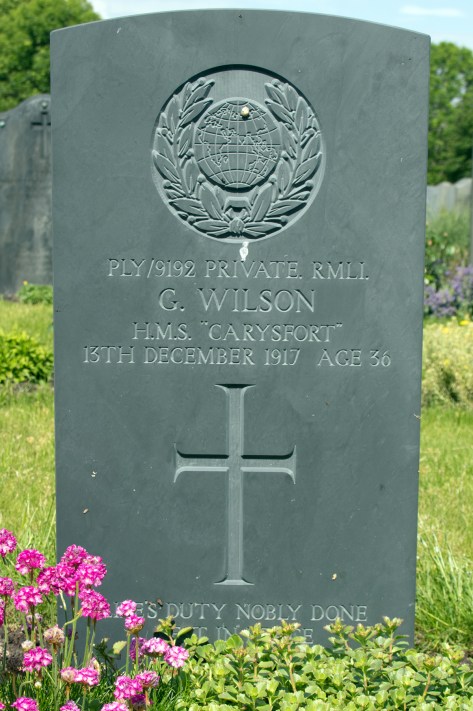
George Wilson was born on 1st February 1879 in the village of Worfield, Shoprshire. Details of his early life are unclear, although his father’s name was John.
When he completed his schooling, George found work as a porter. However, he was keen on adventure and a decent career, and so, on 31st May 1898, he enlisted in the Royal Marine Light Infantry. His service papers show that he was 5ft 7.5ins (1.71m) tall, with brown hair, blue eyes and a dark complexion. He was also noted as having a birth mark above his navel.
Private Wilson signed up for a period of twelve years and, during that time, he would serve around the world. Initially sent to barracks in Walmer, Kent, he would become based at Plymouth, Devon, in between assignments. Time overseas would include two years attached to HMS Magnificent (the 1901 census recording the battleship being moored in Gibraltar), two years on board HMS Spartan and three aboard HMS Encounter.
Away from the military, love blossomed and, in January 1909, George married Annie Curtis. She had a daughter, Gladys, who was either George’s, or was adopted by him. The couple set up home in Plymouth, and went on to have a son, Leslie, in 1911.
By this point, Private Wilson had renewed his military contract, and would go on to serve for a further seven years in the Royal Marines. In June 1915, he was assigned to the light cruiser HMS Carysfort. Part of the Harwich Force, her role was to patrol the waters off the east coast of England. During his time on board, George would have been involved in a number of sorties, including an attempt to intercept an enemy raid on Sunderland in August 1916, and another attempt to make contact with German ships off Zeebrugge, Belgium, that October.
In December 1917, while patrolling off Orford Ness, Suffolk. the Carysfort collided with the SS Glentaise, a collier ship. Two crew were killed in the incident, including Private Wilson: he was 37 years of age.
Carysfort sailed to HMS Pembroke, the Royal Navy Dockyard in Chatham, Kent. From here the body of George Wilson was taken to Woodlands Cemetery in nearby Gillingham, and he was laid to rest in the naval section there.
Edward Thomas Stewart was born on 7th September 1880 in the Kent village of Sturry. The middle of three children, his parents were farm labourer James Stewart and his wife, Frances.
When he finished his schooling, Edward found work as a coachman, but he sought a life of adventure and, on 24th July 1899, he enlisted in the Royal Navy as a Stoker 2nd Class. His service records show that he was 5ft 7.5ins (1.71m) tall, with light brown hair, grey eyes and a fresh complexion.
Stoker Stewart was sent to HMS Pembroke, the Royal Naval Dockyard in Chatham, Kent, for his training, and remained there for the next eight months. He was then given his first assignment, on board the battleship HMS Sans Pareil. She became his home for the next year, during which time he was promoted to full Stoker.
Edward’s initial term of contract was for twelve years, and over that time he would serve on nine different vessels. Between voyages his shore home remained Pembroke, and he spent more than two years based there. By the summer of 1911, Edward had been promoted three times – to Stoker 1st Class in July 1906, Leading Stoker in March 1908, and Stoker Petty Officer in March 1910.
When his contract came to an end, Edward immediately re-enlisted. By this point, his records show that he had grown to 5ft 10.5ins (1.79m) tall, and had a scar on his nose.
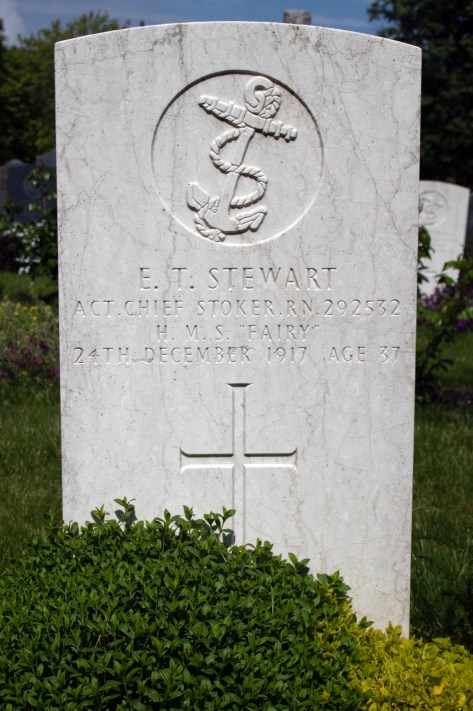
In the autumn of 1912, Stoker Petty Officer Stewart was assigned to the troop ship HMS Tyne. She would become the ship on board which he would spend the longest part of his career, not disembarking until 31st May 1917. He transferred to HMS Fairy, a destroyer, and with the move came a promotion to Acting Chief Stoker.
Attached to the Grand Fleet, Fairy was engaged in convoy work off the east coast. Edward’s time on board would not be a lengthy one, however. On 24th December 1917, he fell overboard, and was killed. He was 37 years of age. There is little additional information about the incident, although his service papers note that “no blame was attributable to anyone.”
Edward Thomas Stewart’s body was recovered, and brought back to Kent for burial. He was laid to rest in the naval section of Woodlands Cemetery, Gillingham, not far from the base he had called home for so long.
Henry Weller was born on 13th January 1877 in the village of Ashurst Wood, Sussex. The second of four children, his parents were John and Mary Weller. John was a farm labourer, and the 1881 census found the family living in a cottage on Brooklands Farm in East Grinstead.
Times look to have been tough for the Weller family. By the time of the next census, John, Mary and three of their children were lodging with Hartfield family. Henry, meanwhile, was living in Deptford, Kent, with James and Susannah Weller. He was noted as being a ‘cousin’, although his exact relationship is unclear. James’ nephew Joseph Weller, was also living with them. Just fourteen years of age, Henry was working as a general labourer, and the family were living at 21 Adolphus Street.
Labouring was an irregular way to being in money, and so Henry sought out a more regular career. On 18th November 1896 he signed up to the Royal Navy as a Stoker 2nd Class. His service records show that he was 5ft 4.5ins (1.64m) tall, with brown hair, brown eyes and a fresh complexion. He was also noted as having the letters HW tattooed on his left forearm, and shaking hands on his upper left arm.
Stoker Weller was sent to HMS Pembroke, the Royal Naval Dockyard in Chatham, Kent, for his training. He spent the next nine months split between there and HMS Wildfire – Sheerness Dockyard – learning his trade.
On 8th June 1897, Henry was assigned to the battleship HMS Victorious. Promoted to Stoker 1st Class three months after boarding, she would remain his home for the next three years. After a month aboard another battleship – HMS Revenge – he returned to Chatham.
Love blossomed and, on 8th July 1900, Henry married Alice Beldham, a dock worker’s daughter. The couple exchanged vows at All Saints’ Church, Rotherhithe, Kent, and moved in with Alice’s widowed father, George, at 12 Osprey Street. They went on to have three children: Henry, Harold and Ivy.
Newly settled, Henry seems to have voiced a preference to remain closer to home and, for the next couple of years he would remain based at HMS Pembroke. Alice relocated, and the family set up home at 51 King Edward Road, Gillingham, Kent. Close to the River Medway, the Wellers’ neighbours were all based at the docks, and, during her husband’s future absences, it is likely that Alice felt a sense of community.
After leaving HMS Pembroke, Henry was attached to the cruiser HMS Bacchante. Promoted to Leading Stoker 2nd Class, over the next six years, he would serve on three more ships, spending six-month stints back in Chatham in between assignments. In July 1903 he was promoted to Leading Stoker 1st Class, although he reverted to 2nd Class nine months later. Promoted again in June 1905, he took the rank of Stoker Petty Officer a year later.
Henry’s initial term of service came to an end in November 1908. He immediately re-enlisted, and remained in service until the spring of 1918.
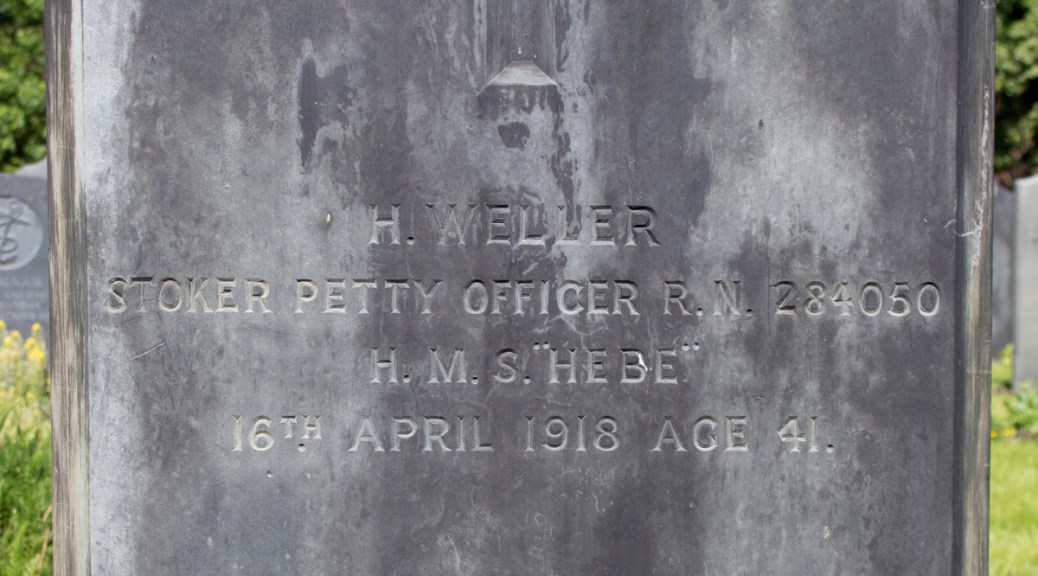
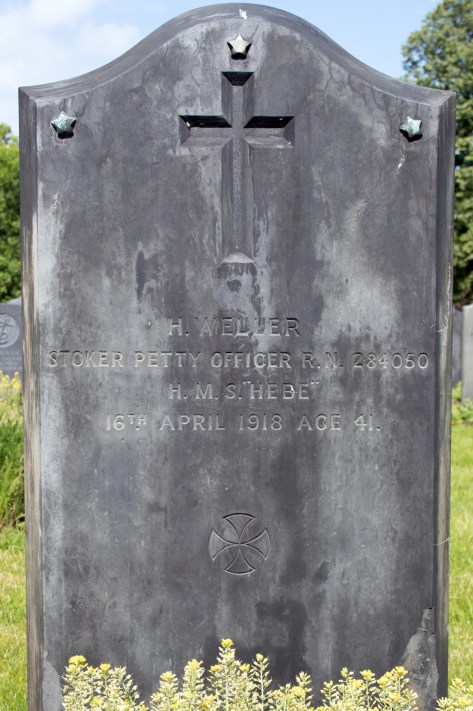
By this point Stoker Petty Officer Weller had been assigned to the torpedo gunboat HMS Hebe for more than thirty months. Patrolling the North Sea coast, on 12th April, she moored at the Alexandra Dock in Hull, Yorkshire. A later inquest outlined what happened next:
Joseph Taylor, a chief petty officer, said that about 11:55pm… [Henry] and he were going from the town to their ship… Witness struck a match to light his pipe. [Henry] walked on for about two yards, and then disappeared. Witness raised the alarm, and went tot he bottom of the dry dock, into which he found [Henry] had fallen, a distance of about 50 feet. They did not know the docks, has they had only come in that morning… If he (witness) had not struck the match they would both have gone over.
[Hull Daily Mail: Wednesday 17th April 1918]
Alive, but severely concussed, Stoker Petty Officer Weller was quickly taken to a local hospital. He was operated on, but his injuries were too severe. Henry passed away on 16th April 1918: he was 41 years of age.
The body of Henry Weller was taken back to Kent for burial. He was laid to rest in Woodlands Cemetery, Gillingham, a short walk from where Alice and their children were still living.










 Death and Service