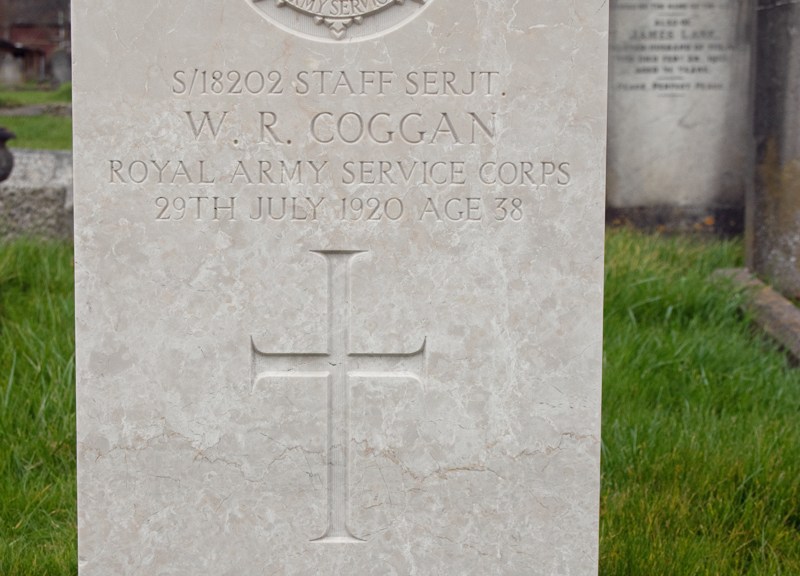
William Reginald Coggan was born in Twerton, near Bath, at the end of 1882. His father, also called William, was a railway guard, and with his mother, Annie, he would go on to raise nine children, six of them girls.
William Jr became known as Reginald, presumably to avoid confusion with his father. He didn’t follow his father onto the railways, but found a way to serve his country. In the 1901 census, he was working as a baker for the Army Service Corps, and was based at the Stanhope Lines Barracks in Aldershot (along with more than 1800 others).
Ten years later – by the time of the 1911 census – William had left the army but continued his trade. He was listed as a baker of confections in Glastonbury, was living above the bakery with his wife of four years. I have been able to find little information about his wife, Kate, other than that she came from Dublin.
William Coggan’s former bakery in Glastonbury, Somerset.
William’s life becomes a little vague after the census. A newspaper report confirms that he had served in the South Africa war (1899-1902), and that he had seen five years’ service in France. The report – and William’s pension records – confirm that he had continued in the Army Service Corps, gaining the rank of Staff Sergeant.
William had died in Ireland, and his death registered in Fermoy, thirty miles to the north of Cork. The report confirmed that:
Nothing is yet known of how he came by his death, although a request was made for a post-mortem examination.
Taunton Courier and Western Advertiser: Wednesday 11th August 1920.
I can find no further information about his death and, unusually, his Pension Record gives the date, but not the cause. Staff Sergeant Coggan died on 29th July 1920, aged 38 years old.
William Reginald Coggan’s body was brought back to England for burial. He lies at rest in St John’s Cemetery in Bridgwater, Somerset.
Ernest James Wood was born in 1891, one of ten children to Alfred and Charlotte Wood. Alfred was a carpenter and machinist for a timber merchant, and, by the time of Ernest’s birth the family lived in Bridgwater, Somerset.
When hostilities broke out, Ernest was quick to enlist. He joined the Royal Army Service Corps in September 1914. Driver Wood was assigned to the Horse Transport Depot Company at Park Royal in London, and there is a note of him being injured on 29th July 1916. Sadly, little else of his military service remains.
In January 1916, Ernest married Hilda Williams. She was the same age as her new husband, and was the daughter of Thomas and Elizabeth, who were also from Bridgwater.
The trail of Driver Wood goes a little cold after that. He was demobbed om 6th January 1919 and on the release form declared that he was not medically unfit as a result of his military service.
Frustratingly, the trail goes totally cold at that point. All we know for certain is that Ernest died on 2nd March 1919, two months after leaving the army. There a no records confirming a cause of death but, as he does not appear in any contemporary newspapers, it is likely that the cause was not unusual; perhaps one of the respiratory conditions going around at the time, such as influenza or pneumonia. Whatever the cause, Ernest was just 28 years old when he died (his headstone is based on an incorrect date of birth).
Ernest James Wood lies at peace in the St John’s Cemetery in his home town of Bridgwater, in Somerset.
William James Bradbeer was born in the spring of 1888, the youngest of eight children to Alfred and Jane Bradbeer from Bridgwater in Somerset. Alfred was a carriage trimmer, fitting out the train coaches for the local railways.
Sadly, William lost both of his parents in 1910; by this point he was 22, and was working as a schoolmaster along with his older brother Alfred. Five of the Bradbeer siblings were living together by this point, along with Sidney Palfrey, a photographer, who was boarding with them.
On 27th December 1911, William married Selina Nurse, who was also from Bridgwater, and whose father was a master mariner. The couple did not have any children together.
There is little evidence of William’s life after his marriage. He was enlisted in the Royal Garrison Artillery during the war, although no details of his military service are available. The battalions provided support in key forts primarily along the south coast of England, but also in places like the Channel Isles, Malta and Sierra Leone. Without Second Lieutenant Bradbeer’s records, it is impossible to know specifically where he served, but it would seem likely that he remained in England during the war.
The last years of William’s are also shrouded in mystery; he passed away on 8th August 1920, at the age of 32. I have been unable to uncover a cause of death, but it seems likely to have been an illness, as there is nothing in the contemporary media to suggest anything unusual or untoward.
William James Bradbeer lies at rest in the Wembdon Road Cemetery in his home town of Bridgwater. Sadly, though, his grave is also lost to time, and I was unable to pinpoint its location. In death, as in his later years, William remains a mystery.
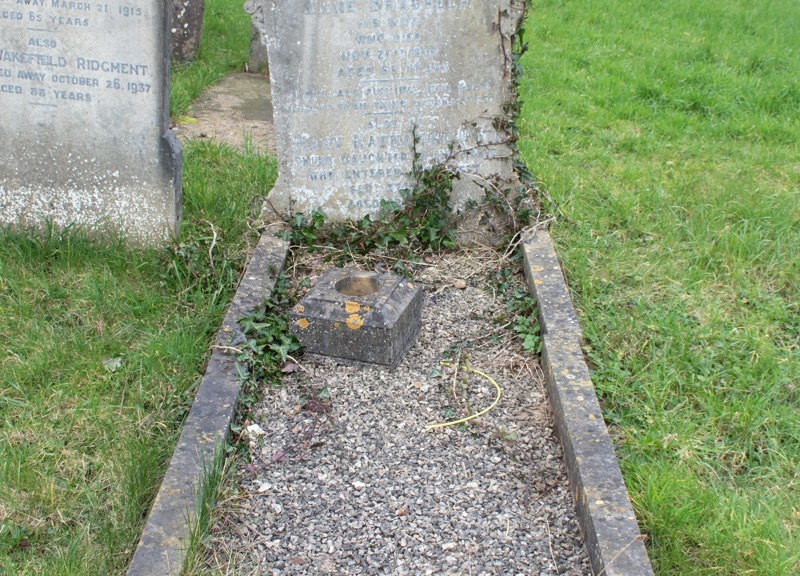
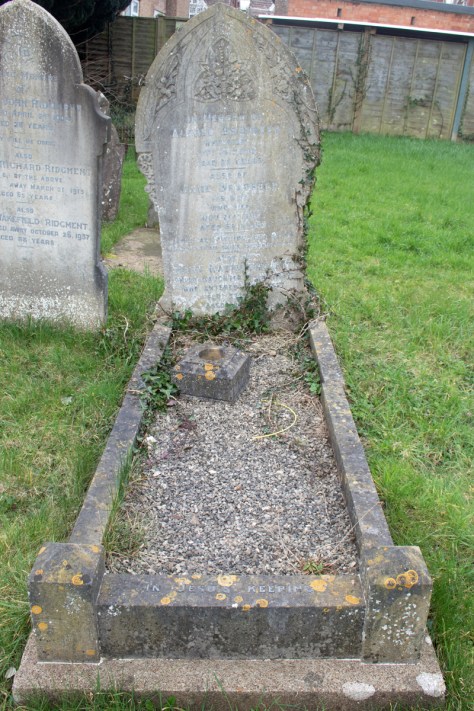
Note: The grave at the top of this page, however, is of a couple of his Bradbeer relatives, buried in the same cemetery.
Walter Ricks Treliving was born in Bridgwater, Somerset, in 1876, the middle of three children to James and Elizabeth Treliving. James was a commercial traveller in the drapery trade, and this is something his son followed him into.
According to the 1891 census, Walter was a pupil at the Commercial Traveller’s School in Pinner, Middlesex, which was, in effect, a boarding school-cum-children’s home for the children of commercial travellers and orphans.
Commerce was obviously engrained into Walter by this point and, after leaving school, he followed his father into the trade of trading. He travelled with his work, frequently boarding with others; in 1901, the census recorded him as living lodging with his maternal aunt Annie Ricks.
Love beckoned, however, and in 1904, Walter married Mabel Broadrick, the daughter of a Unitarian Minister from Worcestershire. The couple set up home in Weston-super-Mare and had a daughter, Beryl, two years later.
Things were not to go smoothly, however, as an article in the Western Daily Press were to show:
In the Divorce Court yesterday, a case was heard in which Mr Walter Treliving, a commercial traveller of Weston-super-Mare, petitioned for a divorce from Mabel Annie Treliving, on the ground of her misconduct with Mr Charles E Rust, an engineer. The case was undefended.
Mr Treliving said he was married on the 13th August 1904 at Bridgwater, and afterwards lived at Weston-super-Mare. There was one child of the marriage. The married life was happy until May 1913, when his wife told him that she cared for someone else.
In July 1913, his wife went away to Manchester on a visit, and when she came back she told him she had stayed with Mr Rust at the Grand Hotel… He forgave her for that, and took her away for a holiday to Lynton. He then discovered that she was still corresponding with the co-respondent, and afterwards that she was meeting him again.
On the 13th September his wife left him, and he heard that she had gone to Khartoum with the co-respondent. He received a letter from her, in which she said:
“Dear Walter. The divorce papers have come. Of course I cannot defend the case, nor he. So you have it all in your power. I hope you will be happy now you are free. If eve I came back to England, may I see Betty [sic]? I cannot marry Mr R. She will not divorce him. I do not know what I shall do now. I hope you will be happy if you marry again, as I hear you will. Oh! if you had only held out one hand to save me, how different it might have been. I am a broken woman. Yesterday, when the petition came, I realised it. You are fully paid back for all your sufferings. Enjoy your victory. Your wife.”
Petitioner said it was not his intention to marry again, as his wife suggested. He had done everything in his power to induce her to remain with him.
Western Daily Press: Thursday 1st April 1915
A decree nisi was granted to Walter and he was awarded costs.
Sadly, it has not been possible to track Walter’s military history. That he enlisted is evident; he joined the Royal Army Service Corps, and rose through the ranks to become Second Lieutenant Treliving. The divorce proceedings did not identify him as serving in the army, so it seems likely that he joined up at some point after April 1915 – his age and his status as a single father seem further proof of this assumption.
Walter returned to Bridgwater in October 1918 to attend his mother’s funeral. Elizabeth had contracted influenza and, sadly, after returning home Walter also caught and succumbed to it. He died on 11th October 1918, at the age of 42.
His probate confirms two beneficiaries; his sister Hilda Treliving, and another woman, Kate Symons, presumably as guardians and trustees for Beryl.
Walter Ricks Treliving lies at rest in the Wembdon Road Cemetery in his home town of Bridgwater, Somerset. He had been buried on the same day as Elizabeth, the mother whose funeral he had returned to attend.
Ernest Edward Hector was born in 1875, one of six children – all boys – to Thomas and Mary Hector. Thomas was a farm labourer, and this was a trade Ernest and his brothers all followed their father in.
Ernest was keen for a better life, however, and enlisted in the Somerset Light Infantry in May 1896, aged 21. After initial training and service in England, Private Hector was off to the East Indies, arriving there just after Christmas 1897.
Six years abroad followed, after which Ernest returned to England to serve another four years. He completed the 12 years of his military career in May 1908.
By this point, Ernest had married Eliza Humphries, a young lady seven years his junior, who came from his home village of North Wootton in Somerset. The couple went on to have six children and, by the time of the 1911 census, Ernest had settled his family in West Pennard, near Glastonbury, and was working as a farm labourer.
Ernest’s service during the Great War remains tantalisingly hidden. Given that he was 39 when hostilities broke out, it is unlikely that he was called up again straight away; his gravestone confirms that he was assigned to the Machine Gun Corps (Infantry), but research on his service number provides little other detail.
There is nothing in the media of the time reporting on his death or funeral either, so no concrete cause of death can be confirmed. All that is known is that Private Hector died on 9th May 1920, aged 45 years old.
Ernest Edward Hector is buried in the graveyard of St Peter’s Church in North Wootton.
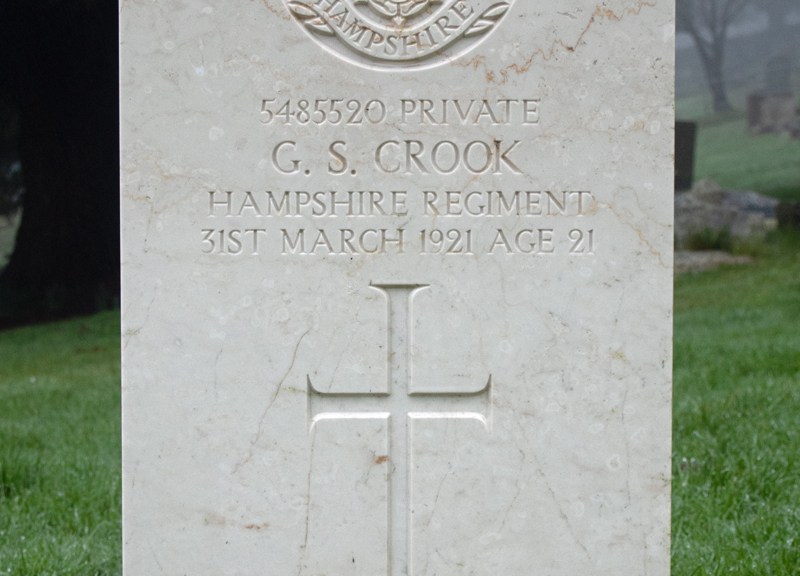
Gordon Spencer Crook was born in 1900, one of thirteen children to William and Elizabeth Crook from Somerset. William, like his father, was a gardener, and the family lived in Lower Lane, a small lane sandwiched between the railway and a stream in the centre of Shepton Mallet.
The military records for Gordon, who seems also to have gone by the name of George, are a challenge to piece together. His older brothers Walter and Bertram both died as a result of the fighting, both in 1916, and it seems likely that Gordon was keen to do his bit as soon as he could, to honour their memories.
He enlisted in the Hampshire Regiment, whose battalions served both in France and on the home front. There is conflicting information about his service, but Private Crook appears to have fought at the front, gaining the Victory and British Medals.
Again, with his passing, there is little information surrounding Gordon, or George. A brief notification in the Shepton Mallet Journal stated that “On March 31, at Royal Victoria Hospital Netley, Gordon Spencer, the dearly loved son of W and E Crook, aged 21 years.”
Gordon Spencer Crook lies at rest in the cemetery of his home town, Shepton Mallet.
Gordon’s brother Walter is also buried in Shepton Mallet Cemetery – read his story here.
A third brother, Bertie, was also gave his life in the Great War. The local newspaper had given a touching report on his death in April 1916.
Bertie Crook left school at the age of 13, and went into service with Mrs Dickinson at Whitstone, as a stable lad. He was there a year and then, on account of Mrs Dickinson giving up horses and leaving the town, they recommended him to Lord Derby’s stables at Newmarket, under the Hon. G Lambton. Small as he was, Bertie Crook undertook the railway journey alone, with a label in his buttonhole. He served five years apprenticeship, which expired at the beginning of October [1915]. He then tried to join the Royal Field Artillery, but not being tall enough he joined a West country regiment on the 20th October, and left Tidworth Barracks for France in the early part of January. He was in his 21st year, having been born on the 29th July. 1895.
The Hon. George Lambton writes “I was terribly shocked and grieved to hear of the death of your boy… Mrs Lambton and I send our deepest sympathy… I always liked your boy so much when he was in my stable; and I felt sure that with his quiet and courageous character he would make a good soldier. I shall have a plate put up in the stable in memento of his glorious death.”
Shepton Mallet Journal: Friday 21st April 1916
Lance Corporal Bertram Stanley Crook is buried at the 13th London Graveyard in Lavantie, France.
Ernest George Morris was born in September 1879, one of six children to John and Eliza Morris. John was a carter for the railways, and this was a trade his son was to follow.
Ernest married Sarah Garrett in Bristol on Christmas Eve 1904, and the young couple went on to have two children, Charles and William.
Ernest’s father died in 1907, and Ernest became head of the family. He moved them in with him in Bristol, and by the 1911 census, the household consisted of Ernest, his mother Eliza, his brothers Frank and William, sister Lily and his own son William.
The census also lists Ernest as a widow; I have not been able to track down any records of when Sarah died. Their eldest boy, Charles, passed very early on, however, so this is likely why Ernest set up home with his family.
By this time, Ernest was working as a carman in the Bristol Goods Yards, and it appears that had a strong character. In September 1912, he was cautioned for “smoking whilst on duty and refusal to give an undertaking to refrain from doing so in future.” He cited his reason that the rulebook “did not prohibit men from smoking when not with a load.”
Ernest was suspended for two days, and was only allowed back to work when he promised to follow instructions in the future. This, it seemed he may not have done, as he was dismissed just three months later.
Ernest’s military service records are hard to piece together. He enlisted in the Rifle Brigade as a Gunner, going on to achieve the rank of Serjeant. He was awarded the Victory and British medals – the standard awards for men involved in the Great War.
Serjeant Morris survived the war, but there is little information for him after that. He passed away on 28th June 1920, aged 40 years old, although there is no record of how he passed. His war pension was awarded to his mother, who was acting as guardian for his son William.
Ernest George Morris lies at rest in the cemetery of his home town of Langport.
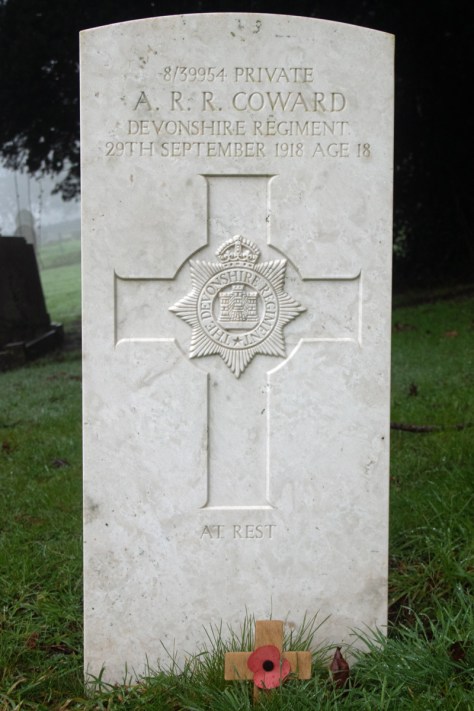
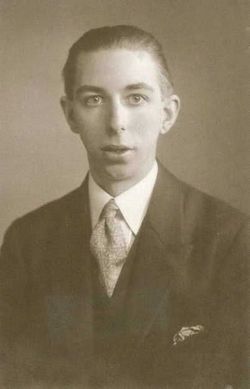
Albert Reginald Robert Coward was born on 26th August 1900, the middle of three children – all boys – for James and Florence Coward. James was a labourer and drayman for the railways, and the family lived in Shepton Mallet, Somerset.
Little remains of Albert’s military service records. His older brother Arthur was a Corporal in the Somerset Light Infantry. He died in France in April 1918, which may have been a contributing factor to his sibling’s decision to do his duty.
Albert enlisted in the 53rd Battalion of the Devonshire Regiment and, given his age, I would presume that this was as soon as he was able to – sometime in 1918.
Whether Private Albert Coward saw any military action is not known. He is listed as having passed away at a military hospital on 29th September 1918, although, as I have been unable to find a cause of death, it is likely to have been an illness, rather than an injury. Albert was aged just 18 years old.
Albert Reginald Robert Coward lies at rest in the cemetery of his home town.
Albert Reginald Robert Coward (courtesy of findagrave.com)
Corporal Arthur William James Coward is commemorated on the Arras memorial in France. He was 23 years old when he died.









 Death and Service