
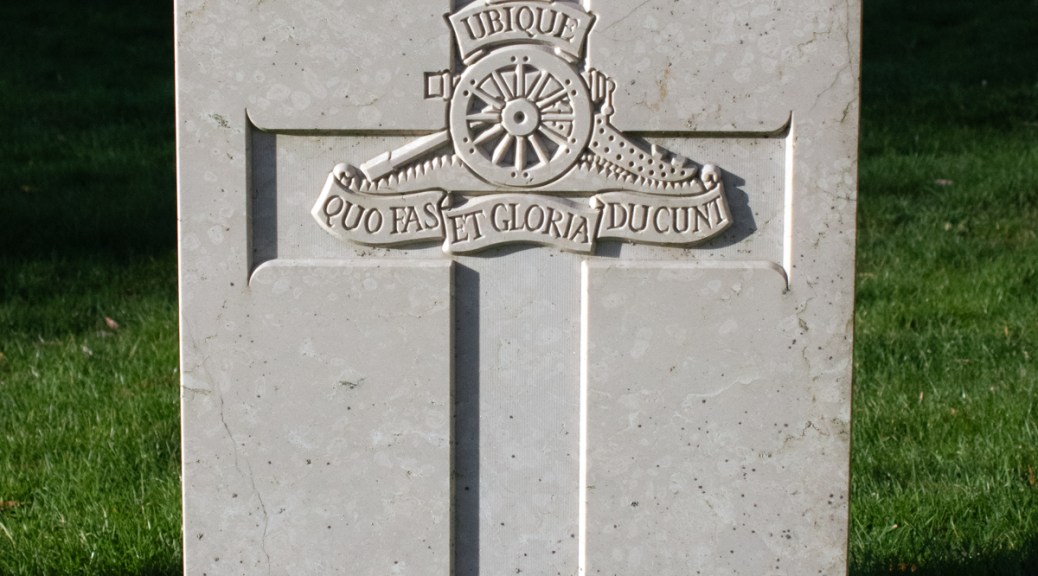
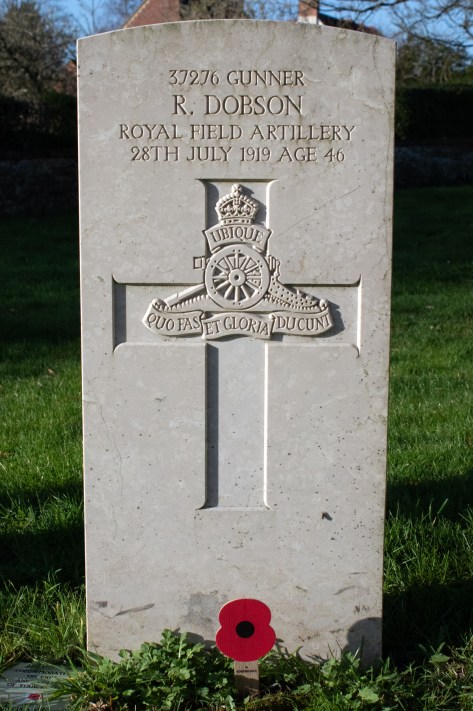
In the graveyard of St Mary’s Church in Steeple Ashton, Wiltshire, is a headstone dedicated to the memory of Gunner R Dobson of the Royal Field Artillery. The early life of Robert Dobson, however, is a challenge to unpick.
Born in Kilbride, County Wicklow, in 1873, he was the son of John Dobson and, according to his later service papers, he had three brothers: William, John Jr and Richard.
When he finished his schooling, Robert found work as a gamekeeper, but he wanted more adventure, and, on 27th April 1891, he enlisted in the Royal Artillery. Given the rank of Gunner, his papers note that he was a little over 5ft 6ins (1.68m) tall, and weighed 150lbs (68kg). A Presbyterian, he had brown hair, blue eyes and a fresh complexion.
Gunner Dobson signed up for a period of seven years, and during this time he travelled the world. From March 1893, he was based in India, but was invalided home for reasons unclear in November 1894. He would remain on home soil for the next three years, and was stood down to reserve status in April 1898.
While back on home soil, love had blossomed and, on the 14th May 1898, Robert married Mary Bull. A labourer’s daughter from Steeple Ashton, the couple wed in the parish church. Robert gave his address as the same village, and, given the proximity of the garrison town of Trowbridge, it is likely a local posting is how the couple met.
On 3rd November 1899, Gunner Dobson was called into duty once more. Attached to the 3rd Battalion of the Royal Field Artillery, his unit headed to South Africa, and he was quickly caught up in the Boer War. He would remain overseas until the spring of 1901, at which point he returned to Britain once more.
After a total of twelve years’ service, Robert was formally stood down from army service on 26th April 1903, returning to Steeple Ashton and Mary. The 1911 census – the only one of the four returns taken during his lifetime on which he appeared – found the couple living in a cottage on Common Hill, to the north of the village centre. Robert, now 38 years old, was working as a farm labourer.
When war broke out in Europe, Robert stepped up to serve his country once more. He initially re-joined his old unit, but seems to have transferred over the Labour Corps, and was attached to the 95th Company. His service records for this period have been lost, so it is unclear when or how he served.
Robert survived the conflict, but would pass away on 28th July 1919. The cause of his passing is unclear, but he was 46 years of age when he died.
The body of Robert Dobson was laid to rest in the peaceful graveyard of St Mary’s Church in Steeple Ashton.


 Death and Service