

Ernest Frederick Hawkins was born in Street, Somerset, in 1884. He was the youngest of six children to Charles Hawkins and his wife Elizabeth. Both of Ernest’s parents were shoemakers in the Clark’s Factory in the town, and this was the trade Elizabeth continued in after her husband’s death in 1887.
Ernest’s life has some mysteries about it and there is a sense that he spent time trying to escape from something. In August 1904, he enlisted in the army, joining the Scottish Rifles (also known as the Cameronians). He did this under an assumed name, preferring to be called James Fisher.
“James” gave his next of kin as his parents, listing them as George and Annie in South Acton (even though these were not his actual parents’ names, and that his father had passed away 17 years previously).
His enlistment papers give an interesting insight into the young man. He was listed as 22 years old, 5ft 4ins (1.62m) tall, with brown eyes, black hair and a sallow complexion. His arms were adorned with a number of tattoos, including Buffalo Bill on his upper right arm and a ship surrounded by flags on his upper left.
Private Fisher served for a year on home soil, before being shipped out to India. He returned to the UK in October 1907, and transferred to the Army Reserve.
Ernest returned to Somerset, and it was here that he met Sarah Jane Manning. The couple married in a registry office in Bristol, and went on to have two children, Hubert and Iris.
War broke out, and Private Fisher was remobilised. By August 1914 he was promoted to Lance Corporal, and sent to France as part of the British Expeditionary Force. Here he became caught up in a number of the key battles of the conflict.
On 24th July 1916, during the British attacks on High Wood at the Somme, he was wounded in the right arm, and invalided back to England for treatment. Admitted to the War Hospital in Guildford, Surrey, it was confirmed that he had received a gun-shot wound to his right arm, which had resulted in a compound fracture of the humerus, radius and ulna. Sadly for Ernest, the only option was a full amputation of his right arm.
After some time to recover, Ernest was transferred to the Pavilion Military Hospital in Brighton where he was fitted for an artificial limb. He spent three months in the Brighton facility, before being moved to the Queen Mary’s Convalescent Home in Roehampton to recuperate. He was eventually discharged – from the hospital and the army – on 10th March 1917, and returned to his wife and family in Somerset.
There is little further documented information about Ernest. He and Sarah went on to have a further child – Leslie – in 1917. Sadly, where Ernest had been a toddler when his father had died, Leslie was consigned to be a babe-in-arms when Ernest passed away.
Ernest Frederick Hawkins – also known as James Fisher – died in Swindon on 2nd July 1918, at the age of 34. He lies at rest in St Mary’s Cemetery in his adopted home town of Taunton, Somerset.
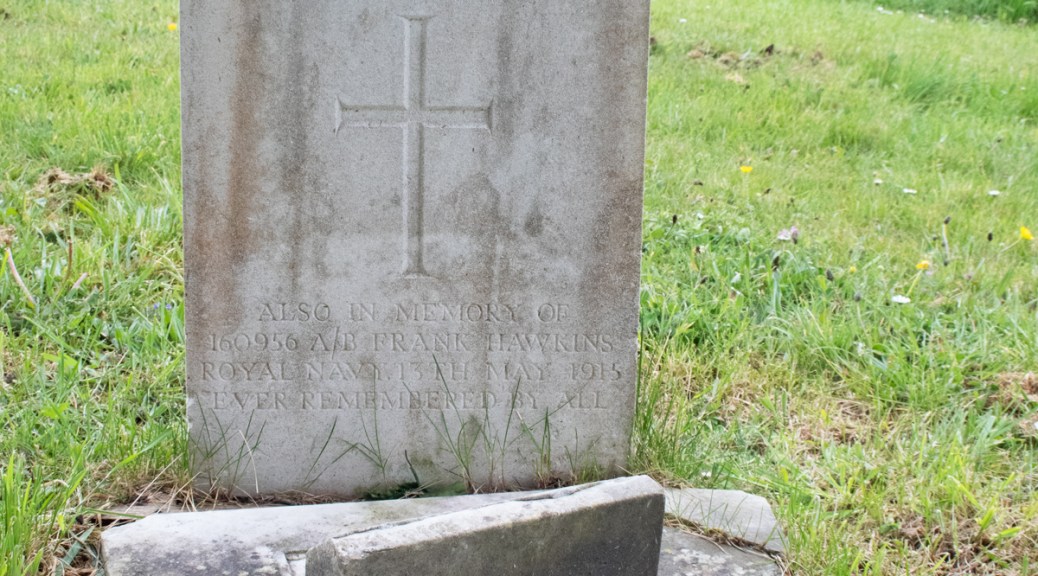
Ernest’s gravestone also commemorates his brother Frank Hawkins. Frank was nine years older than Ernest, and, like his younger brother, had decided that the military life was for him.
Frank enlisted in the Royal Navy in November 1894 and was assigned a Boy 2nd Class on HMS Impregnable – the training ship based in Chatham, Kent. Over the period of his twelve years’ service, Frank rose through the ranks to Able Seaman. When his term was up, he joined the Royal Fleet Reserve for a further five years.
When war came, Able Seaman Hawkins was immediately called back into action. He was assigned to HMS Goliath, serving off German East Africa and the Dardanelles. On the night of the 12th May 1915, the ship was guarding the water off Gallipoli, when it was struck by three Ottoman torpedoes. The resulting explosions caused the ship to sink quickly, and 570 souls – out of a total complement of 750 crew – were lost.
Able Seaman Hawkins was one of those lost, and was subsequently commemorated on his brother’s gravestone.





 Death and Service