Tag Archives: malaria

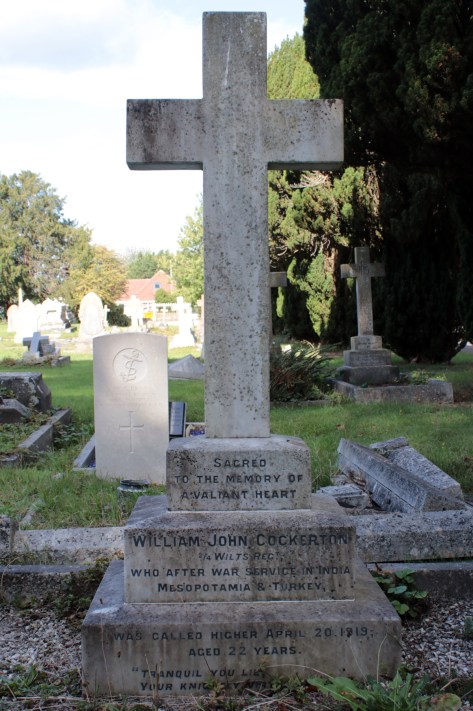
Private William Cockerton

Private William Cockerton

William John Cockerton was born in the autumn of 1896 in Holloway, Middlesex. The older of two children, his parents were baker John Cockerton and his wife, Elizabeth.

The 1901 census found the family living at 28 Highbury Station Road. The house is long since gone, but the Cockerton’s neighbours included a horse keeper, porter and a police constable.

By the time of the 1911 census, William had left London, and was living with his paternal uncle and aunt, Fred and Amy, in Trowbridge, Wiltshire. Fred was an ironmonger, and his nephew had taken an apprenticeship with him. The census notes two visitors to the property – 22 Clarendon Villas – William’s mother and sister, Elizabeth and Dolly.

In his spare time, William started volunteering with the local militia. When war broke out, he was quick to enlist, formally joining the Wiltshire Regiment as a Private. Assigned to the 2nd Battalion, by December 1914, he found himself in India. A later newspaper report detailed how his military service unfolded:

..after a period of garrison duty in India, he volunteered for duty with the Mesopotamian Expeditionary Force, and took part in some of the biggest engagements against the Turks, being eventually wounded, captured and reported dead. For some two years he was held in captivity, during which he ensured great hardships that seriously undermined his health.

[Wiltshire Times and Trowbridge Advertiser: Saturday 26th April 1919]

William was reported missing in February 1917, with an understandably grief-stricken John and Elizabeth later being informed that he had been severely wounded in the chest, succumbing to his injuries half-an-hour later. His name was placed on the roll of honour at Trowbridge, but in July 1917, William’s parents received a card from Turkey in his handwriting, explaining that he was a prisoner of war.

Private Cockerton was released on 16th November 1918, and returned to Britain.

Early in March, he went to Harrow-on-the-Hill for a holiday, staying with his uncle. Here he was taken ill with malarial fever and pneumonia, which resulted in his death.

[Wiltshire Times and Trowbridge Advertiser: Saturday 26th April 1919]

William John Cockerton was just 22 years of age when he passed away on 20th April 1919. His body was taken back to Wiltshire for burial, and he was laid to rest in Trowbridge Cemetery. He lies at rest in the family plot, alongside his father, who had passed away in the autumn of 1916.
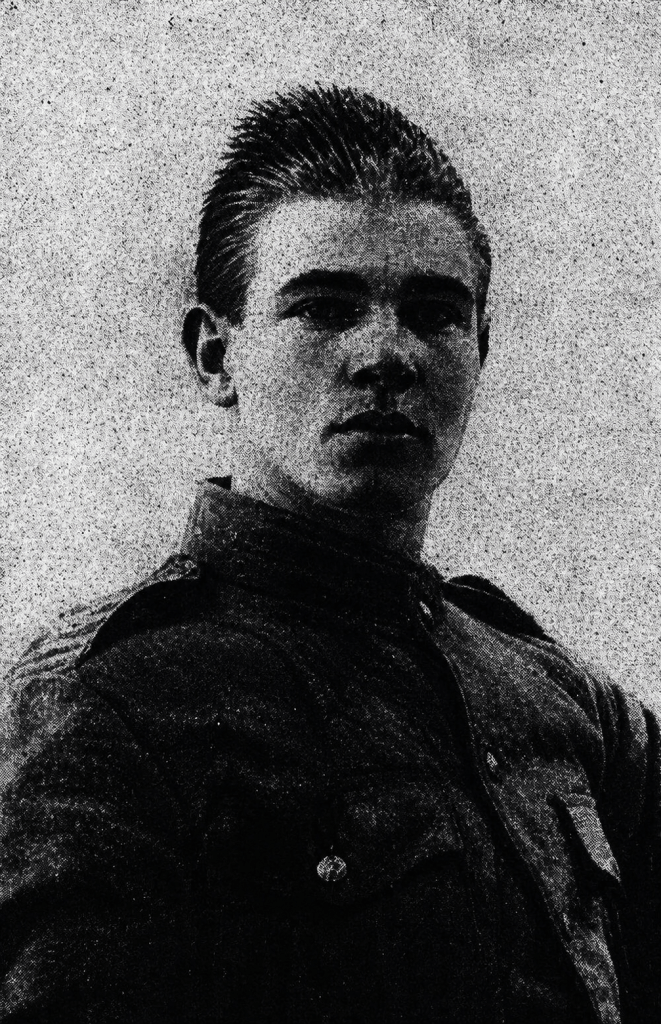

Private William Cockerton
(from britishnewspaperarchive.co.uk)
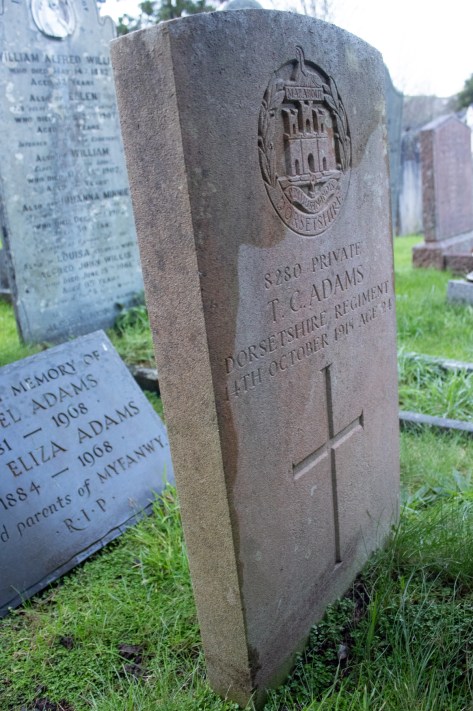
Private Thomas Adams

Private Thomas Adams

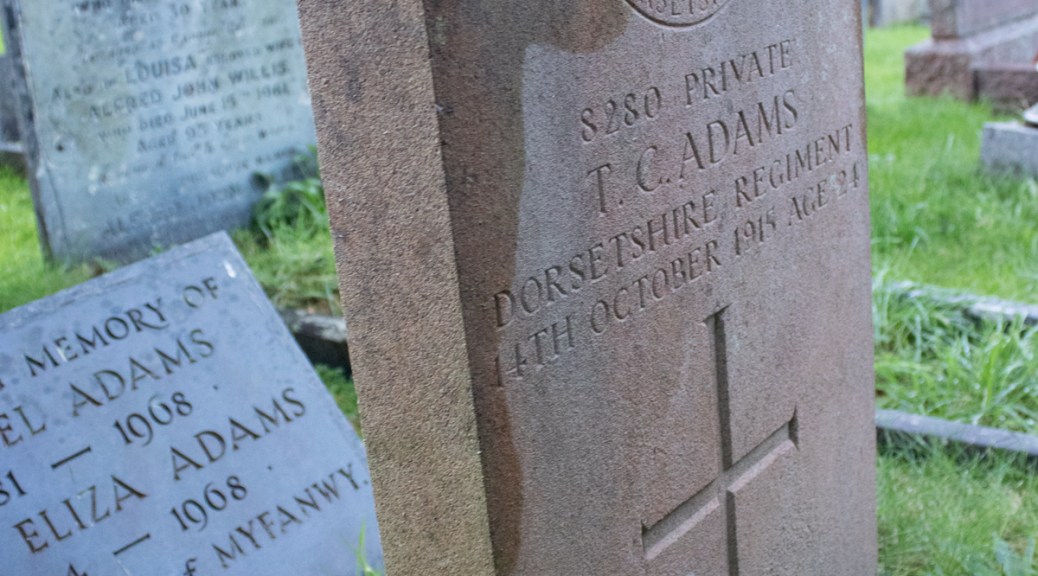
Thomas Charles Adams was born on 18th April 1891 in Ilfracombe, Devon. The oldest of four children, his parents were Thomas and Amanda Adams. Thomas Sr was a mason turned builder, but his son seemed keen to carve his own path in life.

On 5th October 1905, Thomas Jr enlisted in the Royal Navy. His papers show that he was 5ft 6ins (1.67m) tall, with dark hair, hazel eyes and a dark complexion. His time with the navy seems to have been brief, he was sent to HMS Impregnable for training, but was discharged on 9th November 1905, the reason given being “Invd”. Later documents suggest that he was dismissed because he was under the regulation chest measurement, but it was likely due to the fact that he had added two years to his age in order to be accepted.

Thomas returned home, and found employment as a fitter. He was not to be deterred, however, and joined the Dorsetshire Regiment as a volunteer. On 30th January 1907 he gave up his job, and enlisted in the army full time. Thomas’ papers give similar physical descriptions to his naval record, but also include his weight, 123lbs (55.8kg).

Private Adams was assigned to the 3rd Battalion, and spent the next two years on home soil. On 5th January 1909, however, the life of adventure he had wanted truly began. His unit was sent to India, and he would remain overseas for more than six years. His time overseas was not without incident, however, and he had four separate admissions to hospital with neuralgia (in April 1909), gonorrhoea (1910 and 1912) and malaria (in 1914).

By May 1915, Thomas was back in Britain. He was still having health issues, however, and he was admitted to Netley Hospital, Hampshire, suffering from tuberculosis. The condition would lead to his discharge from the army, and he was formally stood down on 15th June 1915.

At this point, Thomas’ trail goes cold. It is likely that he returned to his family, who were now living in Combe Martin, Devon. This is where he passed away, on 14th October 1915, at the age of 24 years old.

The body of Thomas Charles Adams was laid to rest in the graveyard of St Peter’s Church, Combe Martin.


Private Albert Search

Private Albert Search

Albert Search was born in Burford, Oxfordshire, in the autumn of 1891. One of thirteen children, he was the third son to William and Fanny Search. William was a farm labourer, and this is work into which Albert followed.

The 1911 census found the family living on Guildenford, close to the town centre and St John the Baptist’s Church. Three of the household were employed, three of the children were still at school, and they had a lodger – 71-year-old widower Steven Lange, who was also working on the farm.

On 15th August 1915, Albert married Annie Pearse. The same age as her new husband, she was also from Burford, and was the son of a cowman, possible connected to the same farm as her father-in-law. The couple set up home in Lawrence Lane, and went on to have a child, Albert Jr, who was born the following year.

Albert was called upon to serve his country some time after the wedding, and he joined the Gloucestershire Regiment as a Private. Assigned to the 3rd (Reserve) Battalion, he was soon sent to the Eastern Mediterranean. Private Search would spend more than two years there, but contracted malaria.

He was in hospital six months, and was afterwards invalided home for a month. He then returned back to his unit in Bristol, was sent back to hospital, and was discharged in 1920.

[Oxford Chronicle and Reading Gazette: Friday 9th September 1921]

Albert returned home to Annie and his son. When his health had recovered enough, he returned to farm work, and the 1921 census recorded him working on Tangley Farm. During that summer, however, his health deteriorated once more:

..on August 23 he was taken ill and died within eight days. Deceased was a native of Burford, where he was well known and highly respected.

[Oxford Chronicle and Reading Gazette: Friday 9th September 1921]

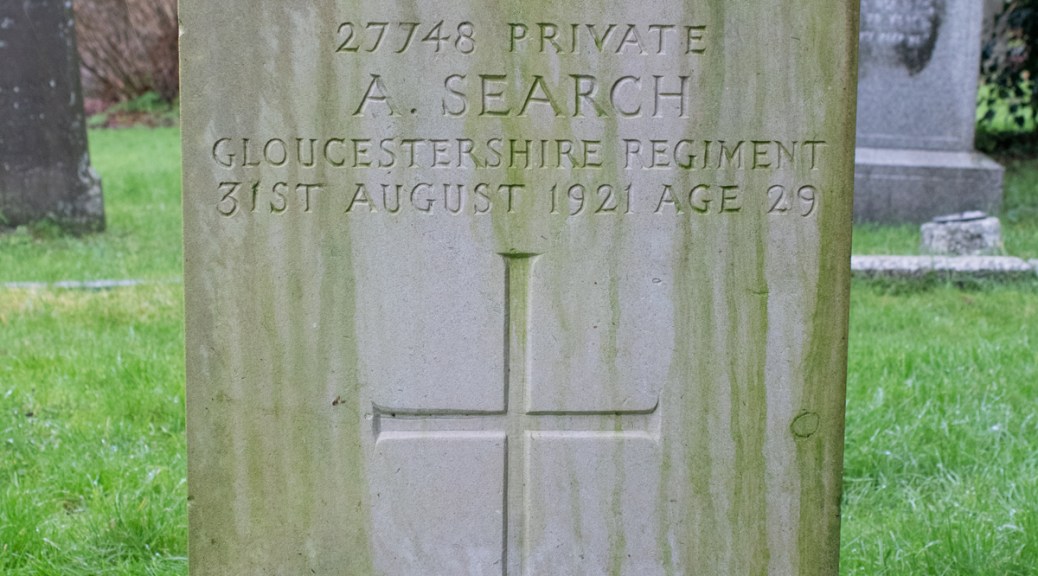
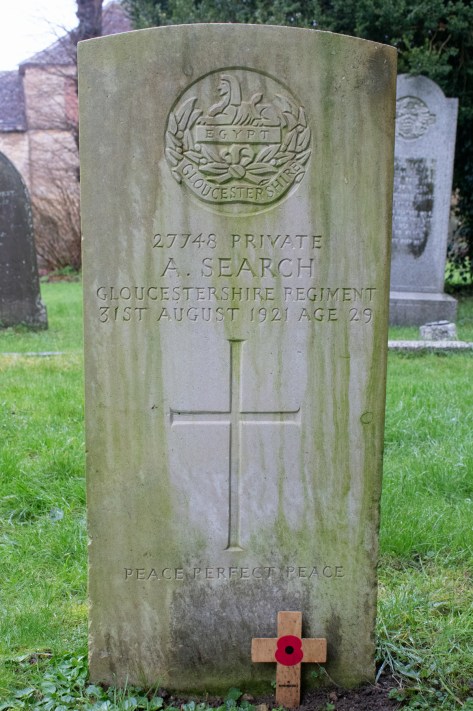
Albert Search was just 29 years old when he died. His body was laid to rest in the graveyard of St John the Baptist’s Church: this was where he had both been christened and married, and was at the end of the road from where his widow still lived.


In dying when he did, Albert became one of the last servicemen eligible for a Commonwealth War Grave.


Private Frederick Cox

Private Frederick Cox

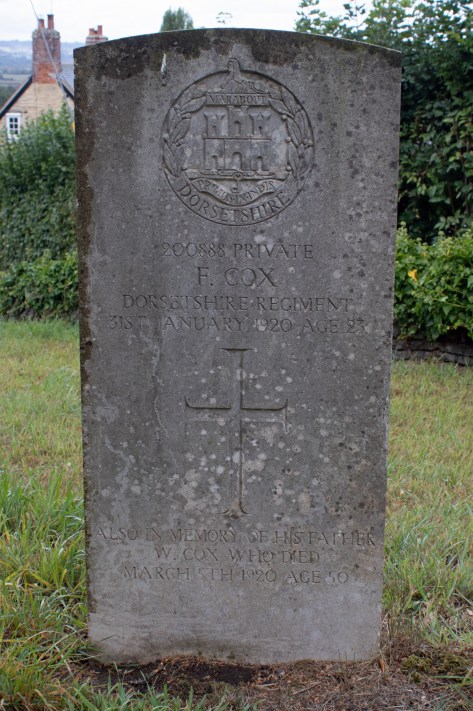
Frederick Charles Cox was born in the Dorset village of Kington Magna in the spring of 1897. One of seven children, his parents were agricultural labourer William Cox and his wife, Kate.

When Frederick completed his schooling, he also found work as a farm labourer. However, when war broke out, he was keen to play his part, possibly having seen his older brother, William Jr, also join up.

Unlike his sibling, Frederick enlisted in the Dorsetshire Regiment. His service papers have been lost to time, but it is clear that he took the role of Private, and that he was assigned to the 1st/4th Battalion. His unit began the war in India, but had moved to Basra in February 1916, remaining in Mesopotamia for the remainder of the conflict.

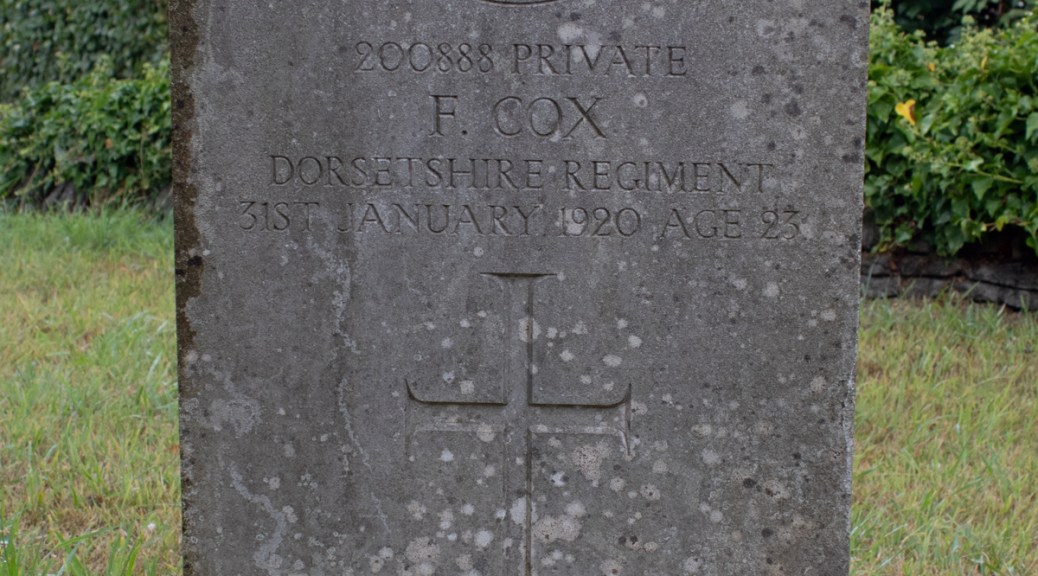
Private Cox survived the war, and had returned home by the end of 1919. His time in the army would impact his health, however, and during the winter of 1919/20, he came down with malaria, a condition which would prove fatal. Frederick passed away in hospital in Shaftesbury, on 31st January 1920: he was 23 years of age.

The body of Frederick Charles Cox was taken back to Kington Magna for burial. He was laid to rest in All Saints’ Churchyard, close to his brother, who had died a few years before.


Read more about Frederick’s brother William here.


Kate had lost two adult sons in a matter of years, and her tragedy was not to end. William Sr passed away less than five weeks after Frederick. He was buried close to his sons.


Corporal Frederick Short

Corporal Frederick Short

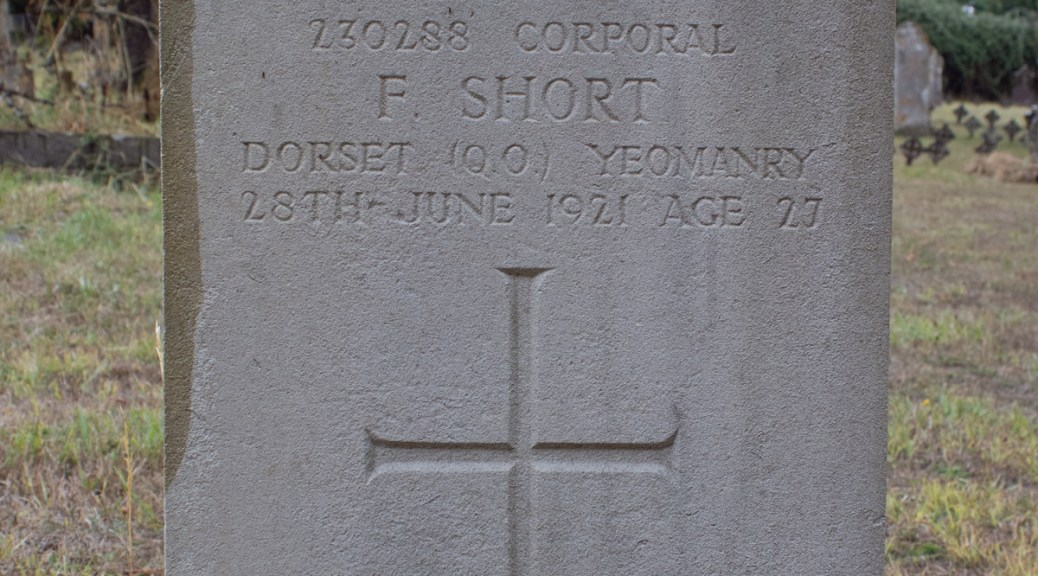
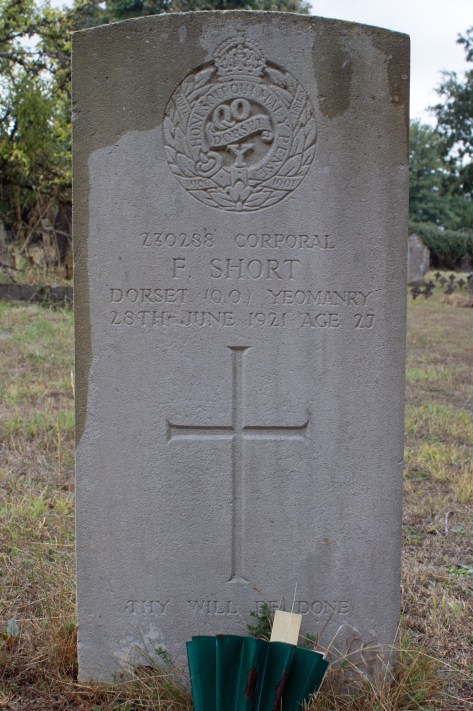
Frederick Short was born in Sturminster Newton, Dorset, in the spring of 1894. The oldest of five children, he was one of three sons to John and Martha Short. John was the caretaker of the village’s cemetery, and the family lived in a cottage on site.

When Frederick completed his schooling, he found work as a groom and, by the time of the 1911 census, he was boarding with John and Clara Binning in the village of Weare, Somerset.

War came to Europe in the summer of 1914, and Frederick was called upon to play his part. Full details of his military service have been lost to time, but it is clear that he enlisted in the Queen’s Own Dorset Yeomanry. By the end of the conflict, he had risen to the rank of Corporal.

Frederick survived the conflict, and returned home. At the start of 1919, he married Mabel Heritage, a soldier’s daughter from Somerton, Somerset. Her father, George, had died by the time of the 1901 census, and Mabel moved with her mother to Milborne Port, on the Somerset-Dorset border. The 1911 census found her working as a leather glove machinist, in a four-roomed cottage on Paddock Walk, to the north of the town centre.

The war had had a negative impact on Frederick’s health. The 1921 census shows him and Mabel visiting his parents in Sturminster: his occupation was given as unfit (formerly a groom). It was only a matter of weeks later that his condition worsened. Frederick passed away from a combination of malaria and heart disease on 28th June 1921: he was 27 years of age.

The body of Frederick Short was laid to rest in Sturminster Newton Cemetery, close to, and under the watchful eye of, his caretaker father, John.


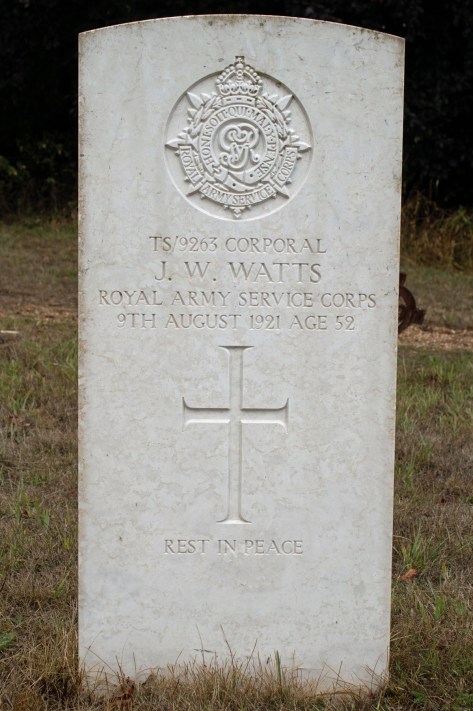
Farrier Corporal John Watts

Farrier Corporal John Watts

John William Watts was born in the summer of 1869, the youngest of six children to Reuben and Maria Watts. Reuben was a sawyer from Haselbury Brian, Dorset, and it was her that the Watts family were born and raised.

John seemed keen to progress himself, and found employment as a police constable. The 1891 census recorded him as living at the station in Blandford Forum. Three years later, he married Elizabeth Hallett, a shoemaker’s daughter from Lyme Regis. The couple would go on to have eight children before Elizabeth’s untimely death in 1912.

By this point, John’s career had taken a sharp turn: in 1901, when the family were living in Sturminster Newton, he was working as a blacksmith. The next return, taken in 1911, found them at 19 Church Street in the village, where John was employed as a journeyman shoeing smith.

With young children to raise, John took a new wife, marrying widow Rose Yeatman on 3rd August 1914. His oldest daughter, Elsie, and her father, Tom Bleathman, acted as witnesses. John and Rose would go on to have a daughter of their own, Muriel, the following year.

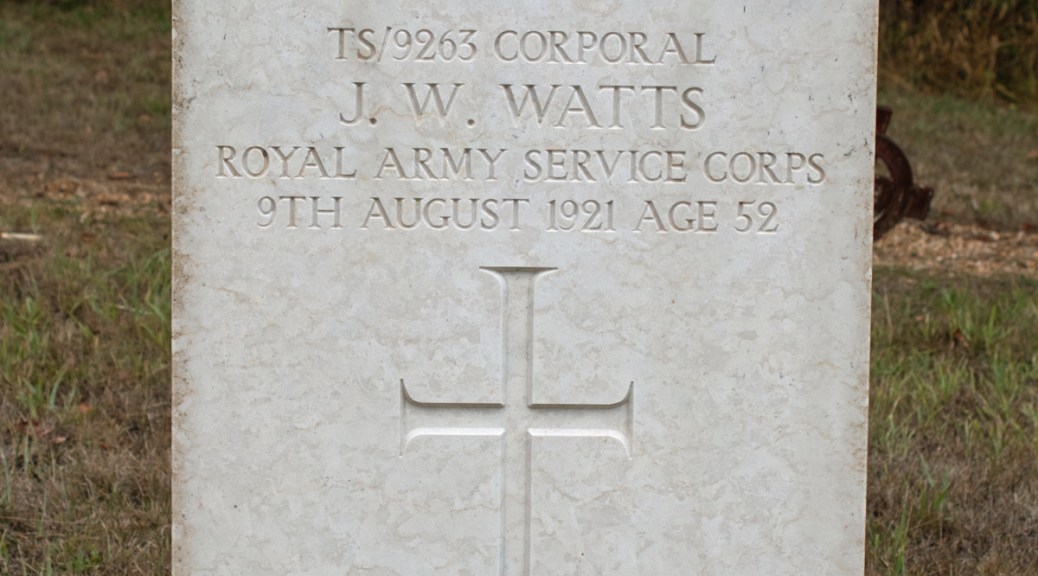
When war broke out, John stepped up to play his part. His service papers have been lost to time, but it is clear that he enlisted in the Royal Army Service Corps, and, presumably because of his age and experience, was assigned the rank of Farrier Corporal There is no indication that he served time outside of Britain, and it seems likely that he would have overseen the preparation of horses and training of blacksmiths for the Western Front.

Farrier Corporal Watts survived the conflict, but was medically discharged with malaria on 16th May 1919. The 1921 census found him living with Rose and five of his children and step-children in their Church Street home. He was employed as a bricklayer’s labourer, and was working for builder and contractor Mr J Silverthorne.

John’s health was suffering now, though, and he would only last until the summer. He passed away at home on 9th August 1921: he was 52 years of age.

The body of John William Watts was laid to rest in Sturminster Newton Cemetery, a short distance from his grieving family’s home.


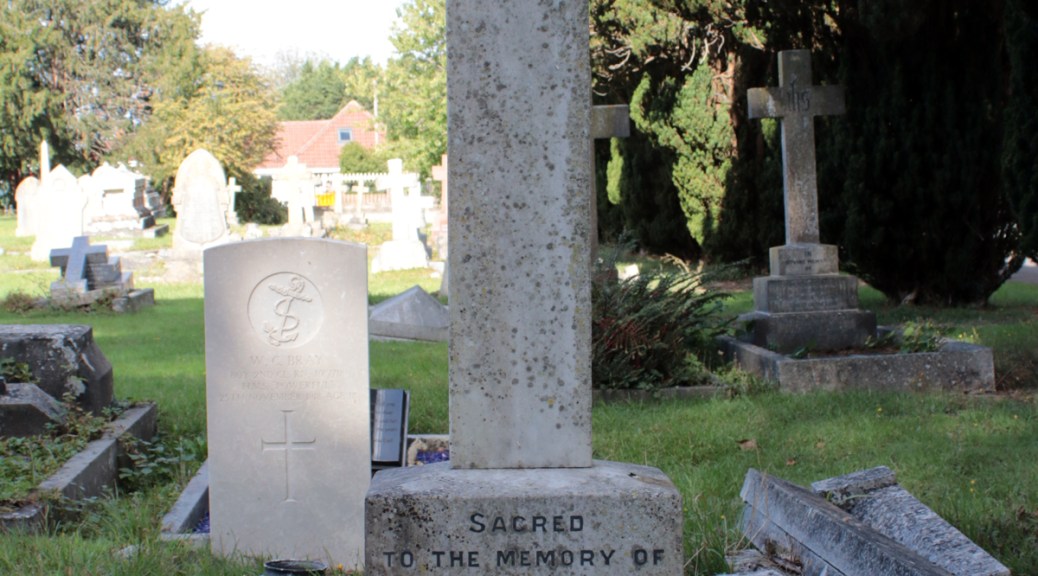
Leading Seaman William Coombes

Leading Seaman William Coombes

William Henry Marsh was born on 6th September 1879 in Whitstable, Kent. An only child, his parents were William and Maria Marsh, and, based on the census records, his early life seemed to have lacked some stability.

The 1881 census recorded William and his mother living on Beach Walk in the town. Marias was recorded as being a mariner’s wife. By 1891, William and his father was living with Maria’s sister and son. Still a mariner, with his son also working as a seaman, William Sr was listed as being a widower.

A decade on, and William Jr’s life had taken a different turn and the 1901 census listed him living on Whitstable High Street. Working as a labourer in the harbour, he is recorded as having a wife, Julia, and a two-year-old son, also William. Sadly, there is no further information about either of them.

The next document for William Jr is his First World War service papers. It shows that he enlisted on 10th March 1915, his previous time at sea making him an ideal candidate for the Royal Naval Reserve. His is noted as being 5ft 7ins (1.7m) tall, with blue eyes and a fresh complexion. He also had a tattoo of clasped hands on his right forearm. The most interesting thing about this document, however, is the fact that William had chosen to go by the surname of Coombes.

Given the rank of Leading Seaman, William would spend the next couple of years serving mainly on shore, at bases in London and Devonport. By the spring of 1918, while attached to the SS Eastville, he was admitted to the Royal Naval Dockyard in Chatham, Kent. Suffering from anaemia and malaria, the conditions would take his life. He died on 19th March 1918, at the age of 38 years old.

The body of William Henry Coombes was laid to rest in the naval section of Woodlands Cemetery, Gillingham, Kent, not far from the dockyard he would have known.


William’s will left £114 (around £8200) to his widow Julia, who was by now living in Leeds, Yorkshire. At his request, however his war pension, however, was given to his aunt, Mrs Rose Rout, of Hull, Yorkshire.


Chief Yeoman of Signals Charles Welling

Chief Yeoman of Signals Charles Welling

Charles James Welling was born on 23rd October 1860, and was the oldest of three children to Charles and Ann Welling. The Wellings were a military family, Charles Sr employed as a Serjeant Instructor of Musquetry in the Parkhurst Barracks on the Isle of Wight when his son was born.

Ann had been born in South Africa while her Irish parents were based out there. She and Charles Sr married in Farnham, Surrey, presumably where the families were based by that point.

Charles Jr’s mother died in 1863, just a month after giving birth to his youngest sibling. His father married again, to Sarah Ash, and by 1871, the Wellings were living in barracks at the School of Musketry in Hythe, Kent.

Being his father’s son, Charles Jr was set to make his own mark on the world and, on 21st January 1876, he joined the Royal Navy. Too young to formally enlist, he was given the rank of Boy 2nd Class, and sent off to HMS Impregnable, the shore base in Devonport, Devon, for his training.

Over the next eighteen months, Boy Welling learnt his trade, spending time at HMS Ganges – another shore base near Ipswich, Suffolk – and the sloop HMS Penguin. It was here that Charles came of age in 1878, and he officially joined the Royal Navy with the rank of Ordinary Seaman. His service papers show that he was just 4ft 10.5ins (1.49m) tall, with light brown hair, blue eyes and a fair complexion.

Ordinary Seaman Welling career was to take a turn in 1880, when he began training as a signaller. His initial contract with the navy was for ten years, and, by the time that came to an end in May 1889, he had served on eight ships in all, rising through the ranks from Signalman 3rd Class, to Signalman 2nd Class in August 1881 and Qualified Signalman seven years later.

When Charles’ term of service came to an end, he immediately renewed it, and with the new contract came a promotion to Leading Signalman. The next decade saw him travel the world, returning to HMS Pembroke, the Royal Naval Dockyard in Chatham, Kent, in between voyages. His commitment to the role paid off: in March 1894 he was promoted to 2nd Class Yeoman of Signals. Just eight months later he took the rank of Yeoman of Signals.

It was around this time that Charles married the love of his life, Harriet Carlaw. Born in London, the couple exchanged vows in St Pancras, Middlesex, on 13th January 1894 and had a son, also called Charles, the following year.

Charles’ naval career continued its upward trajectory, and on 1st March 1898, he was awarded the rank of Chief Yeoman of Signals. By this point HMS Pembroke had become his permanent base and, at the end of his contract in 1899, he was stood down to reserve status.

The 1901 census shows what may have been a downward step for the Wellings: it recorded the family living in rooms at 136 Bayham Street, Camden, Middlesex, where Charles was working as a messenger.

Opportunities come in the most unexpected of places, however, and the following census found them living at Pier House, Sunderland, Tyne and Wear, where Charles was employed as a lighthouse keeper.

By this point, Charles had been invalided out of the navy for medical reasons. The writing on his service papers is unclear, and his dismissal seems to have been as a result of disease of gestes, possibly the neurological disorder dystonia.

When war broke out in 1914, however, anyone with experience was called upon to play their part. Given his age at the time, it seems likely that Charles volunteered for service, reporting to HMS Pembroke on 2nd August 1914. He was given his old rank of Chief Yeoman of Signals, and remained at the naval base for the next two years.

Charles’ health was definitely suffering by this point, and he was admitted to the Royal Naval Hospital in Chatham, in September 1916. Suffering from the heart condition endocarditis, this would take his life. He passed away on 16th September, at the age of 55 years old.

With Harriet still living in Sunderland, Charles’ body was laid to rest in Woodlands Cemetery, Gillingham, Kent, not far from the base he had called home for so long.


Charles and Harriet’s son had also stepped up to play his part when war broke out. Enlisting in the Royal Engineers, Pioneer Welling soon found himself in the Middle East. While serving in Palestine, he contracted malaria, and passed away from the condition on 16th October 1918. Charles was just 23 years of age, and was laid to rest in Haifa War Cemetery.

It is tragic to note that Harriet had lost her husband and her son within two years.


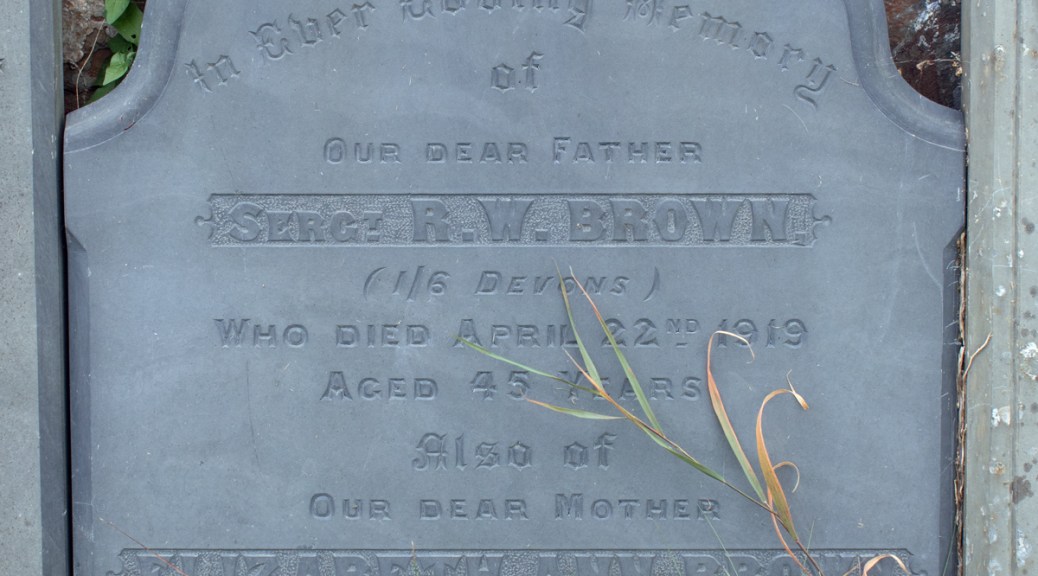
Sergeant Reginald Brown

Sergeant Reginald Brown

Reginald William Brown was born in South Molton, Devon, the summer of 1873. The second of four children – all boys – his parents were William and Mary Brown. William died when Reginald was just a child, and the 1881 census found Mary supporting her children by working as a mangler.

Details of Reginald’s early life are sparse. In the autumn of 1898 he married Elizabeth Mayne and the couple set up home at 13 Cook’s Cross. The couple went on to have six children, and Reginald supported his family with work as a gardener.

Alongside his gardening work, Reginald volunteered for army service. Again, full details are unclear, but he was attached to the Devonshire Regiment from 1908. Initially for a year’s contract, he seemed to renew this on-and-off for the next six years.

When war broke out, Reginald was formally called into service. HIs time in the army resulted in him being given the rank of Sergeant, and by October 1914, his unit – the 4th Battalion – was sent to India.

Reginald spent the next couple of years overseas, before being posted back to Britain in the spring of 1916. That November he spent six weeks admitted to the Manor County of London War Hospital in Epsom, Surrey, suffering from bronchitis. This was the result of malaria, and he would continue to suffer from lung complaints for the next few years.

In September 1917, Elizabeth passed away, and Reginald was left, at a distance at least, to raise his children. By now, his health was being severely impacted, and in April 1919, he was medically discharged from army service.

Reginald returned home, but he would quickly succumb to illness. He passed away at 43 South Street, South Molton, on 22nd April 1919. He was 45 years of age.

Reginald William Brown was laid to rest in South Molton Cemetery. His was a family plot, and he was reunited with his beloved Elizabeth.


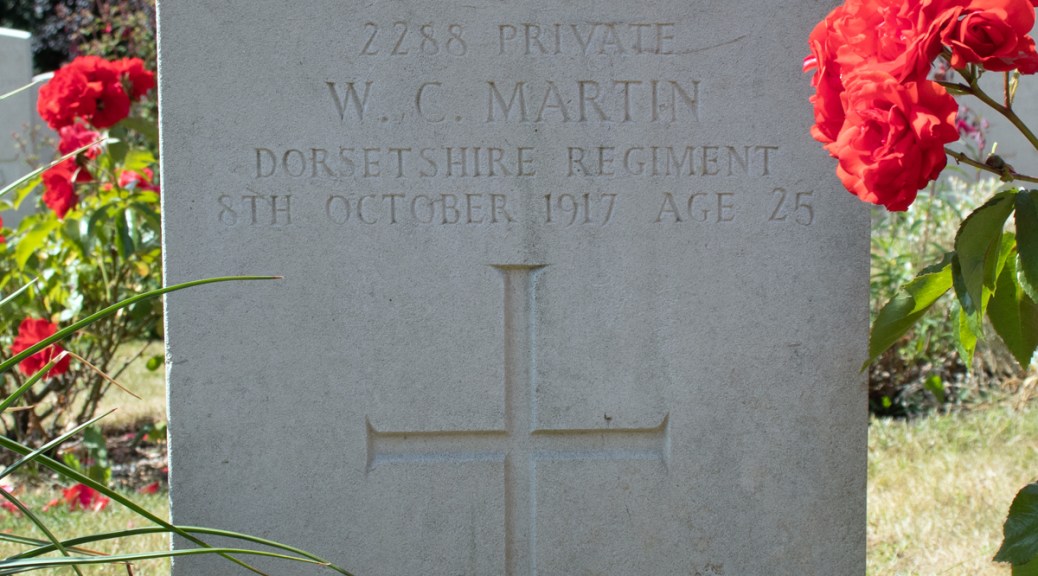
Private Willie Martin

Private Willie Martin

Willie Cyril Martin was born in December 1891 in the Dorset village of Almer. The son of Elizabeth Martin, his mother would go on to marry Edward Holloway nine years later, although it is unclear whether he was Willie’s father.

When he finished his schooling, Willie found work as a kitchen porter, and this led him to the Dorset coast. The 1911 census found him boarding with 35 others at Pryory Mansions in Bournemouth.

When war broke out, Willie stepped up to play his part. He enlisted on 9th October 1914, joining the Dorsetshire Regiment. Assigned to the 4th Battalion, his unit was soon sent to India, moving to the Middle East over the following years.

By the autumn of 1916, Private Martin was back in Dorset. On 7th November he married Edith Williams at St Clement’s Church in Bournemouth. She was the 26-year old daughter of a gas fitter, and the couple’s marriage certificate sheds some light on Willie’s background as well. It gave his father’s name as Richard Martin (deceased), who was a butler, although there is no other information to substantiate this, and Elizabeth had passed away some years before, so could not back up or refute the suggestion.

Private Martin returned to duty after his wedding. At some point he transferred to the Labour Corps, and was attached to 644 Company. His re-assignment may have been down to medical issues – he had contracted malaria while serving overseas – and by the autumn of 1917, he was sent to hospital because of his deteriorating health.

Willie was admitted to Bath War Hospital in Somerset, suffering from a bout of malaria. The condition was to get the better of him, and he passed away on 8th October 1917, from a haemorrhage on his lungs. He was 25 years of age.

Willie Cyril Martin was laid to rest in the military section of Bath’s sweeping Locksbrook Cemetery, not far from the hospital in which he passed away.