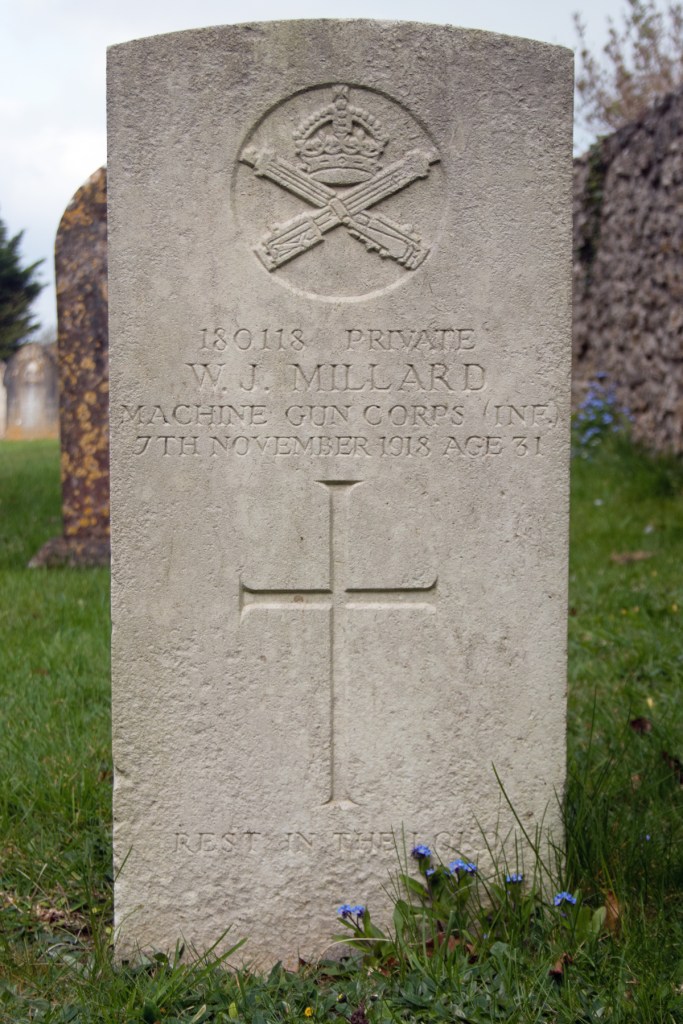
Walter John Millard was born in the summer of 1887, the youngest of nine children to Robert and Elizabeth. Robert was a farmer, and brought his family up in the village of Wedmore, Somerset. Walter followed in his father’s footsteps, and by the time of the 1911 census, was listed as a farm labourer in Wedmore, working for a William Millard, who presumably was a cousin of the family.
In March 1915, Walter married Jessy Masters, daughter of a grocer in nearby Wells. The couple set up home in the neighbouring village of Wookey, but would later make their home in Westbury-sub-Mendip.
In December 1915, aged 28, Walter was called up, and assigned to the Reserve Machine Gun Corps. He was not formally mobilised for almost three years when, in October 1918, he was shipped to Rugeley, Staffordshire, for training.
During this time, Private Millard was taken ill, and was admitted to the Military Hospital at Cannock Chase within weeks with influenza. His health deteriorated and, on 7th November 1918, he died from pneumonia. He was 31 years of age.
Had it not been for the quirk of fate of having been mobilised a month before the war ended, tragically, this would likely not be a story that needed to be told.
Walter John Millard was brought back to Somerset, and lies at rest in the graveyard of St Lawrence Church in Westbury-sub-Mendip.
John Henry Armes was born in Cannock, Staffordshire in 1881. One of eight children to Richard and Mary Armes, his father was a colliery worker and labourer. After their mother’s untimely death in 1890, this was a trade into which his three boys – Richard Jr, John and Alfred – followed.
The 1901 census finds John living with his widowed father and working as a coal hewer. A year later, he married Caroline Caldwell and, by the outbreak of the war, the couple were living in Ilkeston, Derbyshire with their growing family of seven children.
Records of John’s enrolment are not evident, but it is likely to have been later in the war, rather than earlier, given that his trade was one of those protected from enlistment.
By 1915, Caroline had given birth to the couple’s seventh child and John had signed up to the King’s Royal Rifles, stationed at the fort in Grain, North Kent.
Rifleman Armes’ pension record shows that he was accidentally killed on active service, and the contemporary media pick up the story.
[He] had been on outpost duty. On coming off duty about half-past seven on Monday morning he placed his rifle in a rack in a hut, and went to breakfast. Another rifleman names John Bathams Olliff, picked up the rifle to unload it, but having trouble with the extractor he took the magazine of the rifle out, and then thinking all the cartridges were in the magazine he pressed the trigger to close the bolt of the rifle, and a shot went off. At that moment Rifleman Armes came round the door of the hut and received a bullet in the chest.
Exclaiming, “My God, Armes is here,” Olliff rushed to his assistance, and Armes said “I am done for. It was an accident.” Medical aid was telephoned for, but Armes died shortly after the doctor arrived.
Est Kent Gazette: Saturday 5th February 1916
An inquest was held, which found that the two Johns were great friends and had asked to serve together. The jury exonerated John Olliff from blame and recorded a verdict of accidental death.
John Henry Armes died at the age of 34, likely without seeing his youngest child. He lies at rest in St James’ Churchyard in the village of Grain in Kent, close to the barracks where he lost his life.
There are a couple of other protagonists in this story.
John’s widow, Caroline, married again later in 1916, to a George Chapman. She went on to live to the age of 77, outliving three of her children and both of her husbands.
John Battams Olliff, who had accidentally shot John, was born in London in 1880. The son of a butcher, he had emigrated to Canada in 1911. John returned to the UK to fight in the war, joining the King’s Royal Rifles in May 1915. Little information about his post-war survives, but it appears that he remained in England. There is no record of him marrying, but he died in 1938, at 58 years old.
When carrying out research on the Commonwealth War Graves, information remains tantalisingly elusive.
Sometimes just you can chance upon one document and the life of the person behind the name is laid out in front of you.
But in the majority of cases, the someone’s history has to be pieced together from a combination of sources.
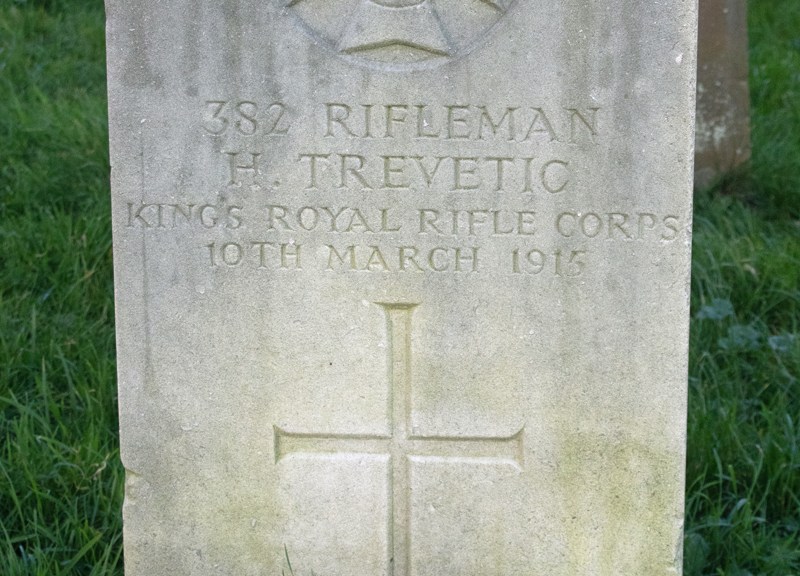
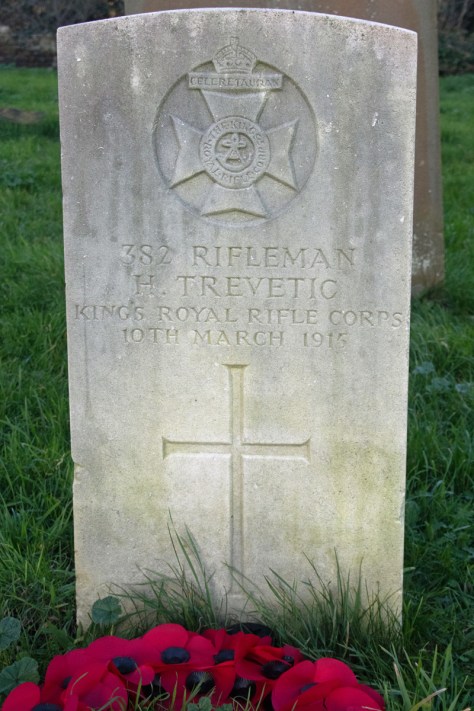
Henry Harry Trevitic was born in around 1879 in Burton-upon-Trent, Staffordshire.
There are no records of Trevetics in and around that area at that time, nor are there any permutations of his surname – Trevethick or Trevithick, for example.
The first evidence I have found of Harry is on his military service records. He enlisted in the King’s Royal Rifles in August 1897, listing himself as a ‘cycle fitter’. The document asks if the applicant has previously served in the armed forces; Harry’s reply is that he is in the militia – the 4th Worcestershire Regiment.
Rifleman Trevetic’s military career is extensive; his records show continual service in the King’s Royal Rifles from 1897 to his death in 1915. This included three years in South Africa, two in India and eight months as part of the British Expeditionary Force within weeks of the outbreak of World War One.
The 1901 census finds Rifleman Trevetic at a convalescent home in Hanbury, near Droitwich, along with eleven other soldiers. He is marked as a Visitor, rather than a Resident, so it can be assumed that the owner of the home, whose brother is party of the military party, has put them up for the night (or longer).
Harry next turns up in 1902 when, in December, he married Frances Boyes in Southampton. His military career continued, however, and moving to the 1911 census, and Rifleman Trevetic is barracked in Woolwich. He is listed as married, while Frances is also based in the town, in female quarters.
While the details of his early life are pretty scarce, those surrounding his passing are much more in depth. Because of the circumstances, an inquest into his passing was ordered into his death; this included four pretty in-depth witness statements.
In January 1914, Rifleman Trevetic was appointed as an assistant to Captain Adjutant Makins in Winchester. In August of that year he was shipped with Makins to France and remained his servant.
On 14th September, Captain Makins was badly injured, and Harry helped carry him to the church in the village of Soupir in France, which was acting as a dressing station.
In Makins’ own words “there were 300 wounded closely packed, occupying the whole of the floor space. The groans and the smell, night and day were most distressing. Fresh wounded were constantly being carried in and dead carried out. Shell fire was constant and the general conditions were such as would severely try a highly strung man. During all this time, [Rifleman Trevetic] was my only attendant.”
Makins was moved to various hospitals in France, always accompanied by Rifleman Trevetic and eventually invalided home. Given the seriousness of Captain Makins’ injury, he was permitted to bring Harry back home with him.
On 1st March 1915, Captain Makins was passed fit for general service, and rejoined his battalion, along with his servant. Conscious that he may be sent back to the Front at any point, he warned Harry to be prepared for France again.
Captain Makins’ testimony takes up the tragic story.
On March 9th, he came to me and asked if I would see the Doctor on his behalf privately. He told me that every since his time in the dressing station at Soupir, his nerves had been ajar, and that he could neither eat nor sleep. He asked whether I could get the Doctor to do something for him, as he feared if he went sick in the ordinary way, he would be passed unfit for the front, and be unable to accompany me there, which he was very keen on doing.
Later in the day he came to me and asked me to take no notice of what he had said in the morning, that as a matter of fact he had taken to drink, which was the true cause of his trouble, and that he was entirely giving it up and would be right within a week.
His whole manner was strange and he appeared under the impression that I had discharged him. This was the first intimation I had of any strangeness in his manner.
Being busy I did not pay the attention to it that perhaps I should, more especially as I knew him to be a thoroughly sober and reliable man.
The following day he called me as usual.
About 8:30 am I was called from the mess and asked to proceed to my room at once. On arrival, I found the door locked, and various Officers’ servants outside. The key was on the inside of the door but so turned that the body of Rifleman Trevetic could be seen through the keyhole lying on the floor.
I broke open the door and found Rifleman Trevetic shot through the heart, my revolver lying by his side. The revolver contained one empty shell, I cannot say where this was obtained. There were a few rounds of ammunition in the room, but the marks did not correspond nor am I able to trace any similar ammunition in the Fort.
Captain G Makins’ statement, Inquest from Rifleman Trevetic’s service records
Three other servicemen gave statements into the tragic events of that day, and all summed up Harry’s demeanour in the same way as Captain Makins.
Rifleman Trevetic has throughout his service to me, been a model servant, and had during my time in hospital not only been invaluable to me, but also to the hospitals themselves. He was very happily married, and constantly spoke affectionately of his wife and as far as I can tell, was in no financial difficulties.
Captain G Makins’ statement, Inquest from Rifleman Trevetic’s service records
The inquest found that his death was self-inflicted and “at the time he shot himself he was temporarily insane, and that his mental condition was clearly caused by what he saw and went through when on Active Service in France, and that there was no other contributory cause.”
Temporary insanity, shell shock, war neurosis, combat stress, cowardice; however it was badged Post Traumatic Stress Disorder is commonly recognised these days, but was frowned upon in the Great War.
Sadly, while appearing eager to accompany his superior, it seems that the thought of actually returning to the Western Front was so terrifying to Rifleman Trevetic, that he felt there was only one route out. He was 36 years old.
Harry Trevetic lies at rest in the quiet graveyard of St James’ Church on the Isle of Grain, metres from the fort where he ended his life.
Harry’s widow Frances lived on. Whilst there was no mention of her husband’s death in the newspapers of the time, she received a handsome war gratuity and a pension that reflected Harry’s long service. She went on to marry again in 1917, to Jack Finch, a Sergeant in Harry’s battalion.
Given the stigma around mental health in the early twentieth century, and, it is amazing that the documents have survived as part of the Harry’s military records. The inquest into his death was carried out within days of his passing, and I find the findings of the report forward thinking in the way that it was written.
Harry was obviously a man who experienced way more than his mind was able to cope with – the trauma of that dressing station must have been so much worse than he had seen before during his two decades’ military service. But the report is clear in that it apportions blame for his death on the fighting and bloodshed in France; this was clearly out of character for Harry, and it was his experiences in the field of battle that drove him to his death.
What is less clear is how much Frances was told of his death. While the inquest was decisive, suicide was as much of a stigma as shell shock at that time. Would the King’s Royal Rifles have be honest with her about how he died? Or, while they where internally open, would they have pulled ranks around their own and protected Frances from the truth and themselves from rebuke?




 Death and Service