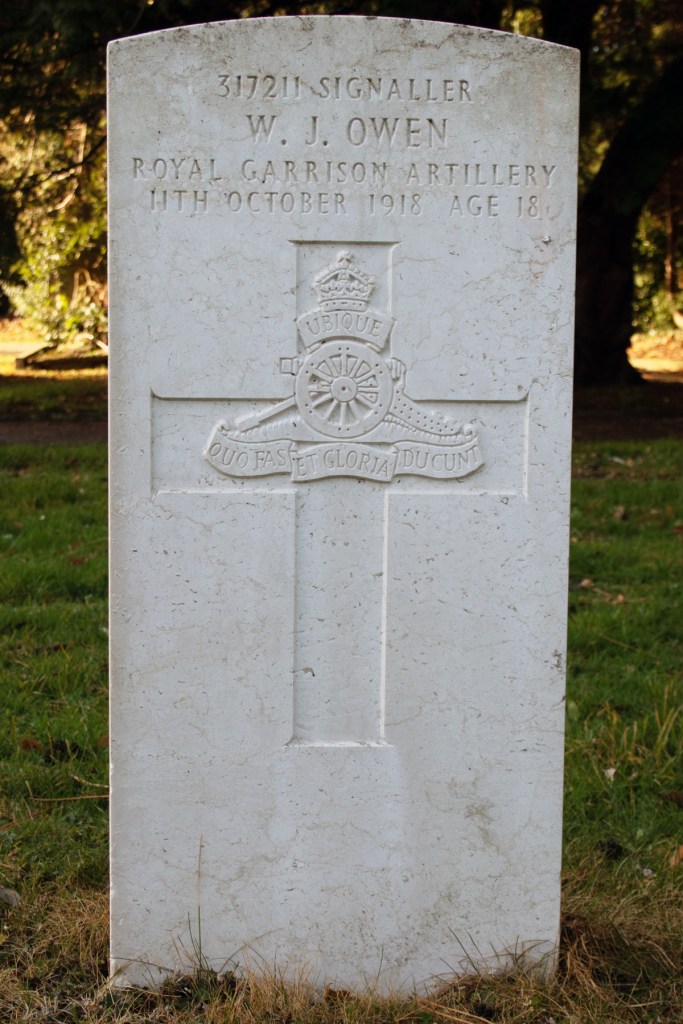
William John Owen was born in the spring of 1900, and was one of thirteen children to Henry and Emma Owen. Henry was an oyster dredger turned coal porter from Faversham in Kent, and this is where the family were born and raised.
There is little concrete information about William’s life, but it is clear that, by April 1918, he had joined the Royal Garrison Artillery, and was assigned to the 2/1st Kent Heavy Battery. Signaller Owen was sent to Larkhill Camp in Wiltshire for training.
The only further information is that William was admitted to the Fargo Military Hospital on Salisbury Plain, suffering from pneumonia. Sadly the lung condition was to get the better of him: he passed away on 11nd October 1918, aged just 18 years old.
William John Owen was brought back to Kent for burial. He was laid to rest in Faversham Borough Cemetery, just a few minutes’ walk from his family home.
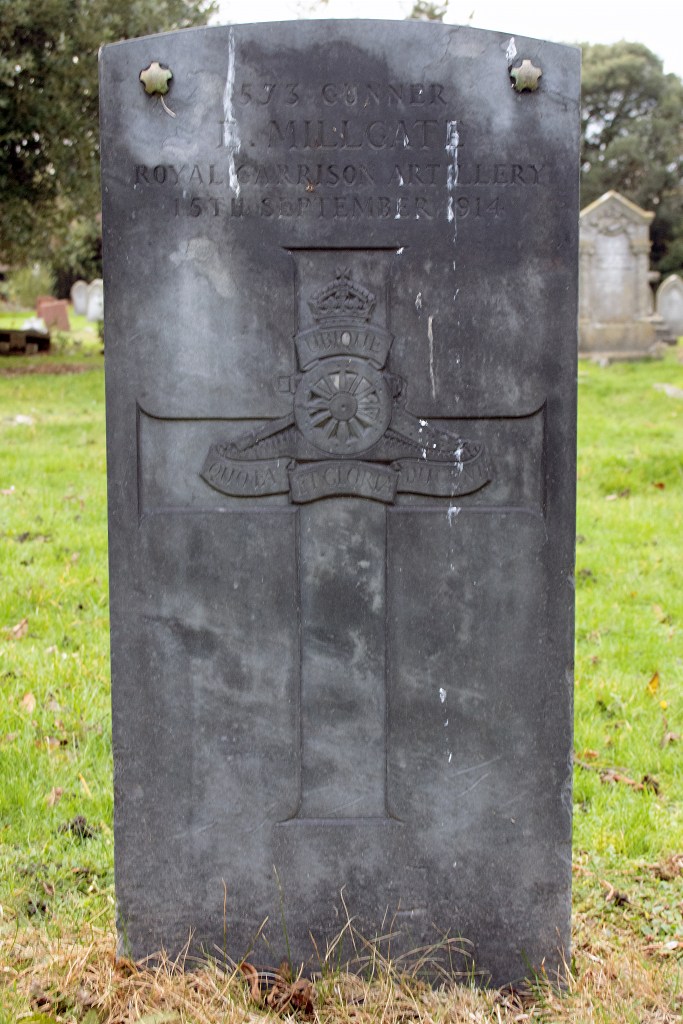
Ernest Millgate was born in late 1893, the fifth of six children to Henry and Agnes. Henry was a brewer’s drayman from Boughton, Kent, but it was in nearby Faversham that he and Agnes raised their family.
Ernest found work as a labourer in the town’s Cotton Powder Works, but when war was declared, he was one of the first to enlist. He joined the Royal Garrison Artillery as a Gunner on 5th September 1914, and was billeted nearby on the Isle of Sheppey. His service records show that he stood 5ft 9ins (1.75m) tall, had fair hair, blue eyes and a fresh complexion.
Gunner Millgate’s military service was to be tragically short, as a contemporary local newspaper was to report:
A terrible tragedy occurred at Minster, Sheppey, on Tuesday morning last, Ernest Millgate… who joined the Kent Heavy Battery barely a fortnight ago, being accidentally shot by a comrade, George Walter Cornelius… a gunner of three years’ service in the same Battery.
Gunner Cornelius, it appears, was handling a rifle preparatory to going on sentry duty shortly after eleven o’clock on Tuesday morning. On examining the rifle he had found that the magazine was charged but that there as no charge in the bore. Apparently the cut-off was in operation, for he pulled the trigger and there was no discharge. He examined the breech a second time and, afterwards pulled the trigger again. To his dismay there was this time a discharge and Millgate, who was standing near, fell dead, having been shot through the head. The theory is that Cornelius’ great coat, which he was wearing, caught in and released the cut-off, thereby bringing the magazine into operation.
Faversham Times and Mercury and North-East Kent Journal: Saturday 19th September 1914
An inquest was held, and it was a verdict of accidental death was given.
Gunner Ernest Millgate was just 21 years old, and had been in the service of the army for just eleven days. His body was brought back to Faversham, and he lies at rest in the town’s Borough Cemetery, just a few minutes walk from the home he had left just a fortnight before.
The same newspaper also ran a report on on Ernest’s older brother, Henry.
Private Millgate was a volunteer for the Northumberland Fusiliers, and was called into active service a couple of weeks before his brother. He had been caught up in the fighting at Mons, le Cateau and the Marne, and was, according to the newspaper, injured.
Medically evacuated to England for treatment, at the time of his brother’s funeral he was in a hospital in Newcastle-upon-Tyne.
Henry survived the war; he and his wife, Elizabeth, had two children, and he lived until 1939, passing away at the age of 52 years old.
Frederick Brooks was born in the spring of 1897, the ninth of eleven children to Stephen and Grace Brooks. Stephen worked as a woodsman in Bredhurst, Kent, a trade his eldest sons followed him into.
Yewtree Cottages in Bredhurst, home to the Brooks Family
Frederick’s service records show that, when he enlisted in nearby Rainham, he was working as a fence maker. He was 5ft 6ins (168cm) tall, weighed 143lbs (65kg) and had fair physical development. He joined up in September 1915 and was assigned to the 2/1 Company Kent Royal Garrison Artillery.
Gunner Brooks’ early service was on home soil as part of the Territorial Force. However, he was transferred overseas as part of the British Expeditionary Force on 10th March 1917, where he served for nearly two years.
Frederick fell ill in January 1919, and was brought back to the UK for treatment. He was admitted to the Weir Red Cross Hospital in Balham, London, with bronchial pneumonia. He succumbed to heart failure just a few days later, on 4th February 1919. He was just 21 years old.
Gunner Frederick Brooks lies at rest in a peaceful corner of the secluded graveyard of St Peter’s Church in his home village of Bredhurst.
Frederick’s life throws a couple of coincidences my way. I used to live within spitting distance of his village, Bredhurst, and, indeed, have driven past his family home countless times. I also happened to have been born in the same hospital – the Weir in Balham – where Frederick had passed away 53 years earlier.





 Death and Service