
Category Archives: Life Guards

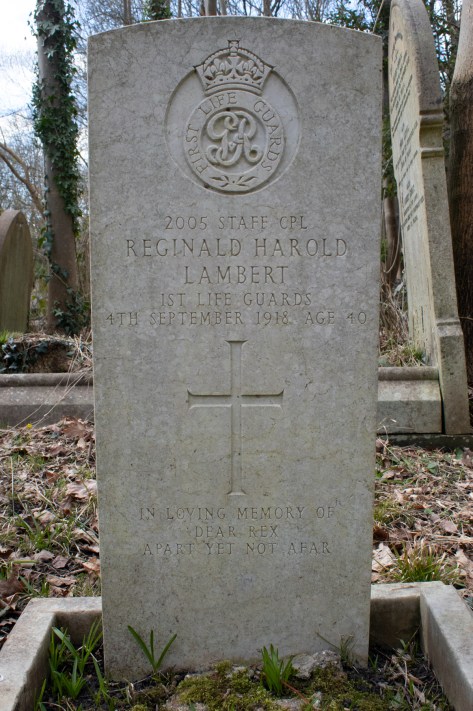
Farrier Staff Corporal Reginald Lambert

Farrier Staff Corporal Reginald Lambert

Reginald Harold Lambert was born in the spring of 1878 in Hurstpierpoint, Sussex. One of eight children, his parents were Henry and Elizabeth Lambert. Henry was a surgeon dentist, who had five more children from first marriage, giving Reginald a total of twelve siblings.

When Reginald finished his schooling, he took up work as a dental assistant, presumably under his father’s tutelage. Away from this, he volunteered for the Royal Sussex Regiment, and the military life drew him in. On 8th July 1897, he joined the 1st Life Guards: based in London, he took on the role of Farrier, tending to the regiment’s horses and looking after their hooves in particular.

On 25th April 1909, Reginald married Lilian Burns at St George’s Church in Tufnell Park, Middlesex. There is little information about her background, but she was the daughter of a grocer and, at 38 years old, seven years her new husband’s senior.

As the point of his marriage, Reginald was listed as a Corporal, and gave his address as Knightsbridge Barracks. By the time of the 1911 census, however, he and Lilian had set up home in second floor rooms at 6 Princess Road, Camden.

When war broke out in 1914, Corporal Lambert was called upon to play his part. His service records are long since lost, but the 1st Life Guards fought in some of the key battles of the conflict: at Ypres in both 1914 and 1915, at Loos in 1915, and at Arras in 1917. Exactly where and how Reginald served, however, is unknown, but by the end of the war he had risen to the rank of Farrier Staff Corporal.

The next record for Reginald is that of his death, which was registered in Islington, Middlesex. It seems likely that he either returned home, or was hospitalised close to home. He passed away through illness on 4th September 1918, at the age of 40 years old.

Reginald Harold Lambert was laid to rest in Highgate Cemetery, not far from where his widow still lived. His epitaph gave a nod to her pet name for him: In loving memory of dear Rex. Apart yet not afar.
Trooper William Rhodes

Trooper William Rhodes

William Henry Rhodes was born in the summer of 1886 and was the youngest of six children. His father Reuben was a gardener who, with his wife Ellen, raised their family in a small cottage near the central station in Worthing, West Sussex.

When he left school, William found work as an assistant in a bookshop. This was just a stepping stone, however, and his mind was on a life of adventures. In March 1908, he enlisted in the army, joining the Household Cavalry, and was assigned to the 1st Life Guards. William’s medical report showed that he stood at just under 6ft (1.83m) tall, and weighed 141lbs (64kg). He had a fresh complexion, grey eyes and brown hair.

Trooper Rhodes was initially based on home soil; his barracks were in London and he served in Hyde Park, Regents Park and at Windsor, where he would have been called upon to be involved in royal duties that would have taken place. This changed when the Great War broke out, however, and his division was sent out to northern France as part of the British Expeditionary Force.

The 1st Life Guards were involved in the First Battle of Ypres, and went on to fight in many of the fiercest battles of the conflict. His service record identifies that he was wounded in February 1915, when he received a gunshot wound to the head, although, surprisingly, there is nothing in his medical record that suggests any subsequent hospital admission.

In fact, Trooper Rhodes did receive hospital treatment during his military service; he was admitted for bronchial catarrh in April 1908 and May 1909 and headaches in June 1911. Four years later, he contracted tuberculosis while in action in France, and moved back to London for treatment.

William’s condition was serious enough for him to be medically discharged form the army; having spent more than a month in hospital, he was released from duty on 31st August 1915.

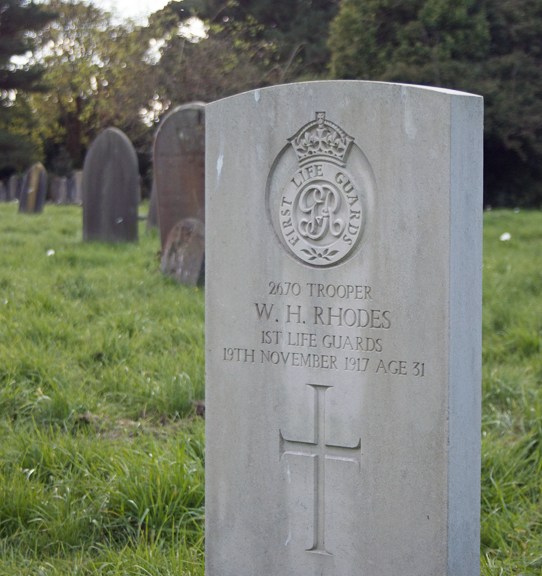
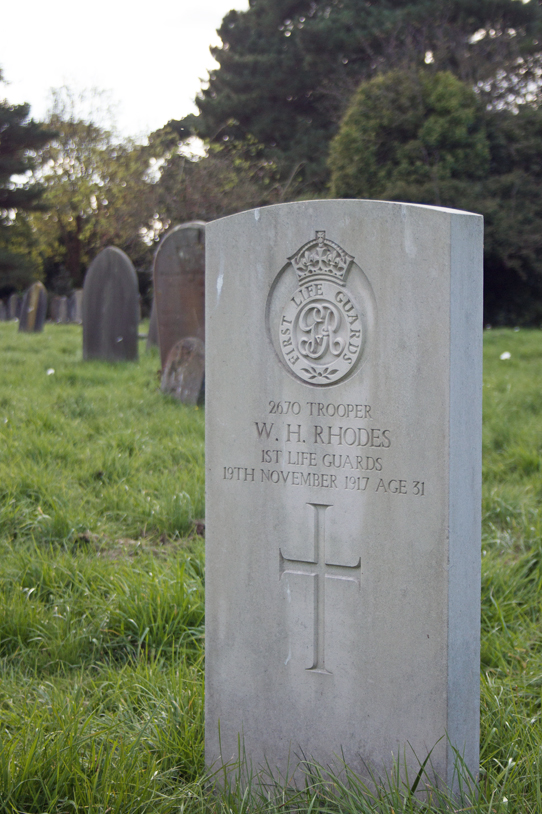
There is little further information about William’s life back home. The next document on him confirms that he died on 19th November 1917. While the cause is not noted, it seems likely to have been connected to the lung conditions he suffered during the war. William was 31 years of age.

William Henry Rhodes was laid to rest in Broadwater Cemetery in the town of his birth, Worthing, West Sussex.