Category Archives: Royal Inniskilling Fusiliers

Private Rondaine Cary

Private Rondaine Cary

Rondaine Tristram Cary was born in Lancashire in the autumn of 1896 and was the oldest of two children to Henry and Wilhelmina. Henry was an insurance agent, and, by the time of the 1901 census, the family had moved to the parish of Linsfort in County Donegal, Ireland. This is near where Wilhelmina had been born, so it seems likely that the draw of family had been partially responsible.

The 1911 census found the Carys living a few miles down the road, in Buncrana. Rondaine was listed as being a scholar, while his younger brother, five year old John, completed the family setup. John was employed as a commission agent, and all four members of the household were listed as being Episcopalian.

When war came to Europe in 1914, Rondaine was keen to play his part. He seems to have enlisted almost at once, joining the Royal Inniskilling Fusiliers. Assigned to the 11th (Service) Battalion (Donegal and Fermanagh), Private Cary was sent to Ballymena, County Antrim, for training.

Rondaine had only been in the camp for a matter of weeks, when he contracted measles. He was admitted to a hospital in Ballymena on 17th February 1915, but his condition worsened, and his father came to visit. Private Cary passed away on 27th February 1915, aged just 18 years of age.

The Cary family seemed unable to afford the cost of bringing their son’s body back to Buncrana. Instead, the local authority paid for Rondaine Tristram Cary’s coffin and funeral at Ballymena Cemetery, while his army colleague funded his headstone.


Private Charles McManus

Private Charles McManus

Charles McManus was born in Ballymena, County Antrim, in 1891. The middle of three children, his parents were John and Maryann McManus. John was a horse dealer: when they finished their schooling Charles’ older brother, John Jr, found work as a hawker.

Maryann died in 1907, aged just 47 years of age. The next census record, in 1911, found John Jr living with his wife and family in Ballymena, while John Sr was boarding with a fishmonger elsewhere in the town. Alexander, Charles’ younger brother, was a pupil at an industrial school in Dublin, but Charles himself is missing from the census return.

John Sr passed away in 1913, at the age of 53 years old. Charles was 22 years old and an orphan. The following year war was declared, and Charles was one of the first to step up and serve his country. He joined the Royal Inniskilling Fusiliers on 14th September 1914, and was attached to the 1st Battalion.

Full service records for Private McManus are lost to time. However, his unit was sent to Gallipoli in the spring of 1915, only to be evacuated from the region the following January. The 1st Battalion was then sent to France where it became entrenched at the Somme. For Private McManus and his colleagues, this must have felt like going from the frying pan into the fire, but this time he was not to emerge unscathed.

At some point Charles was wounded. He was medically evacuated to Britain for treatment, and admitted to the King George’s Hospital in London. Whatever his injuries, they were to prove too severe: he died on 24th July 1916, at the age of 25 years old.

Charles McManus’ body was taken back to Antrim for burial. He was laid to rest in the Crebilly Cemetery, overlooking his home town, Ballymena. His pension ledger suggests there was happiness in his life, beyond the killing fields. His next of kin is noted as Miss Mary Gordon of Ballymena, recorded as his unmarried wife.


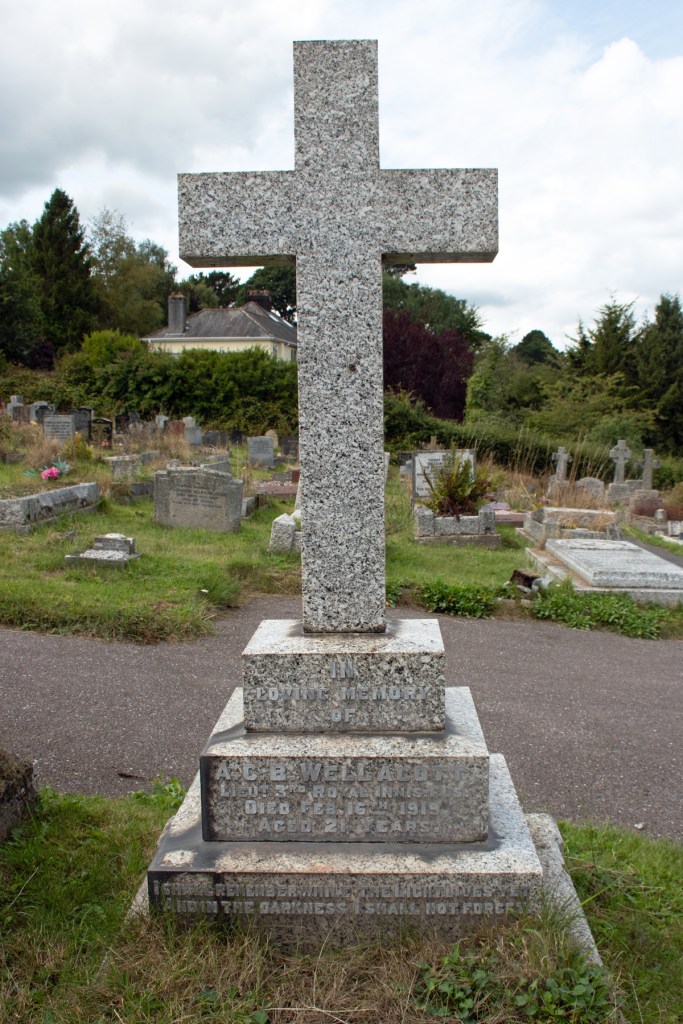
Lieutenant Arthur Wellacott

Lieutenant Arthur Wellacott

Arthur Cecil Baber Wellacott was born the summer of 1897, in the village of Bradworthy, North Devon. Ond of seven children, his parents were William and Ada Wellacott. William was the parish vicar and with his status came additional support for the family.

The 1901 census saw the vicarage employ three members of staff, and William was hosting two students as well as his and Ada’s own children. Ten years later, with Arthur and his younger brother William, boarding at a school in Bude, Cornwall, the Wellacott retinue remained in place.

On leaving boarding school, Arthur studied at Kelly College in Tavistock and, at around the same time his father took up a new post in Totnes. When Arthur left the college, he joined the 7th (Cyclist) Battalion of the Devonshire Regiment. He was subsequently given a commission in th 3rd Battalion of the Royal Inniskilling Fusiliers, and was based in Londonderry.

At Easter 1916, Lieutenant Wellacott took part in quelling the rebellion in Dublin, and was subsequently sent to France. In the battle for Contalmaison his platoon was gassed and buried, and Arthur was badly injured. Suffering from shell shock, the experience had a lasting impact on him “and from that time his health had given cause for anxiety…” [Western Morning News: Tuesday 18th February 1919]

Lieutenant Wellacott returned to England and he was billeted near Leeds. During the winter of 1918/1919, he contracted pneumonia, and was admitted to the Drax Hospital. Sadly, the condition was to prove too much for his already damaged lungs and he died on 16th February 1919. He was just 21 years of age.

Arthur Cecil Baber Wellacott was brought back to Devon for burial. He was laid to rest in the cemetery in Totnes, Devon.


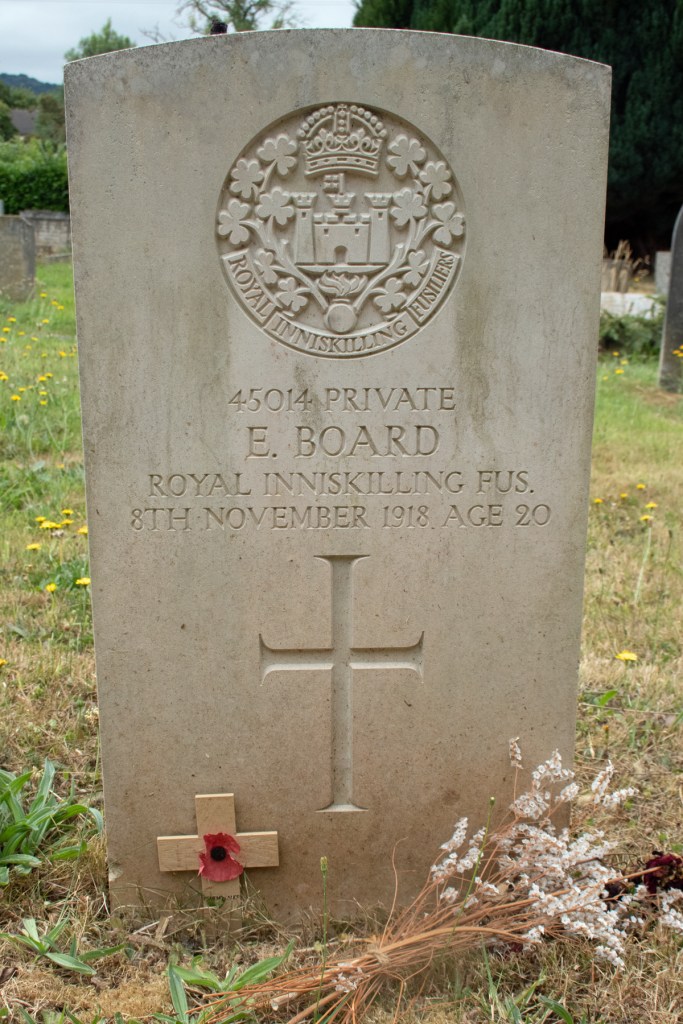
Private Ernest Board

Private Ernest Board

Ernest Board was born in Taunton, Somerset, on 20th September 1898 and was one of at least six children to Walter and Mary Board. Walter was a carter for the town’s gasworks, but, when Mary passed away in 1910, things changed dramatically for the family.

The 1911 census found Walter working as a cowman on a farm in Milverton, Somerset. All but two of his children are missing from that year’s national record, but Ernest and his older brother Arthur are noted as being ‘inmates’ at the National Nautical School in Portishead, near Bristol.

This was an establishment set up in 1869 for the destitute and neglected boys of the area. Ernest and Arthur were two of more than 320 students at the school which, at that time, was under the control of Commander Willoughby Still. School life was very strongly based on the running of a ship, with hammocks instead of beds, and a parade ground in front of the building.

There is no information about how long the brothers remained at the school, but, when war came to Europe, it would seem that they were keen to play their part. Sadly little detail remains of Ernest’s military life.

What can be determined, however, is that he enlisted in the Royal Inniskilling Fusiliers, and was assigned to the 1st Battalion as a Private. His battalion fought at, and were evacuated from, Gallipoli, before moving to France. There is no record where Private Board was involved, sadly, although his Medal Roll Card shows that he was assigned the Victory and British Medals, although may not have actually seen time overseas.

Private Board’s passing is also lost to time. All that can be confirmed is that he died on 8th November 1918, and was just 20 years of age.

Ernest Board was laid to rest in Wellington Cemetery, Somerset: as this is not far from where his father was recorded on the census seven years earlier, it is likely that his place of burial was due to family connections in the area.