Thomas William Grabham was born in September 1883, one of six children to Thomas Richard Grabham and his wife Emma. Thomas Sr was a labourer and drayman for a brewery and the family lived in Taunton, Somerset.
When Thomas Jr left school, he found work as a grocer’s porter, before he too found work in a brewery, working as a maltster. He married a local woman, Maria Rowsell, and the couple went on to have a son, who they named after Thomas’ father.
Details of Thomas’ military service are sketchy; he enlisted in the West Somerset Yeomanry, but there are no details of when this was.
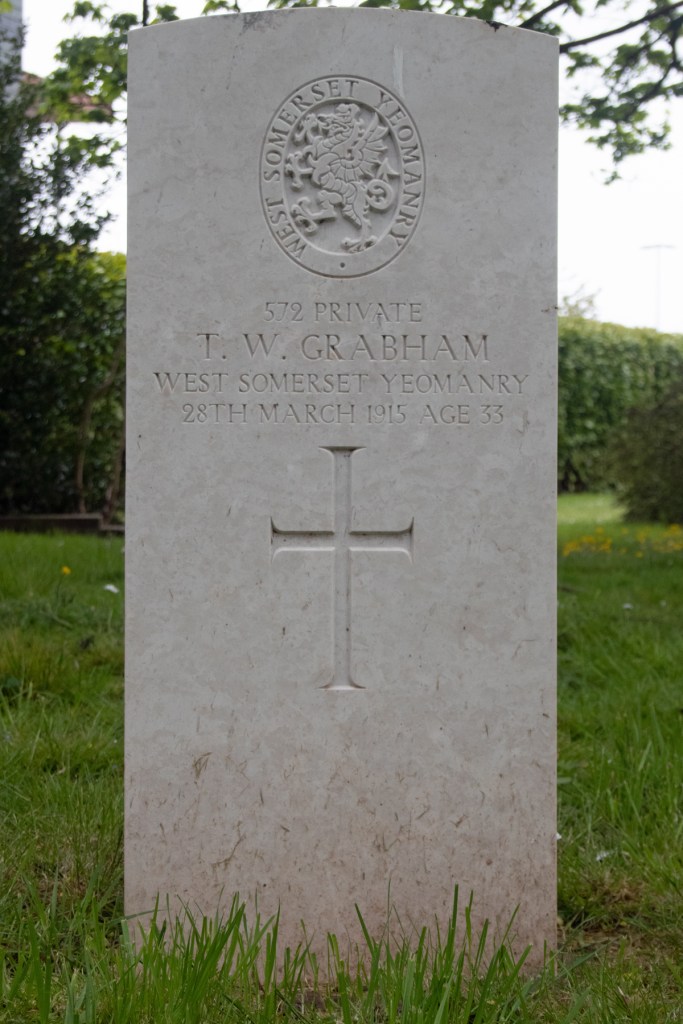
Sadly, Private Grabham’s period of service was short; his pension records show that he passed away from a perforated gastric ulcer on 28th March 1915. He was just 32 years old.
Thomas William Grabham lies at peace in St Mary’s Cemetery in his home town of Taunton.
Sadly, the tragedy for the young Grabham family was not to end there. Maria, Thomas’ widow, died just five months after her husband.
Young Thomas was just eight years old when his parents died; he seems to have been brought up by a Mrs Kate Barnes, possibly a maternal aunt. Here, however, the family’s trail goes cold.
Born in September 1896, John Russell was one of thirteen children to Henry and Ellen Russell. Henry worked as a turf cutter on the Somerset levels, and the family lived in the village of Meare, near Glastonbury.
By the time of the 1911 census, John, aged 15, had left school and joined his father’s business.
When war broke out, John joined up; sadly, his military records are absent, but what we do know for certain is that he enlisted in the West Somerset Yeomanry, and was based at the Stanway Camp near Colchester in Essex.
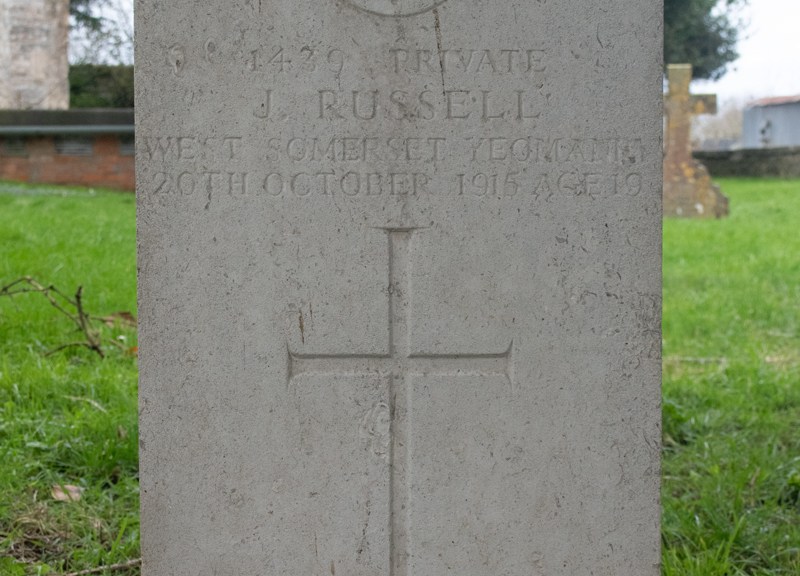
Sadly, much is written of Private Russell’s death. He was acting as a sentry at the camp on the morning of Tuesday 19th October 1915 when he was hit by a car; taken to the military hospital in Colchester, he passed away the following morning.
An inquest was held into the incident, and the following was ascertained:
Vera Coysh, aged 19, was driving near the camp with two friends and her gardener; as she was approaching the entrance, a horse-drawn military wagon ahead of her turned and she swerved to avoid it. In doing so, she hit Private Russell “and carried him some way along the ground”.
John’s injuries were significant. When admitted to hospital, he “was suffering from bruises on the back of the head and haemorrhage from the right ear and nose. His left hand and the lower part of his left arm were swollen from bruising. He was semi-conscious and restless…”
The inquest identified some discrepancies in what happened.
Witnesses in the military wagon and a second one following it all saw a turning signal being given, although not necessarily in time for Vera to slow down or stop. All of the army witnesses stated that she was driving at a quick speed, possibly as much as 35mph.
Vera and her passengers all stated that they saw no signal, saying that the wagon pulled across without indication. They also stated that they were not travelling at speed.
The inquest was a lengthy one, but the final verdict was one of accidental death, with a recommendation that signs were put up on the road to warn of the entrance to the camp.
John Russell was just 19 years old when he died. He was laid to rest in the graveyard of the Church of the Blessed Virgin Mary and All Saints in his home village of Meare, Somerset.
It’s worth also having a look into the life of the driver of that fated motor car.
Vera Murdoch Coysh was born in September 1896, the eldest child of Commander William Henry Coysh and his wife Beatrice Murdoch. The family lived in Yorkshire and, by the time of the incident, William and Beatrice had had four other children – Humphrey Cecil (who became a Commander), Geoffrey Ernest (who went on to be Sub Lieutenant), John William and Barbara Daphne.
Three months after the accident, Vera married Second Lieutenant Trevor Davidson, of the Essex Regiment, and the couple soon emigrated to Mozambique.
All was not well, however, as, by 1924, Vera has moved back to England, the couple had divorced and she had remarried, to a Douglas Stuart-Jervis. The couple went on to have two children.
Meanwhile, Vera was also making a bit of a name for herself in the literary world, writing a number of novels under the name of Jane England. While rarely seen nowadays, she wrote books with such ‘pulp fiction’ titles as Red Earth, Romantic Stranger, Flowering Harvest, Stormy Passage and Winter Jasmine.
It’s bittersweet to see that Vera made a life for herself, in the way that John Russell was sadly unable to.
Gilbert Victor Drew was born in Dinder, Somerset in 1898, the youngest of the eight children of James and Theresa Drew, a groom/coachman and laundress respectively.
Gilbert initially enlisted in the West Somerset Yeomanry on 11th December 1915, serving on the Home Front.
Private Drew then transferred to the 1st Battalion of the Somerset Light Infantry and was shipped overseas as part of the British Expeditionary Force on 1st August 1916.
He first reported to a medic in mid-November 1916; his records pick up the story from there:
First noticed he was passing a larger quantity of water than usual and was also feeling very thirsty.
2nd December 1916, caught influenza and was sent to England. Thirst has been great and urine very large in quantity since November. General condition good. Passes from 14 to 17 pints of urine each 24 hours – large quantity of sugar contained. No evidence of other disease. No improvement since admission.
Result of AS[?] Prolonged strain – especially during Somme offensive.
Medical Records
Private Drew was discharged from the army on 3rd February 1917 as “no longer physically fit for war service” due to diabetes.
Gilbert Victor Drew died on 1st July 1917; he was just 19 years of age. He was buried in the graveyard of the Church of St Michael in his home village of Dinder, Somerset.
He was one of six villagers to fall during the Great War.
Stephen John Rawle was born in 1894, the second of four sons of George Rawle, a sailor, and Louisa, his wife.
By the time war broke out, Stephen was working as a groom in Wheddon Cross, just south of Minehead.
As the Great War loomed, he enlisted and Private Rawle serving on the home front. His record show that he stood at 5ft 9.5ins (1.76m) and was of good enough health to be enrolled for the Territorial Force. He was assigned to the West Somerset Yeomanry.
He was medically discharged from service on 29th March 1915, having served for one year and 31 days.
The records show no signs of injury or wounds, and newspapers of the period do not link him with any misadventure. I can only assume, therefore, that he died of natural causes, possibly linked to the Spanish Flu Pandemic. Stephen died on 5th September 1918. He was 25 years old.
Private Stephen John Rawle lies at rest in the churchyard of Lydeard St Lawrence, alongside two of his brothers, Ernest and William.
George and Louisa’s other son – Edward – also served, enlisting in the Somerset Light Infantry and fighting in the Balkans. Private Edward Rawle survived the war, returning home in March 1919.
It should be noted that, by June 1921, George and Louisa had lost three of her four sons to the Great War. Their daughter, Norah, had also passed away in 1918.
The 1921 census found Louisa living in East Town, in the parish of Tolland, not far from Lydeard St Lawrence. Edward was living with her, as were her three-year-old granddaughter, Lorna, and her eighteen-month-old grandson Beatty. It is unclear whose children they were. George, at this point, was helping his younger brother out on the family farm in Williton.
Ernest Charles Rawle was born in 1899, the fourth son of George Rawle, a sailor, and Louisa, his wife.
Ernest was still at school at the time of the 1911 census, and enlisted in the West Somerset Yeomanry, but enlisted in the army in April 1915. His served on the Home Front, but was discharged as being unfit for war service on 22nd July 1916.
Private Rawle’s discharge records confirm that he had pulmonary tuberculosis, which he had contracted a couple of months before. They go on to suggest that it was not a permanent condition, but was likely to render him unfit for service for a number of months.
Eager to do his bit, Ernest’s record show that he re-enlisted in August 1916, and that he was considered fit for military service by the November of that year.
His medical records continue further – he was admitted to a field hospital again in March 1917, again suffering from tuberculosis. He was moved back to base as he was “a danger to his comrades”.
His records after March 1917 are not available, but he passed way from TB in November 1919. He was just 21 years old.
Private Ernest Rawle lies at peace in the churchyard of Lydeard St Lawrence, alongside his two brothers, Stephen and William.
George and Louisa’s other son – Edward – also served, enlisting in the Somerset Light Infantry and fighting in the Balkans. Private Edward Rawle survived the war, returning home in March 1919.
It should be noted that, by June 1921, George and Louisa had lost three of her four sons to the Great War. Their daughter, Norah, had also passed away in 1918.
The 1921 census found Louisa living in East Town, in the parish of Tolland, not far from Lydeard St Lawrence. Edward was living with her, as were her three-year-old granddaughter, Lorna, and her eighteen-month-old grandson Beatty. It is unclear whose children they were. George, at this point, was helping his younger brother out on the family farm in Williton.




 Death and Service