Category Archives: Boy

Able Seaman Percy Strong

Able Seaman Percy Strong

Percy William Strong was born in April 1897, the youngest of five children to Albert Strong and his wife Elizabeth. The family lived in Shepton Mallet, Somerset, where Albert worked as a mason’s labourer.

Percy was keen to make his own way in the world. By the 1911 census, and having left school, he was working as a farm boy on Kingsdown Farm in Shepton, alongside a couple of other paid, and boarding, employees.

He seemed to have been after adventure in his life too; in January 1913, he enlisted in the Royal Navy, getting his training on a number of vessels, even before the start of the Great War. In his six years of service, he was promoted from Boy to Able Seaman, and served on nine ships.

Able Seaman Strong’s final assignment was at HMS Idaho, the naval base in Milford Haven, Pembrokeshire, which he joined in May 1918. It was while he was stationed at HMS Idaho that tragedy would strike.

A boat belonging to a Government Patrol-boat capsized in Milford Haven, when three members of the crew lost their lives. They were Sub-Lieutenant Lever (20), Birkenhead; Leading Seaman Thomas Palmer (30) Shepton Mallet; and AB Percy Strong (21), Shepton Mallet.

The boat, containing six men, had come ashore in a rough sea. It left Milford Haven Naval stage on return to the ship at eleven am. A sharp squall caught the men when well out on their return journey, and this the craft failed to weather, and was capsized. The six occupants were cast into the sea, and despite the efforts of men in boats from other vessels, the three named were drowned, and the others had a narrow escape.

Western Mail: Friday 11th October 1918

Able Seaman Strong has lost his life on 9th October 1918. He was just 21 years old.

Percy William Strong’s body was returned to Shepton Mallet, the town of his birth, and lies at rest in the cemetery there.
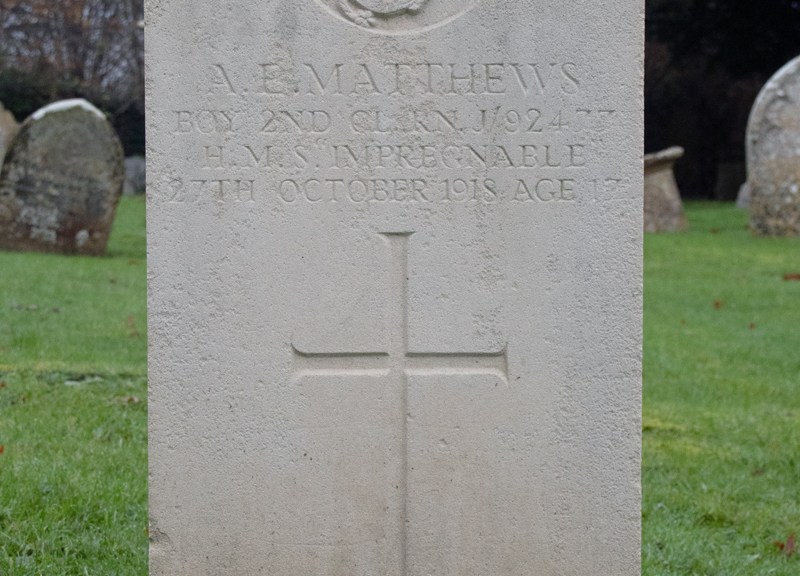

Boy 2nd Class Albert Matthews

Boy 2nd Class Albert Matthews

Albert Edward Matthews was born in October 1901 in the Somerset village of Tintinhull. His father James was a glove maker, and he and his wife Mary had three children in all, Percival, born in 1897, Clementina, born in 1898, and Albert, the youngest.

Sadly, Clementina died in 1909, aged just 11 years old. Percival also passed away six years later, aged just 17. James and Mary must have been distraught when Albert announced his decision to do his bit for King and country.

He enlisted almost as soon as he was able to, joining the Royal Navy on 14th September 1918, and you can almost sense his enthusiasm to get involved before missing out on the glory of military service.

Boy Matthews was assigned to HMS Impregnable, the ship based in Devonport, Plymouth, where he was to receive his training. Standing at 5ft 8ins (1.73m) tall, with brown hair, brown eyes and a fair complexion, he was recorded as having a very good character and satisfactory ability.

Sadly, however, Albert was not destined to meet his full potential. Shortly after beginning his training, he contracted influenza and pneumonia, succumbing to the disease on 27th October 1918.

He had just turned 17 years old.

Albert Edward Matthews lies at rest in the graveyard of St Margaret’s Church in his home village of Tintinhull.


The story of this family continued to be tragic. By the time of Albert’s death, the Spanish Flu pandemic was sweeping the world and his tiny part of Somerset was in no way immune.

Just four days after Albert Matthews passed away, his mother, Mary, also fell victim to the illness.

In the space of just nine years, poor James Matthews had buried all three of his children and his wife. A newspaper reported on Mary’s funeral, recognising the “very heavy trials” he had undergone.

The same paper, reports that the influenza pandemic is fizzling out.

A large number of parishioners have been attacked with “flu”, but the epidemic is now on the wane. The school has been closed for the last fortnight.

Western Chronicle: Friday 8th November 1918

Boy 2nd Class Sidney Stagg

Boy 2nd Class Sidney Stagg

Sidney Herbert Stagg was born in 1901. The eldest child of bootmaker Sidney Stagg and his wife Frances, Sidney Jr was too young to fight in the when war broke out.

He enlisted in the Royal Navy at the beginning of 1919, and was assigned to HMS Powerful, a training vessel based in Plymouth.

Boy Petty Officer Stagg’s time in the navy was heartbreakingly short. Within a few weeks he had contracted pneumonia and succumbed to the disease on 27th February 1919. He was just 17 years old, and had been in service for 36 days.

The Western Gazette reported on his funeral:

[He] left Sherborne just over a month ago to join the Royal Navy, a career for which he had expressed a great liking, and was attached to HMS Powerful, being made Boy PO within a fortnight of his joining that ship. A short time afterwards he contracted influenza, and pneumonia supervening, he died on Thursday at the Royal Naval Hospital, at Plymouth.

A service was held in the Congregational Church, and continued at the graveside, where three volleys were fired by a firing party of the Volunteers [the Sherborne Detachment 1st Volunteer Battalion, Dorset Regiment], and buglers sounded the last post. The Rev. W Melville Harris (uncle of the deceased) officiated, and the principal mourners were Mr Stagg (father), Miss Joyce Stagg (sister), Mr H Hounsell (uncle), and members of the business establishment.

Western Gazette: Friday 7th March 1919.

Sidney Herbert Stagg lies at peace in the cemetery in his home town of Sherborne.