Tag Archives: 1916

Corporal Sidney Hornby

This image has an empty alt attribute; its file name is photo-01-11-2020-12-01-50-e1605266325697.jpg

Sidney Horace Hornby was born to John and Emily in March 1880. John was a tailor’s assistant from Paddington, and the family – Sidney was the eldest of six siblings – initially lived in the Greenwich.

Sidney enlisted in the army in 1898. He joined the East Kent Regiment for a short service of seven years and was sent to South Africa. In March 1900 he was wounded at the Battle of Driefontein. His service, though, saw him promoted through the ranks from Private to Sergeant.

Something must have happened during his enlistment, however, as on 2nd September 1901 Sergeant Hornby’s military record marks him as having deserted.

Sidney’s records pick him up again on 24th April 1908, when he is put on court martial. Found guilty of desertion, he is reduced to the ranks and sentenced to three years’ penal servitude (later reduced to two years’ hard labour).

His attitude seems to continue, however, as within a matter of months he was discharged due to misconduct and denied any pension for his previous service.

Sidney’s family had moved from Greenwich to Kent at some point before the 1901 census, and his father died three years later. By the 1911 census, he had moved back in with his mother, and worked as a labourer to help look after them.

The Great War called, however, and it seems that Sidney’s previous misdemeanours did not excluding him from fighting again. He joined the Royal West Kent Regiment although his full service for the 1914-18 campaign are not accessible. Again, his service seems to have been good, as he was elevated to the rank of Sergeant for a second time.

Hints of Sergeant Hornby’s rebellious nature remain, however, as he was court marshalled again in February 1916. He was convicted of drunkenness, and reduced to the rank of Corporal.

That was the summer of the Battle of the Somme, and by the autumn Hornby was one of the many who fell during that time. He died on 4th October 1916 and was 36 years old.

Corporal Sidney Hornby is commemorated on the Thiepval Memorial.


Sidney Horace Hornby was my 1st cousin, four times removed.

Private Frederick Smith

Private Frederick Smith

Frederick Smith was one of twelve children to George and Ann Smith of Rainham in Kent. Sadly, the couple lost their first four children early on, but at least seven of Frederick’s siblings survived beyond childhood.

His father was a labourer, and Frederick’s two surviving older brothers followed him into this profession.

A lot of Frederick’s service records are missing, but I have been able to ascertain that he enlisted in early 1915, joining the 8th Battalion, Queen’s Own (Royal West Kent Regiment). He trained at Fort Darland in Chatham before being shipped overseas.

The battalion was involved in the Battle of Loos later that year, but it was the fighting at Wulverghem in Western Flanders that changed Private Smith’s life. The German army launched a gas attack on the Allied lines on 30th April 1916; in the second attack on 17th June, Frederick was injured by the gas, and was shipped back to home soil.

The East Kent Gazette takes up the story:

He was brought to Camberwell Hospital, where he was for seven weeks. Enteric fever developed, and young Smith died on Thursday in last week [14th September].

East Kent Gazette: Saturday 23rd September 1916.

Frederick was just 19 years old.

Private Frederick Smith lies at rest in the graveyard of St Margaret’s Church in Rainham, Kent.

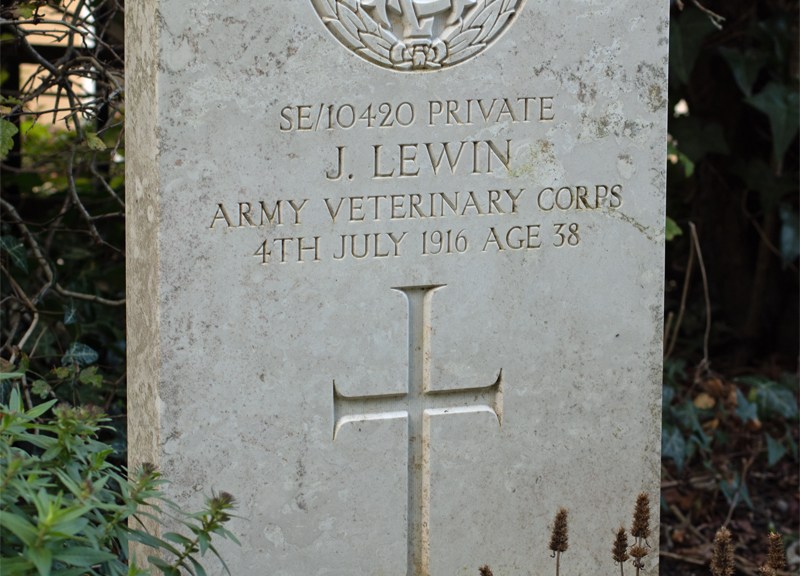
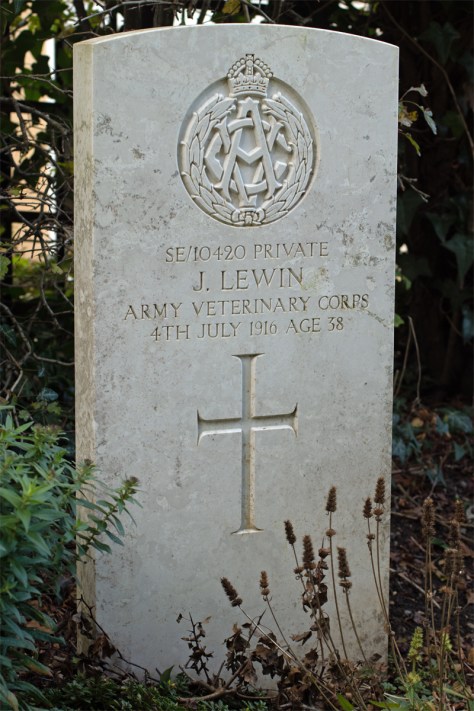
Private Jonathan Lewin

Private Jonathan Lewin

There is tantalisingly little information available about Private J Lewin, and what I have been able to identify has come from a variety of disparate sources.

Jonathan William Lewin was born in 1877/8 in Essex. By the time of the 1911 census, he was working as a painter in Colchester. He was living in the town with his wife, Agnes Cudmore, who he had married in early 1902. The couple had no children.

The remainder of the information of Private Lewin’s life comes from a piece in the Western Gazette:

The death has occurred at the Yeatman Hospital [Sherborne, Dorset] of Private Jonathan Lewin, of the Army Veterinary Corps. The deceased soldier had been at the Front for a year, and about three months ago was brought home sick and sent to the Yeatman Hospital. He was there found to be suffering from a malignant disease, and his recovery from the first was hopeless. Deceased, who belonged to Colchester, and was 38 years of age, leaves a widow but no children. The funeral took place yesterday and was attended by a number of wounded soldiers and the members of the VTC.

Western Gazette: Friday 7th July 1916.

Private Jonathan Lewin lies at rest in Sherborne Cemetery.


One of the reasons I love researching this type of history, is trying to discover the person behind the name on the gravestone. It seems such an additional loss, therefore, when the life of a brave soldier, like Private Lewin, has disappeared through time.