Tag Archives: Army Veterinary Corps

Serjeant Harry Stephens

Serjeant Harry Stephens

Harry Stephens was born in Banwell, near Weston-super-Mare on 4th January 1873. He was one of six children to Frederick Stephens and his wife, Emma. Frederick was a butcher, and this was a trade that both Harry and his older brother, Fred, would go into when they left school.

It appears that being a butcher was not the full-time career that Harry was looking for, and so, in the 1890s, he found other employment as a farmer, and moved to Lynton, on the north coast of Devon.

It was here that he met Norah Watts, another farmer’s daughter and, in 1898, the couple married. They set up home at Furzehill Farm, and went on to have four children, Frederick, Alice, Albert and Herbert.

By the time of the 1911 census, Harry had moved his family back to Banwell, where they lived in a four-roomed house on the High Street. Harry was now a cattle dealer, and was presumably supplying meat to his mother who, having been widowed in 1902, was now running the butcher’s shop with three of Harry’s siblings.

War was coming, though, and on 21st July 1915, Harry enlisted. Given his farming background, he was assigned to the Army Veterinary Corps and, while remaining on the Home Front, over the next few years he gained promotion.

Towards the end of 1917, when Serjeant Stephens was serving in Romsey, Hampshire, he fell ill, complaining of chest pains and breathlessness. He was taken to Hursley Hospital near Winchester for cardiac checks, and it became apparent that he was no longer fit for active duty.

Discharged from military service on 5th July 1918, he returned home. Admitted to the Military Hospital in Taunton, it was only a matter of weeks later than Serjeant Stephens passed away. He was 45 years of age.

Harry Stephens was laid to rest in the St James’ Cemetery in Taunton.


Private Ernest Painter

Private Ernest Painter

Ernest Hart Painter was born in December 1884 one of eight children to Alfred and Elizabeth from Devon. Alfred moved the family to Cheddar, Somerset to work at a paper mill in but sadly passed away when Ernest was only eleven years old.

The family rallied round Elizabeth, however, and, by the time of the 1901 census, she was living on the outskirts of the town with her six younger children. Elizabeth worked as a domestic cook; Ernest was an agricultural labourer; his two older sisters were shirt machinists; his 13 year old brother Albert was listed as a gentleman’s servant.

Ernest, by this point, seemed to have taken on the role of head of the family; he continued work as a farm labourer, while Elizabeth earned money as a housekeeper. Alfred became a mechanic for a car dealer and, at the 1911 census, the three of them lived with the youngest member of the family, Ernest’s sister Emily, who had followed in her older sisters’ footsteps as a machinist.

As with many of the fallen men and women of the Great War, a lot of Ernest’s military service records have been lost to time. He enlisted in the Army Veterinary Corps in December 1915, his work as a farm labourer presumably having involved animals and livestock.

Private Painter must have been on the front line as, on 30th May 1918, he was shot in the ankle. Shipped back to England for treatment, he was eventually discharged from service on 19th November, a week after the Armistice. The ankle wound continued to give him trouble, however, and over the following couple of years, he had a number of operations on it.

Sadly, the last of these procedures resulted in an infection, and sepsis took hold. Private Painter passed away from blood poisoning on 15th April 1921. He was 36 years old.

Ernest Hart Painter lies at rest in the graveyard of St Andrew’s Church in Cheddar, Somerset.


Private William Collins, AKA Geoffrey Clark

Private Geoffrey Clark / Private William Collins

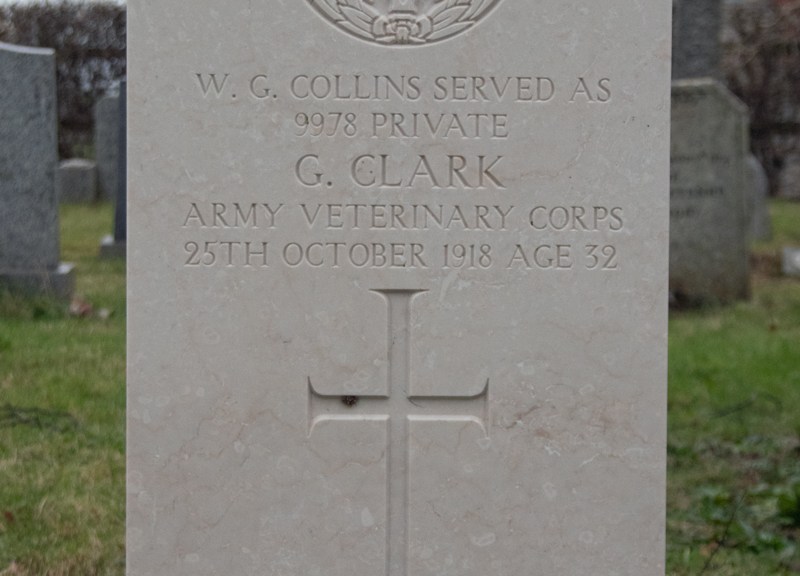
One of the things I have found during this research is that occasionally a mystery will come to light. In the case of the gravestone in the Somerset village of Coxley – nestled on the main road between Wells and Glastonbury – it was the very identity of a person buried there that threw me.

The headstone in question simply says “WG Collins served as Private G Clark in the Army Veterinary Corps”, but the research tools I normally use drew blanks.

The Commonwealth War Graves Commission website confirmed that the second name is Geoffrey Clark, but does not give full names for WG Collins.

Unfortunately, the Findagrave website does not have the burial listed under either name, so that too was a dead end.

The British Newspaper Archives site – a record of media across the UK covering 250 years – similarly has no entry for either name around the time of his death, which suggests it was either not ‘out of the ordinary’ (not headline-grabbing) or his death and funeral were just not submitted to the local paper.

Fold3 – which stores military records – has a record for 9978 Private Geoffrey Clark. The Register of Soldiers’ Effects confirms that a war gratuity was awarded to his sister, Ada Jane Waldron, after his death.

And, as it turns out, it was Ada who proved the key to the mystery of her brother. Working on the basis that Ada’s maiden name was Collins, I used Ancestry.co.uk to try and track her down. The site presented a family tree featuring both an Ada Jane Collins and, more importantly, a William George Collins, and the game was afoot…


William George Collins was born in the Somerset village of Coxley in the summer of 1889. He was the youngest of seven children – Ada was his oldest sister – to James Collins, an agricultural labourer, and his wife Jane.

Following the death of his mother in 1901, and his father a decade later, it’s evident that William wanted to make his way in the world. By the 1911 census, he had moved to Wales, working as an attendant at the Glamorgan County Lunatic Asylum. The asylum, which was in Bridgend, South Wales, was home to nearly 900 patients, and William acted as one of the 120 staff looking after them.

War was on the horizon, however, and the mystery surrounding William returned once more. Military records for William (or Geoffrey) are limited; he enlisted in the Royal Army Veterinary Corps in the summer of 1915 and was shipped to France in September of that year.

There is no record why he enlisted under the name Geoffrey Clark, nor does there seem to be any evidence of either names in his family. As to his passing, there is nothing to give a hint to how he died. All that can be confirmed for certain is that he passed away at the University War Hospital in Southampton on 25th October 1918, at the age of 32.

William’s probate records give his address as Railway Terrace in Blaengarw and show that his effects went to his sister, Ada.

William George Collins – also known as Geoffrey Clark – lies at peace in the graveyard of Christ Church, in his home village of Coxley.


Private Jonathan Lewin

Private Jonathan Lewin

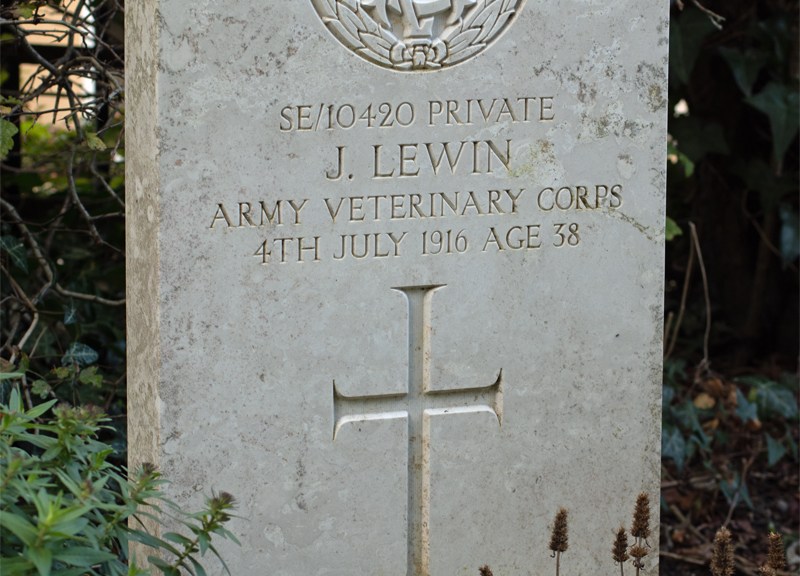
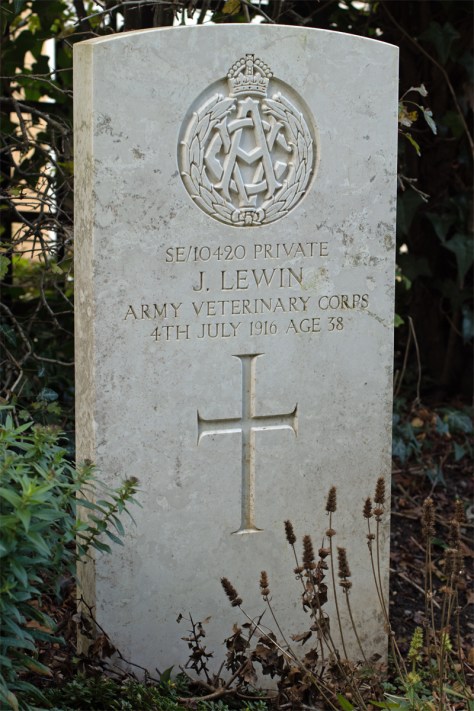
There is tantalisingly little information available about Private J Lewin, and what I have been able to identify has come from a variety of disparate sources.

Jonathan William Lewin was born in 1877/8 in Essex. By the time of the 1911 census, he was working as a painter in Colchester. He was living in the town with his wife, Agnes Cudmore, who he had married in early 1902. The couple had no children.

The remainder of the information of Private Lewin’s life comes from a piece in the Western Gazette:

The death has occurred at the Yeatman Hospital [Sherborne, Dorset] of Private Jonathan Lewin, of the Army Veterinary Corps. The deceased soldier had been at the Front for a year, and about three months ago was brought home sick and sent to the Yeatman Hospital. He was there found to be suffering from a malignant disease, and his recovery from the first was hopeless. Deceased, who belinged to Colchester, and was 38 years of age, leaves a widow but no children. The funeral took place yesterday and was attended by a number of wounded soldiers and the members of the VTC.

Western Gazette: Friday 7th July 1916.

Private Jonathan Lewin lies at rest in Sherborne Cemetery.


One of the reasons I love researching this type of history, is trying to discover the person behind the name on the gravestone. It seems such an additional loss, therefore, when the life of a brave soldier, like Private Lewin, has disappeared through time.