Tag Archives: injury

Private James Patch

Private James Patch

James Patch was born in 1882, the third of four children – all boys – to Albert and Jane. Albert was a farm labourer in the village of Meare, Somerset, and this is something that, once leaving school, the Patch boys also went into.

Albert passed away in 1904, so James stepped up and stayed living with his mother. By the time of the 1911 census, they were living near the Grape Vine Pub in Meare, both working as agricultural labourers, and had a John Lee boarding with them.

No firm details remain of James’ military service, although it is evident that he enlisted in the Devonshire Regiment and, from the Army Register of Soldiers’ Effects, this can be narrowed down to the 7th Infantry Works Company.

While Private Patch’s military records are sparse, his name crops up a lot in the newspapers around the time of his death, with headlines like “Mysterious Death of Meare Soldier”.

On the evening of the 25th March 1917, James was found lying across the tram tracks in Horfield, a suburb to the north of Bristol. He was in a semi-conscious state, and was taken to the nearby barracks.

An inquest was held and the story unfolded.

Witness statements confirmed that Private Patch was on a tram and had asked the conductress to let him know when they reached the barracks. The tram halted at the allotted stop, but, when nobody alighted, the driver started up again.

James apparently asked the conductress if that had been the stop for Horfield Barracks and, having confirmed that it was, and that he had wanted to get off there, she pressed the bell for the driver to pull up at the next stop. She then went up to the top deck of the tram, and it appear that James had decided he couldn’t wait for the next stop and jumped off the moving tram.

It seems that James fell from the tram and hit his head when he landed; this was when a passer-by found him.

The morning after his fall, the camp doctor identified the extent of James’ injury and he was moved from the barracks to the Royal Infirmary in Bristol. Private Patch died an hour after being admitted, having suffered an extensive fracture of the skull. He was 35 years of age.

The inquest into his death returned a verdict of “accidental death, due to a fall from a tram-car, caused by stepping from the car while in motion”.

James Patch lies at rest in the ground of the Church of the Blessed Virgin Mary and All Saints in his home village of Meare in Somerset.


Trooper William Dawbin

Trooper William Dawbin

William Joseph Dawbin was born on 23rd April 1888, in Yeovil, Somerset. He was the oldest of three children to William and Julianna Dawbin, a farming family.

In 1897, when William Jr was 9 years old, the family emigrated to New Zealand, settling in the town of Feilding, 100miles (150km) north of Wellington.

William enlisted in 1905, joining the Wellington Mounted Rifles for a five-year term of service, and being promoted to the rank of Corporal. He re-enlisted on 14th August 1914, and the troop departed New Zealand for Europe a month later.

Trooper Dawbin arrived in Alexandria, Egypt on 3rd December, from where they travelled to Cairo for training. Initially planning on becoming involved in the defence of the Suez Canal, on 14th April 1915, William and his battalion landed in Gallipoli, to support the invasion there.

History knows that the fighting in this battle was some of the fiercest of the Great War. History also tells us that this campaign resulted in huge losses for the Anzac troops, including the Wellington Mounted Rifles. Sadly, Trooper Dawbin was not to escape injury.

On 27th May 1915, he received a gunshot wound to the back, fracturing his spine. He was evacuated by hospital ship back to Egypt, and, suffering from paralysis, was shipped back to England ten days later.

Trooper Dawbin was admitted to the Netley Hospital in Southampton, but his wounds appeared too severe; he died there on 22nd August 1915. He was 27 years old.

William Joseph Dawbin lies at peace in the quiet churchyard of St Andrew’s, in the village of Compton Dundon, Somerset, not far from extended family in Butleigh.


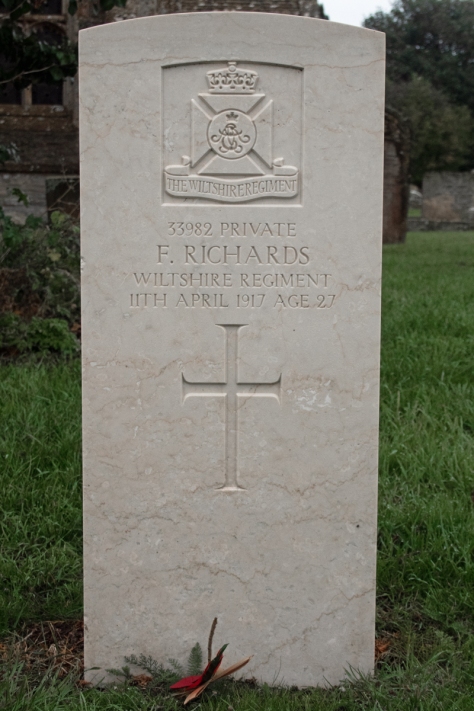
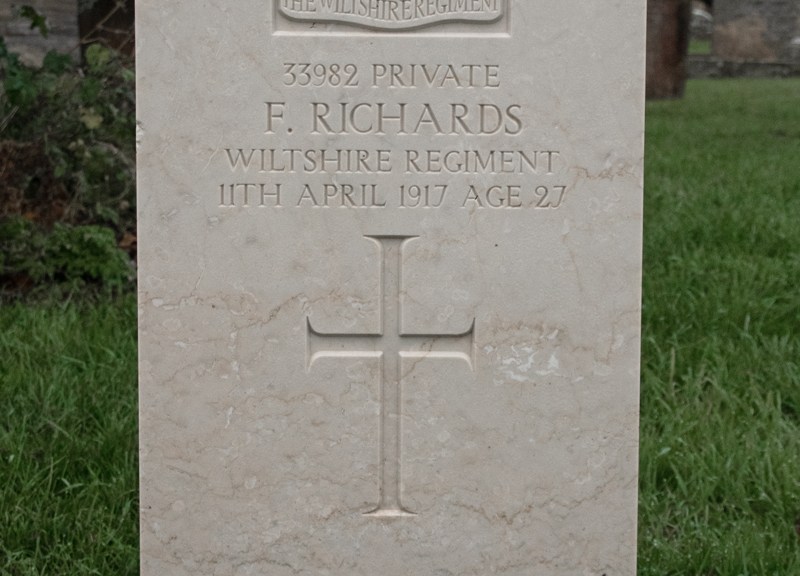
Private Frank Richards

Private Frank Richards

Francis George Richards (or Frank) was born in 1889, the oldest of five children to William and Rhoda Richards. William was an agricultural labourer and the family lived in his home village of Long Sutton in Somerset.

Frank followed his father into agriculture, and, by the 1911 census, was working as a carter.

And that is where the trail of Private Richards goes cold.

What records do exist confirm that he enlisted in the Wiltshire Regiment, serving at its depot in Devizes. This suggests he was part of the 7th (Service) Battalion, raised through the Kitchener Scheme.

The battalion were shipped to France in September 1915, before being moved on to the Balkans, where they fought in the Battle of Horseshoe Hill and the Battles of Dorian. As there are no records of Private Richards’ service, it is not possible to confirm how involved in the fighting in Europe he was, or whether he remained on the Home Front.

Frank’s death also remains a mystery. All that can be said for sure is that he died in hospital on 11th April 1917, in a hospital in England. He was 27 years old. He does not appear to have married, and his pension was assigned to his father.

Frank George Richards lies at rest in the quiet graveyard of Holy Trinity Church in his home village of Long Sutton.


Private Frank Antell

Private Frank Antell

Frank Antell was born in 1880, one of seven children – six sons – to Thomas and Harriett Antell. Thomas was a groom, and Harriett a dressmaker and the family lived in the village of Martock in Somerset.

After Thomas died in 1893, Frank left school and became a carpenter. By the time of the 1901 census, he was living with his mother and youngest brother. Income seems to have been short – there were three other people boarding and lodging with the family.

In August 1904, Frank married Augusta Ring, and together they had five children – Lily, Ada, Leslie, Ronald and Freda.

Frank enlisted in the 13th (Works) Battalion of the Devonshire Regiment; this had been formed in the summer of 1916, so it can only be assumed that he was called up at the start. The battalion was based in Plymouth, so it is likely that Private Antell did not see fighting on the Western Front.

Private Frank Antell’s death is also a bit of a mystery. All that there is to confirm what happened is one stark sentence on his pension ledger:

Wounds self-inflicted during temporary insanity whilst on active service.

This one statement covers a multitude of sins, but does nothing to explain the mystery of what happened. There is no coverage of the incident or funeral in contemporary newspapers, so I have been unable to find any further explanation.

Frank Antell was a man with a young family. His regiment was based in England and was to be so for the duration of the war. One cannot imagine what thoughts were going through his head at the time he took his own life. That the 37 year old felt this was his only option is tragic.

Frank Antell lies at rest in the graveyard of All Saints’ Church in his home village of Martock in Somerset.


Frank’s widow Augusta went on to marry again in 1919, to a Joseph Maunder. She died in 1951 at the age of 73 years old.


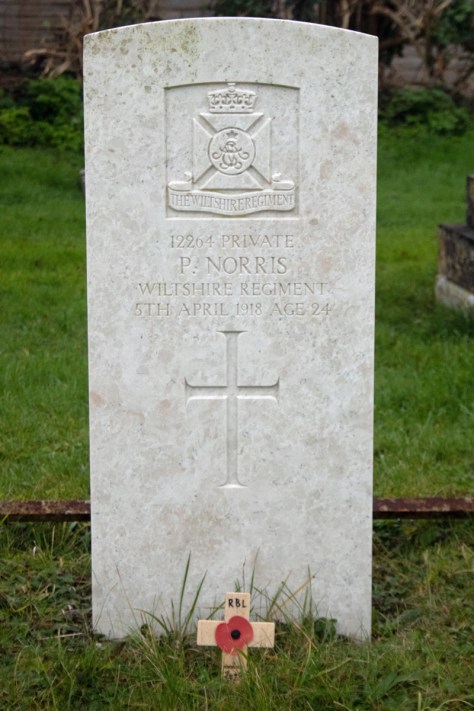
Private Percy Norris

Private Percy Norris

Percy Norris was born in 1894, the youngest of eleven children to William and Julia Norris. William was the caretaker for the water works in Somerton, Somerset, and this is where the family of eleven lived.

By the time of the 1911 census, Percy’s older brother Henry had joined his father at the water works. Julia had passed away five years before, and Percy and three of his siblings continued to live with William. At this point Percy was working as a gardener.

Private Norris’ full military records are not readily available, but it is evident that he enlisted in the 7th Battalion of the Wiltshire Regiment. This was a service troop, formed in 1914, who saw service in France and the Balkans.

It seems that it was during one of the skirmishes that Private Norris was injured. While there is no confirmation of exactly when or where this happened, it is likely to have been at some point in the spring of 1918. Percy was shipped back the England for treatment, and admitted to the Red Cross Hospital in Bridgwater, Somerset.

Sadly, Private Norris did not recover from his injuries. He passed away on 5th April 1918, aged 24 years old.

Percy lies at rest in the cemetery of Somerton, his home town.


Percy’s older brother Henry Norris also died in the Great War. Joining the Royal Naval Volunteer Reserves, Able Seaman Norris was also wounded on active duty, dying of his injuries in January 1918, aged 32. He is buried at the St Sever Cemetery in Rouen, France.


Lance Corporal Harold Russell

Lance Corporal Harold Russell

Harold Stanley Russell was born in 1895, the third of six children to carpenter Henry Russell and his wife Mary. The family lived in Sherborne, Dorset, and this is where Harold grew up; by the time of the 1911 census, he was working as a hairdresser in the town.

While Harold’s military records are not readily available online, his last few weeks can be determined through the local press of the day.

He enlisted in the Dorsetshire Regiment in the summer of 1915, but was attached to the Wiltshire Regiment when battalions went to France in May 1916.

Lance Corporal Russell’s Lieutenant wrote to his parents to report on Harold’s injury:

[He] was wounded by a bomb on the morning of July 28th while on duty in the trenches. “At the moment of writing I do not know if it is a very serious case, but I do know he will lose the use of his left hand. He was a most popular fellow, and always willing to do his part nobly with a brave heart, and nothing grieved me more than to see him in pain. His wants were immediately attended to, and I suppose by now he is under treatment in the hospital. He is being well cared for, and the authorities will let you know how he is progressing.

Western Gazette, Friday 4th August 1916

A week later, the newspaper reported an update:

Lance-Corporal Harold Russell… is now at the Leicester Military Hospital in a critical condition. His parents were telegraphed for on Friday last, and visited him. They found he had been very seriously wounded by a bomb whilst on duty in the trenches in France. His injuries are in the chest and right arm, while his left hand has been amputated. [He] was acting platoon-sergeant at the time he was wounded, and had taken part in three battles. After being wounded he walked one and a-half miles to the dressing-station, but afterwards collapsed. His parents returned to Sherborne on Tuesday as he was slightly better, but were telegraphed for again on Wednesday.

Western Gazette, Friday 11th August 1916

The day of the second article, Lance Corporal Harold Russell lost his fight for life, dying in a Military Hospital in Leicester. He was just 21 years old.

The next week, the young soldier featured in the newspaper again, with an 80-line report on his funeral being featured on the Roll of Honour page.

Harold Stanley Russell lies at rest in the cemetery of his home town, Sherborne.


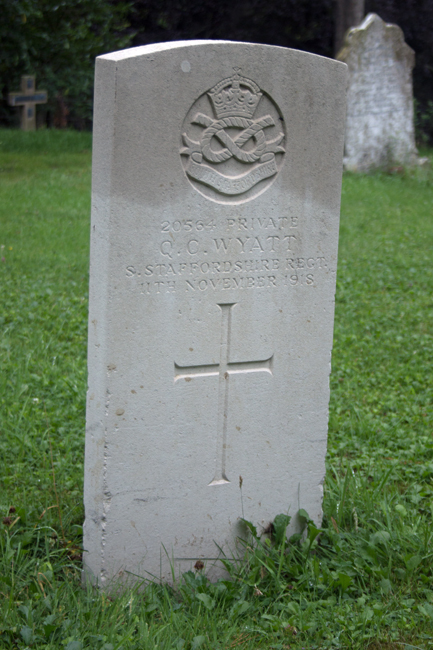
Private Quinton Wyatt

Private Quinton Wyatt

Quinton Charles Wyatt was born in the Gloucestershire town of Northleach in 1893 to William and Elizabeth. His mother died when he was a toddler, leaving William to look after Quinton and his older sister Agnes.

By the time war was declared, Quinton was working as a farm labourer and waggoner in the Gloucestershire village of Hampnett.

Quinton enlisted in the 8th Battalion of the South Staffordshire Regiment on 22nd November 1915. Appointed Lance Corporal just two months later, he was posted to France in March 1916.

Neglect of duty in June meant that Lance Corporal Wyatt was demoted to Private four months later. His battalion was caught up in a German gas attack in the autumn of 1917, and he was injured; ultimately, he was medically discharged from the Army on Boxing Day 1917.

Quinton Charles Wyatt finally succumbed to his injuries on 11th November 1918 – Armistice Day. He was 25 years old.

He is buried in St Mary’s churchyard in the village of Charlton Mackrell in Somerset.

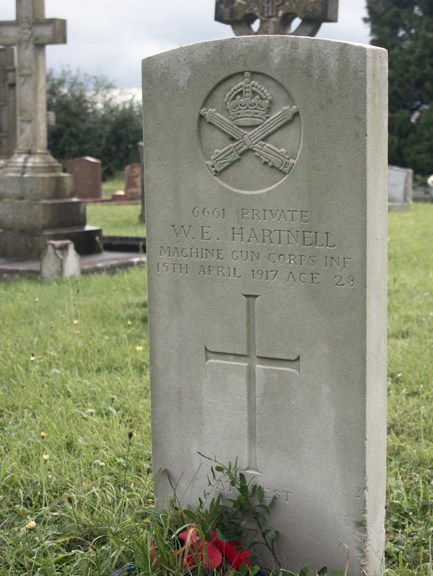
Private Walter Hartnell

Private Walter Hartnell

Walter Ernest Hartnell was born in 1888 to William and Jane Hartnell in Charlton Musgrove, on the outskirts of Wincanton in Somerset.

One of eight children, it appears he could have been a bit of a tearaway in his youth; in October 1905, the Shepton Mallet Journal reports on a “Hobbledehoy Nuisance” in Evercreech, when a Walter Hartnell was caught with nine of his friends causing a disturbance close to the church.


They were shouting, racing after each other up and down the road, using obscene language, and smoking cigarettes. This continued till 7.15, about half an hour.

Shepton Mallet Journal – Friday 20th October 1905

Hartnell was fined 5/- and 2/6 costs, or would face ten days in prison.

Things looked up for Walter and, by the time his call to enlist came, he was working on the railways. He joined the Somerset Light Infantry and the Machine Gun Corps (MGC), while his brother Fred fought in the Royal Artillery.

The MGC was a particularly brutal part of the armed forces. Of the 170,500 officers and men who served in the corps, 62,049 became casualties, including 12,498 killed, earning it the nickname ‘the Suicide Club’.

Details of Private Hartnell’s death are sketchy; his company saw action at Ypres and Arras. However, records suggest that he died in Colchester; the Military Hospital there was used to dealing with troops straight from the Front. It is likely that he was injured at Ypres and shipped back home to recuperate, but died of his injuries.

This is all conjecture on my part, of course, but either way, Private Walter Hartnell lies at peace in a quiet cemetery at Evercreech in Somerset.


Private Thomas Moody

Private Thomas Moody

Thomas Edward Moody was born in 1890, the second of five children for Thomas and Emily.

By the start of the war, “Little Tommy Moody” was working with his father in the quarries around Shepton Mallet and was the eldest son living at home.

He joined the North Somerset Yeomanry and was shipped out to France, where he was badly injured. An article in the Shepton Mallet Journal, included after his funeral, says as much about the life of this young man as it does about the Edwardian approach to military matters.


DEATH AND FUNERAL OF A SOLDIER – The death has taken place of Thomas Edward Moody, son of Thomas Moody, of Stoney Stratton, Evercreech, at the age of 18, and who as a 1914 man, joined the North Somerset Yeomanry and went out to France. He was badly wounded, resulting in the loss of an eye, and after some time in hospital and a short leave at home, he was sent back to rejoin his regiment, the 3rd Reserve Cavalry, in France. This was about two years ago. He spent his last leave home at Christmas. After a time in hospital at Devonport, he was removed to Bath early last month, discharged from the army as incurable, and there he died on May 5th, the cause of death being consumption of the brain. The funeral, on Saturday afternoon last, was of military character. The corpse, brought from Bath the day before, was borne from the deceased’s home at Stratton on a hand bier, attended by a bearer party of eight men from Taunton Military Barracks, to the Parish Church, where the first portion of the service was taken. The Union Jack enshrouded the coffin, on and around which a number of floral tributes rested. Sixty members of the Evercreech Branch of the Comrades of the Great War, and a couple of marines, joined the funeral cortege at the home, and on leaving the Church lines up on either side, as the body of their dead comrade was borne hence on the shoulders of four of their number to the cemetery. The vicar, Rev. RY Bonsey, officiated. The Last Post was sounded by Bugler Tucker, of Shepton Mallet, and another bugler from Tauton Barracks. “Little Tommy Moody”, as he was familiarly called amongst his chums, was a conspicuous member of the Evercreech Football Club previous to the War.

Shepton Mallet Journal – 9th May 1919.

(It is interesting to know that the date of death in the article does not match that on the gravestone. I would be inclined to believe the latter.)

Private Moody was obviously a fighter and a strong character – returning to the front after losing an eye, some time in hospital and a short leave – and you can guarantee he was missed in the village.

Thomas Edward Moody lies at rest in the cemetery of his home town, Evercreech.

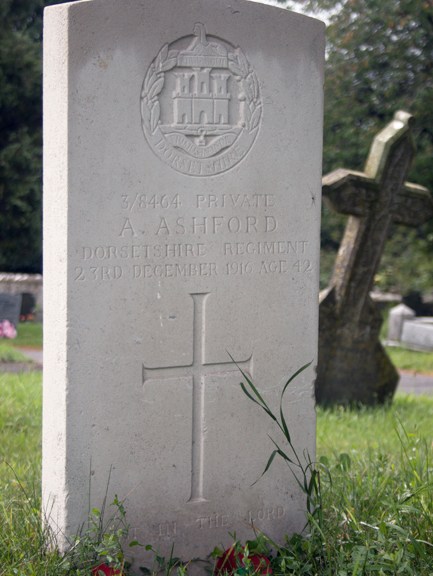
Private Arthur Ashford

Private Ashford

Arthur James Ashford was born in the Dorset village of Okeford Fitzpaine, to John and Tryphina Ashford. His father died when Arthur was only seven years old, leaving Tryphina to raise him and his three siblings.

Arthur had had a military career before the start of the Great War. He had enlisted into the Dorsetshire Regiment in 1891 and, while I have not been able to locate his records from that time, the regiment had been stationed in Ireland in the 1890s.

In 1899 he married Amy Upshall, at which point he was employed as a labourer. The couple had six children, though sadly, two of them – Arthur George and Elsie May – died in childhood.

He enlisted within months of the First World War beginning, returning to the Dorsetshire Regiment he had previously served on 30th September 1914. (It is interesting that on his enlistment papers he said that he had previously served for 12 years, although the dates don’t fully tally up.) This time, however, Private Ashford served on the Home Front, in Dorchester and Portland.

On the evening of 22nd December 1916, Arthur fell down a gulley in Portland. He was taken to the Verne Military Hospital in the town, but died of his injuries – a fractured skull – in the early hours of the following day.

Private Arthur Ashford was buried in his home village of Evercreech on Thursday 28th December 1916.