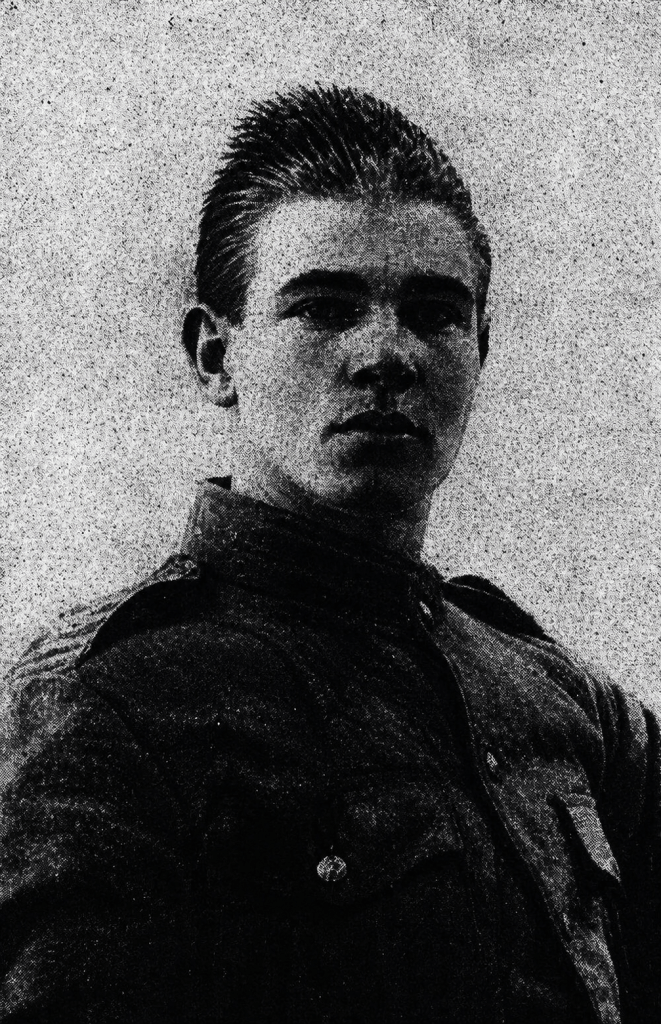
Ernest Bennett was born in Calne, Wiltshire, early in 1887, and was the only child to Henry and Elizabeth. Henry was a general labourer and carter for a local mill, but when he son completed his schooling, he took work as a mason’s labourer.
Alongside his paid work, Ernest also volunteered with the local militia, as a Private in the 4th Battalion of the Wiltshire Regiment. He also fell in love and, on the 6th December 1913, he married Emily Hitchens. The couple set up home in Trowbridge, and went on to have two children: Phyllis and Nelson.
When war broke out, Ernest’s time in the army proved invaluable. He was mobilised on the 1st September 1914, and assigned to the 3rd Battalion of his former regiment. Private Bennett’s medical report shows that he was 5ft 8.5ins (1.74m) tall and weighed 140lbs (63.5kg). He had fair hair, blue eyes and a fair complexion.
Details of Private Bennett’s time in the army are sparse, but it is clear that he was sent to France by the end of November. He wasn’t overseas for long, however, and was back in Britain by the first week of February 1915. The reason for Ernest’s return is unclear, but it is likely to have related to his health: on the 2nd September 1915, he was medically discharged from the army.
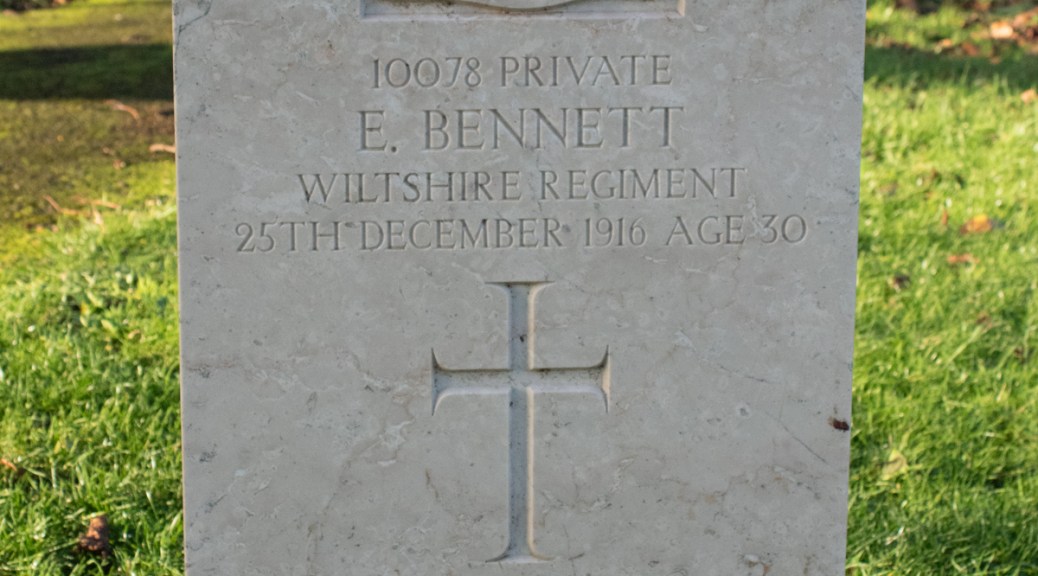
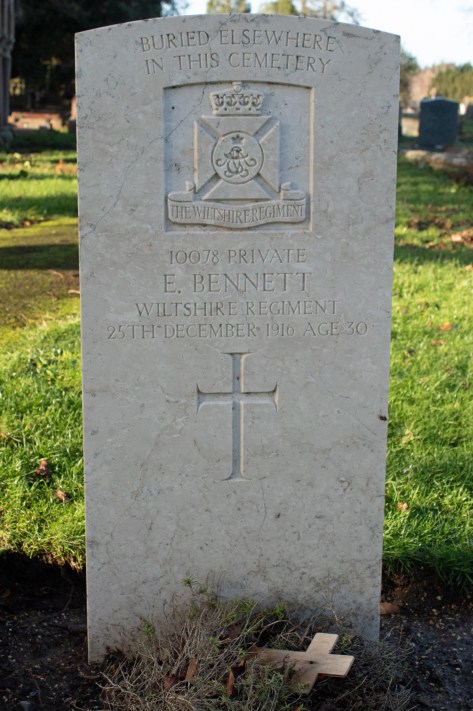
At this point, Ernest’s trail goes cold. He appeared to have gone back home as, on Christmas Day 1916, this is where he passed away. He was 29 years of age.
The body of Ernest Bennett was laid to rest in Trowbridge Cemetery: the exact location has been lost to time, but he is commemorated with a CWGC headstone close to some other war graves.
Stephen Smith was born in Hilperton Marsh, Wiltshire, in 1890. The fourth of eight children, he was the second of three sons to Thomas and Vashti Smith. Thomas was a hawker, and the family were living at 14 Islington Place when Stephen was born.
By the time of the 1901 census, the family had moved to 65 Shails Lane, slightly closer to Trowbridge town centre. Three of the family – Thomas, Vashti (who went by her middle name, Sarah), and their oldest child, Selina – were all employed in hawking. Stephen, just 12 years of age, was still at school, but his older brother, Alfred, was earning a little by collecting rags.
On 30th August 1908, Stephen married Beatrice Harding. They were both just 18 years of age at the time, and it seems to have been a love match: they went on to have three children, but their eldest, daughter Annie, was not born until 1911.
By the time of that year’s census, the young were renting a tenement at 5 Burbidge’s Yard. Just around the corner from Stephen’s Parents in Shails Lane, it was small courtyard filled with dyers, needleworkers, carpenters and hawkers.
Stephen also wanted to do his bit in the service of his King and, on the 14th June 1908, he enlisted in the 3rd Battalion of the Wiltshire Regiment. His service papers show that he was 5ft 7.5ins (1.71m) tall, and weighed 155lbs (70.3kg). He was noted as having brown hair and brown eyes.
Over the next four years, Stephen remained on home soil. He proved his mettle, and was appointed to Lance Corporal on 21st June 1911, and Corporal less than a year later. In October 1912, he extended his service for another four years. By June 1913, Stephen had been promoted again, his exemplary service resulting in him being made Sergeant.
War broke out in the summer of 1914, and Sergeant Smith found that his rank meant that he wouldn’t be able to serve with his men. At his own request, he reverted to the rank of Private and, on 11th September, he transferred to the 1st Battalion and was sent to France.
Private Smith’s unit fought at the Battle of Messines, and he was injured there. A gunshot wound to his right foot meant a medical evacuation to Britain, and he was admitted to the 2nd Western General Hospital in Manchester, Lancashire, for treatment.
Following his discharge, Stephen remained on home soil, but his health was becoming affected in unexpected ways. He had developed varicose veins in late childhood, and these developed to the point where he was not longer fit for military duty. He was discharged on 15th April 1916, and returned home to Trowbridge. The condition was declared not to be related to his service, so he did not receive any recompense for it.
By the spring of 1917, another issue had presented itself. Stephen was suffering from tuberculosis, and the prognosis was not good. “In my opinion [Private Smith] acquired the disease whilst in the service and the disease was aggravated in consequence of his military duties. He is suffering from the disease in rather an advanced stage and it does not appear to me probable that he will live for another year.” Signed Leonard Crossley MD, County Tuberculosis Officer. [Medical Report on Stephen Smith: 28th March 1917]
Ultimately, Dr Crossley’s prediction would prove correct:
The death occurred on Saturday at Lower Broad Street of Stephen Smith, aged 27, who served for some time in the Army and was discharged nearly two years ago on account of a wound in the leg. For some time past he had suffered from tuberculosis, but he was out of doors as recently as Friday. He leaves a widow and four young children.
[Wiltshire Times and Trowbridge Advertiser: Saturday 8th December 1917]
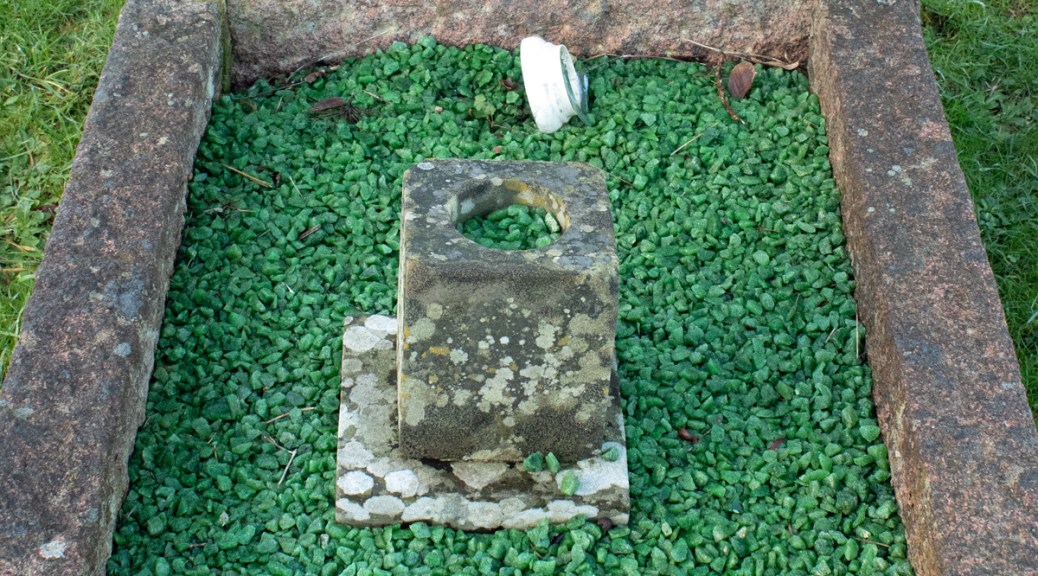
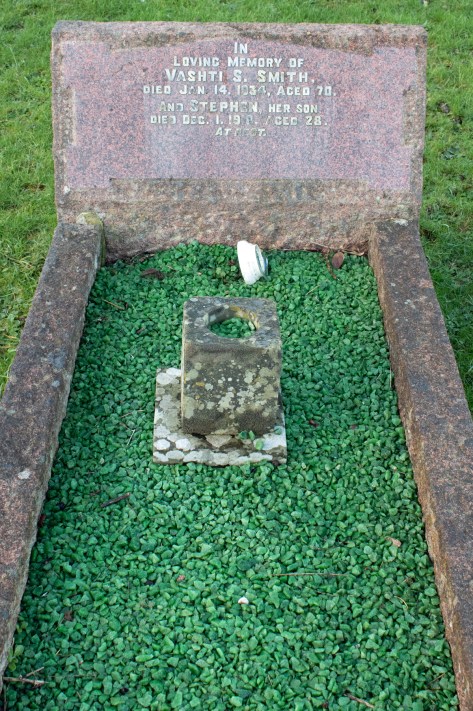
The body of Stephen Smith was laid to rest in Trowbridge Cemetery, not far from where his grieving family were still living.
While Stephen’s father disappears into history, his mother, Vashti, lived on until 1934. She was laid to rest with her son, mother and son reunited after 17 years.
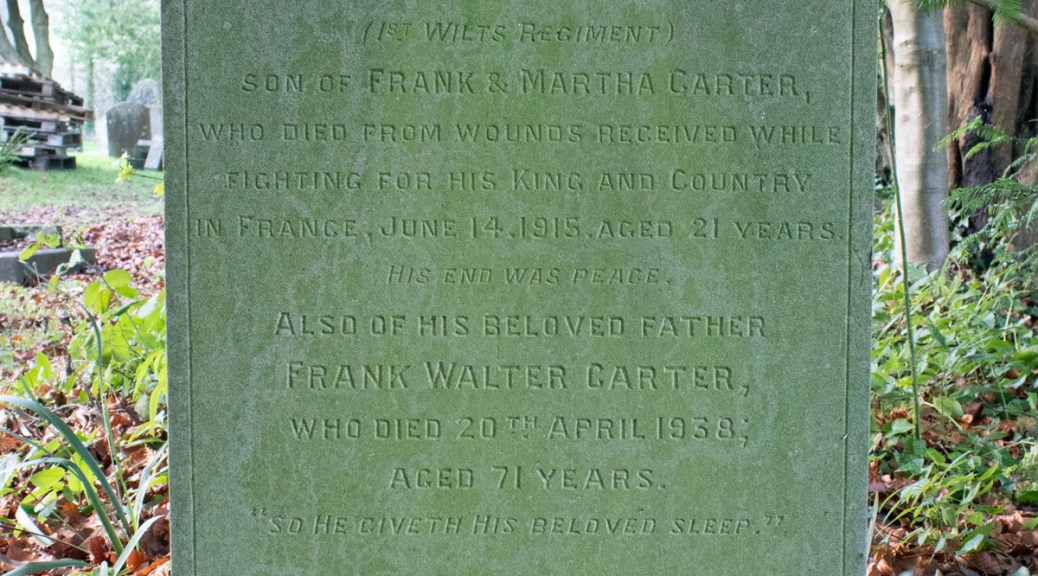
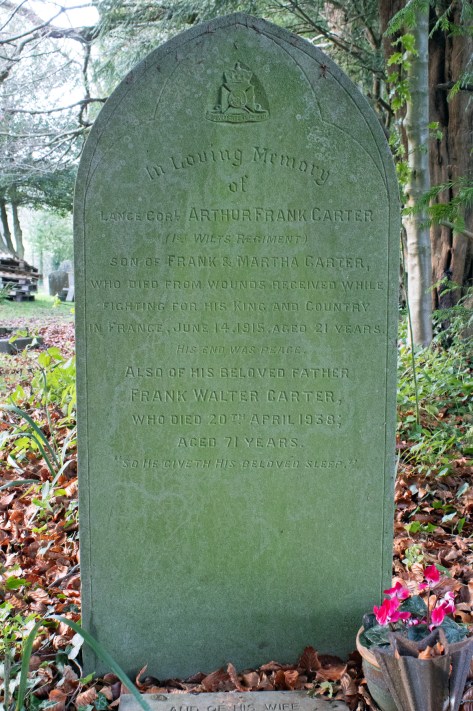
Arthur Frank Carter was born in the 10th July 1893 in Bratton, Wiltshire. The third of seven children, he was the oldest of four sons to Frank and Martha Carter. Frank was a farm labourer, and the family lived on Lower Street, to the north of the village centre.
When Arthur finished his schooling, he found work as a carter, probably unintentionally living up to his family’s name. When war broke out, however, he stepped up to play his part. Serving in the Wiltshire Regiment as a Private, he was attached to the 1st Battalion and, by the 19th January 1915, he found himself in France.
Full details of Private Carter’s service have been lost to time, but during his time overseas, he received a promotion to Lance Corporal. In June 1915 he was wounded, and was sent back to Britain for treatment. Admitted to hospital in London, Arthur’s injuries would prove to be too severe. He passed away on 12th June 1915, at the age of just 21 years old.
The body of Arthur Frank Carter was taken back to Wiltshire for burial. He was laid to rest in the family plot in St James’ Churchyard, Bratton.
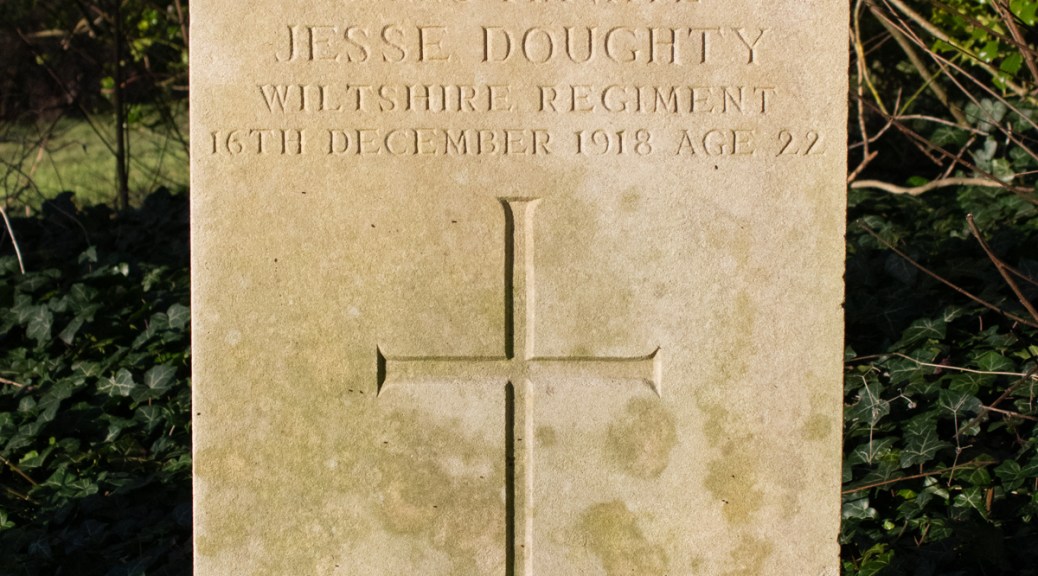
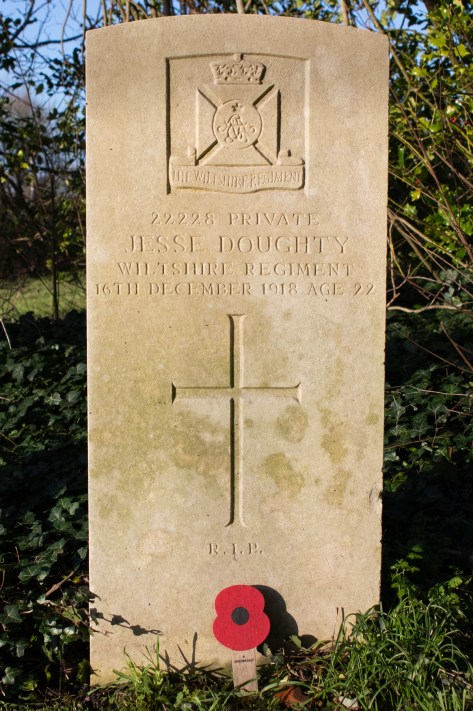
Jesse Doughty was born in the Wiltshire village of Bapton in the autumn of 1896. One of ten children, his parents were shepherd George Doughty, and his wife, Fanny.
George died in 1902, and Jesse’s mother was left to raise the children. His older brother William took the role of head of the family, however, and, by the time of the 1911 census, the Doughtys were living in a six-roomed cottage, with six wages coming in. Jesse, the second youngest of the siblings, had finished school by this point, and was working as a shepherd boy.
When war broke out, Jesse stepped up to serve his country, although full details of his time in the army have been lost to time. It seems that he initially joined the Machine Gun Corps, but transferred to the Labour Corps of the Wiltshire Regiment.
By the autumn of 1918, Private Doughty was based in Fovant, Hampshire. While there, he fell ill, and was admitted to a military hospital with pneumonia. The condition would prove fatal, and he passed away on 16th December, at the age of 22 years old.
The body of Jesse Doughty was taken back to Wiltshire for burial, and he was laid to rest in the graveyard of St Nicholas’ Church, Fisherton de la Mare, a short walk from where his family were still living in Bapton.
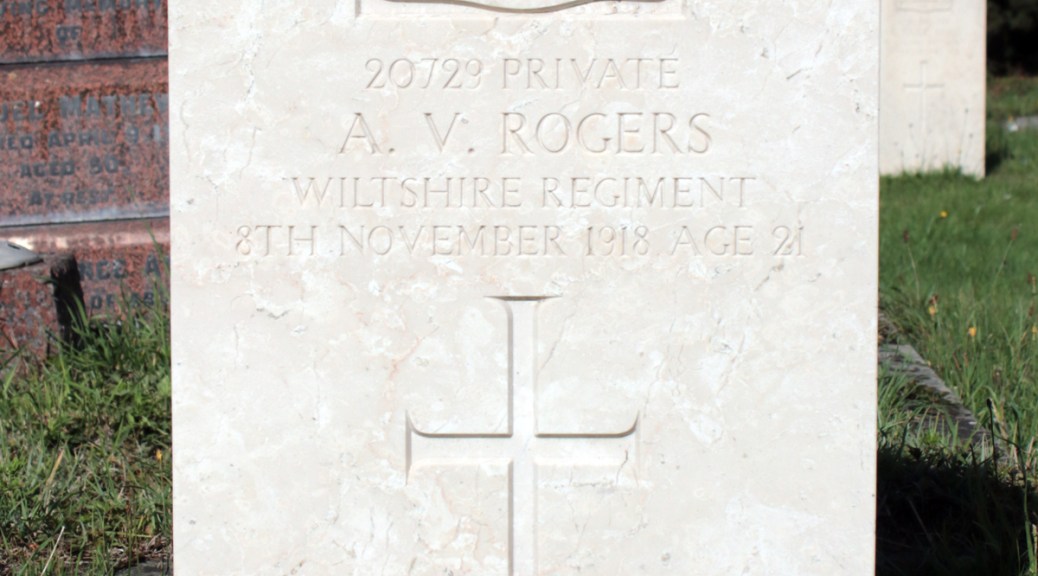
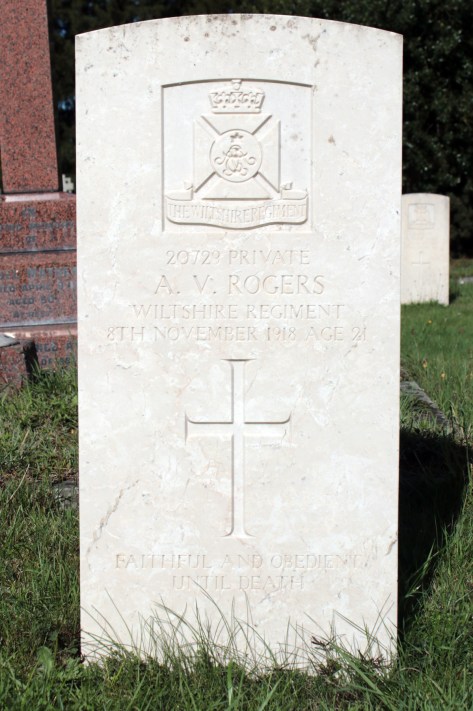
Albert Victor Rogers was born in Trowbridge, Wiltshire, on 2nd June 1897. The middle of three children, he was the older son to Edward and Elizabeth Rogers. A Liverpudlian, Edward worked as a carter for a flour mill, and the family lived in Lower Westwood, to the west of Trowbridge itself.
By 1911, the Rogers family had relocated to the centre of Trowbridge, and were living in a small cottage at 3 Church Street. Edward was now employed as a mason’s labourer, while Albert’s sister, Amy, had taken a job as a wool and worsted piecer for a local cloth mill. Albert, just thirteen years of age, was likely in his last year at school.
Albert’s military records are limited. They note that, as a Private, he was attached to Wiltshire Regiment Depot, and the he died in a military hospital on 8th November 1918. He was just 21 years of age. Details of his passing and funeral do not appear in any local contemporary newspapers, so it is unclear how he passed.
The body of Albert Victor Rogers was laid to rest in the sweeping grounds of Trowbridge Cemetery, not far from where his family still lived.
By the time of the 1921 census Edward had also died. The document recorded Elizabeth living in a cottage at 85 Mortimer Street, Trowbridge, and that she was employed as a waste picker for Salter & Co, a wool manufacturer.
The four-roomed property was a busy place, which Elizabeth shared with her surviving son, Leslie, brother Arthur Hobbs, and niece Gladys Rogers. Amy had also died by this point, and so Elizabeth had opened her home to her three grandchildren Leonard, Doris and Victor.
[My thanks go to Rob Clarke for his invaluable information about Albert’s life and family.]
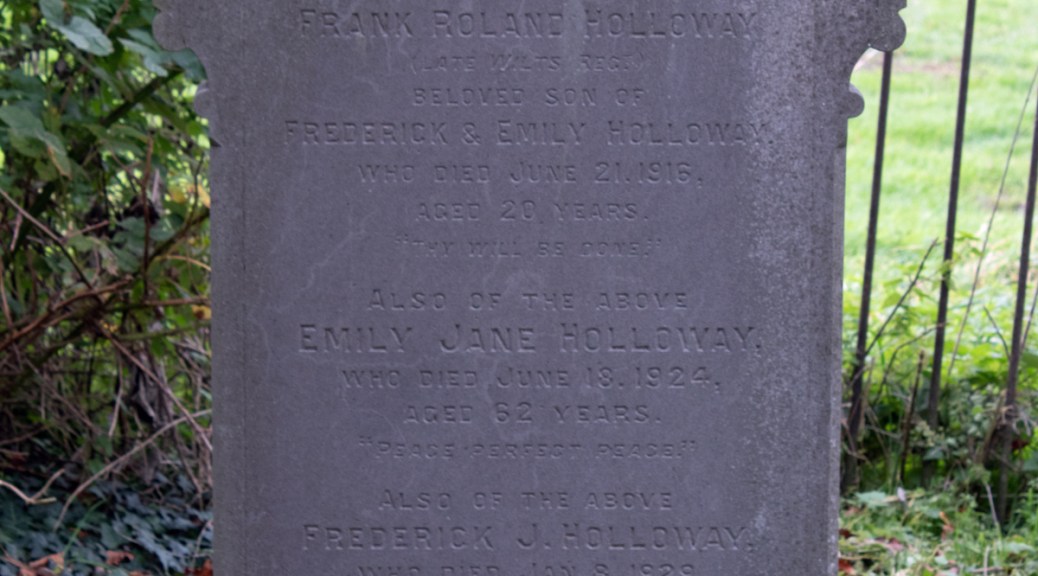
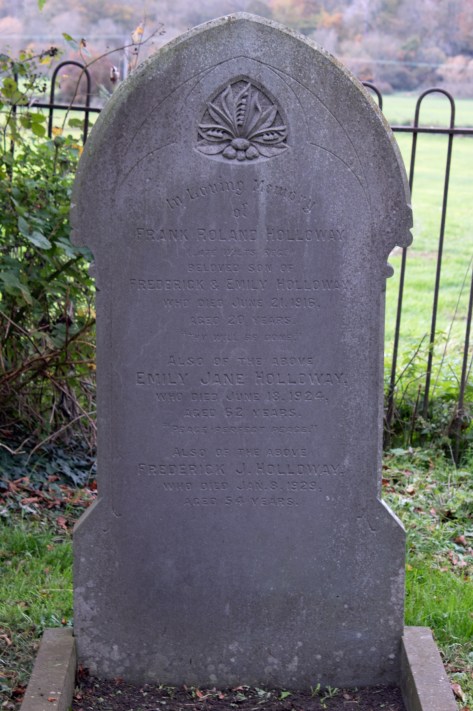
Frank Roland Holloway was born in Bristol, Gloucestershire, early in 1896. One of five children, he was the only son to Frederick and Emily Holloway. Frederick was a general labourer, and by the turn of the century, the family had moved to Hilperton, Wiltshire.
When Frank completed his schooling he found work in a local cloth mill. The 1911 census record the family living on Marsh Road, Hilperton, with four – albeit meagre – wages coming into the household. Frederick was employed by the Anglo Swiss Milk Company as a labourer, while his daughter, Frank’s older sister Edith, was also working in the factory’s tin shop. Emily was helping other people with their laundry, bringing in a few extra pennies.
War broke out in the summer of 1914, and Frank would step up to play his part. His service papers show that he was employed as a rubber worker by this point, and that he was a volunteer with the local militia. He formally enlisted on the 20th February 1915, and was assigned to the 8th Battalion of the Wiltshire Regiment as a Private.
Private Holloway remained with his unit for four months, before being discharged from military service, having contracted tuberculosis. Interestingly, his service papers include a statement from Frederick about his son’s health:
I am making an application on behalf of my son. He had been ill now for over 12 months. He served 2 years 175 days in 4th Wilts and 129 days in 8th Wilts. He had not any illness for some years and had been in good health and passed several military doctors for active service, but having left Salisbury Plain he came to Trowbridge where they slept in damp straw also under [a] bad roof in [an] old disused factory. He was a lad in good health and is now suffering with consumption.
Sadly, any response to Frederick’s request for compensation would come too late. Frank passed away on 21st June 1916: he was just 20 years of age.
The body of Frank Roland Holloway was laid to rest in St Paul’s Churchyard, in village of Staverton, the parish church for his home in Hilperton.
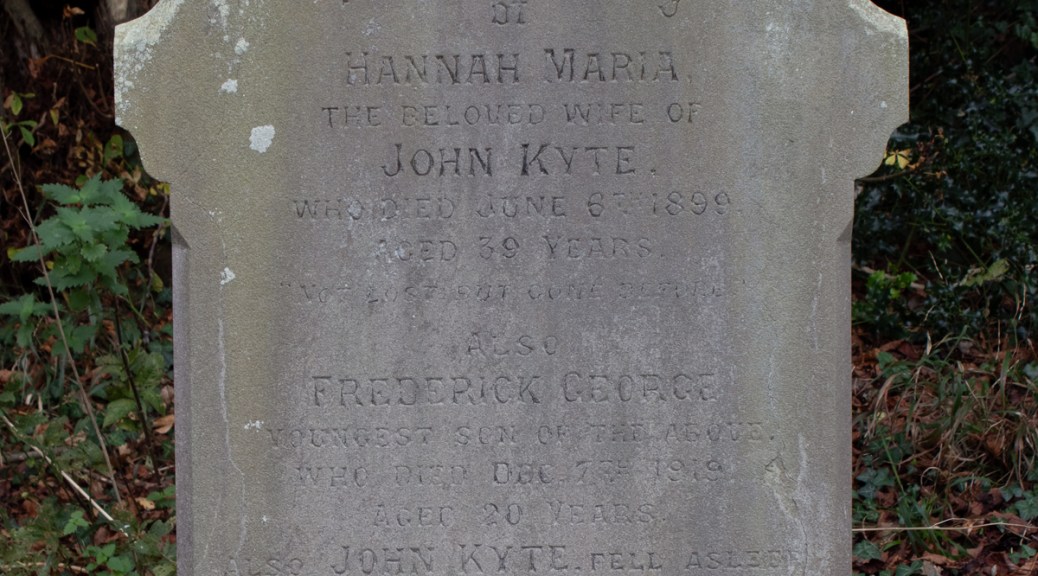
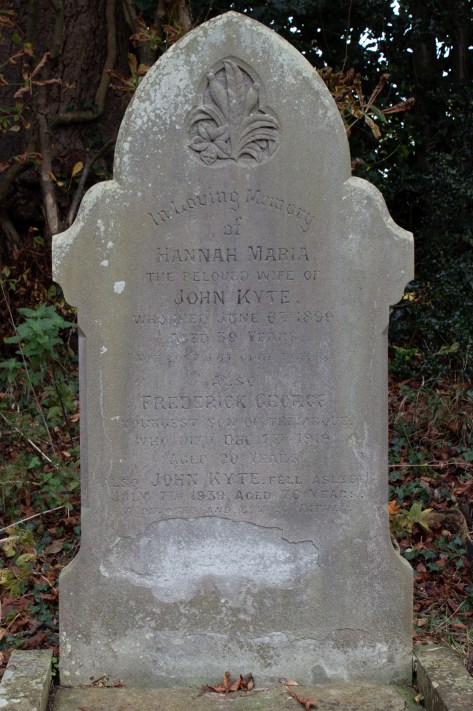
Frederick George Kyte was born on 23rd January 1899. The youngest of five children, his parents were Wiltshire-born market gardener John Kyte, and his wife, Esther. Frederick’s mother had been born in Chelsea, Middlesex, but it was in John’s home county where the family lived, on 16 Wine Street, Bradford on Avon.
Education was important to John and Esther. The 1911 census found his older brothers working as clerks, one to a rubber works, the other to a solicitor.
In his spare time, Frederick was a chorister and the local parish church, and was ‘an enthusiastic member of the Church Lads’ Brigade’ [Wiltshire Times and Trowbridge Advertiser: Saturday 13th December 1919] When he completed his schooling, he also found work as a clerk, and was employed by a local insurance broker.
On 13th January 1915, Frederick joined the Wiltshire Regiment, and, as a Bugler, was attached to the 8th Battalion. He was only 15 years of age, but remained with the unit for the next two years, until he was invalided out of the army for medical reasons.
After some time he partially recovered, and resumed his occupation as an insurance agent, but took to his bed some three months ago.
[Wiltshire Times and Trowbridge Advertiser: Saturday 13th December 1919]
The lung condition Frederick had contracted would be the one to which he would ultimately succumb. He passed away in the family home on 7th December 1919, aged just 20 years old.
The body of Frederick George Kyte was laid to rest in the family plot in Bradford on Avon cemetery.
The newspaper report provides some further information about Frederick’s brothers. Both also served in the army, and both rose to the rank of Serjeant.
The eldest [Edward] is now with HM Forces in Palestine, whilst the younger, Herbert, who was mentioned in despatches and awarded the Military Medal for good work during the retreat, is demobilised.
[Wiltshire Times and Trowbridge Advertiser: Saturday 13th December 1919]
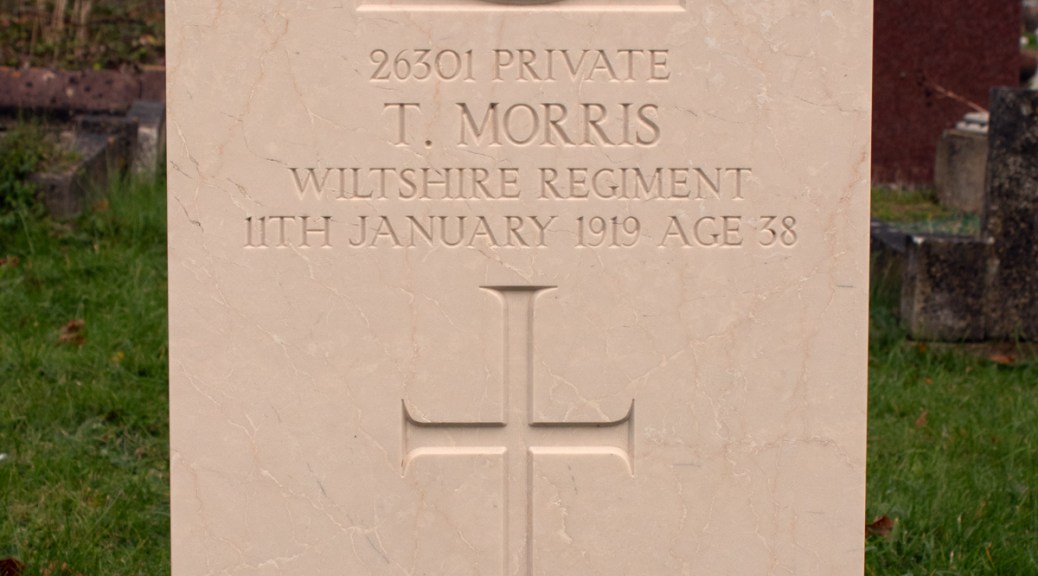
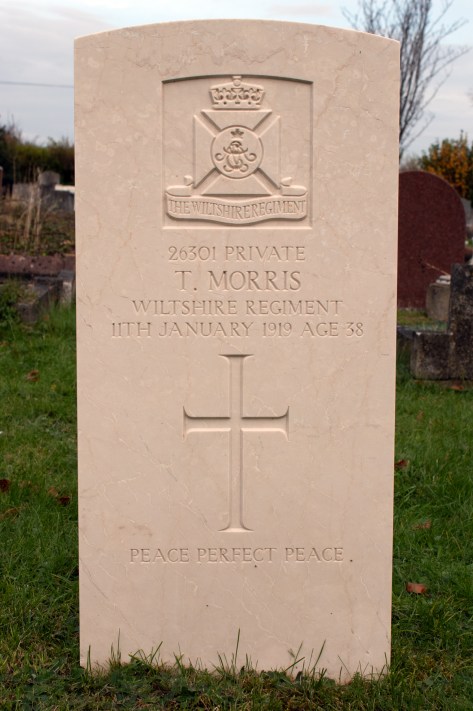
Thomas Morris was born on 12th November 1880 in Bradford on Avon, Wiltshire. One of thirteen children, his parents were Henry and Eliza Morris. Henry was a chimney sweep, and this is a trade that Thomas would also go into, unsurprisingly, from a very young age. The family lived to the north of the town centre, initially at 57 Newtown, before moving round the corner to 5 Wine Street.
By the turn of the century, love was beckoning for Thomas. On 29th March 1903, he wed Annie Britten, a labourer’s daughter, who also lived on Wine Street. The marriage certificate noted that Thomas had changed jobs, and was employed as a labourer.
The 1911 census return shows the family home that had been set up. Henry and Eliza were still at Wine Street, although now at No. 44. Thomas and Annie were also living there, crammed into the four-roomed cottage with their four children as well. Henry was still working as a chimney sweep, while Thomas had found employment as maltster’s labourer.
Annie would go on to have six children in all, and when war broke out, she was left to raise the family with the help of her father-in-law (Eliza having passed in May 1914). Thomas enlisted in the Wiltshire Regiment early on in the conflict and, according to later reports, had seen a lot of service on the Western Front. He survived the conflict, however, and returned to a base in the garrison town of Trowbridge, Wiltshire.
At the start of 1919, Private Morris came home on leave, but while there, he fell ill. He was admitted to the military hospital in Sutton Veny, also in Wiltshire, but succumbed to the influenza he had contracted. He passed away on 11th January 1919, aged the age of 38 years old.
The body of Thomas Morris was taken back to Bradford on Avon to be buried. He was laid to rest in the town’s cemetery.
Annie was now a widow with children to raise. Henry had also passed away in 1918, and so she remarried, wedding William Bishop in December 1919. The couple went on to have a child of their own, Phyllis, in March 1921.
Annie would live a peaceful life, passing away in Trowbridge in 1943, at the age of 60.
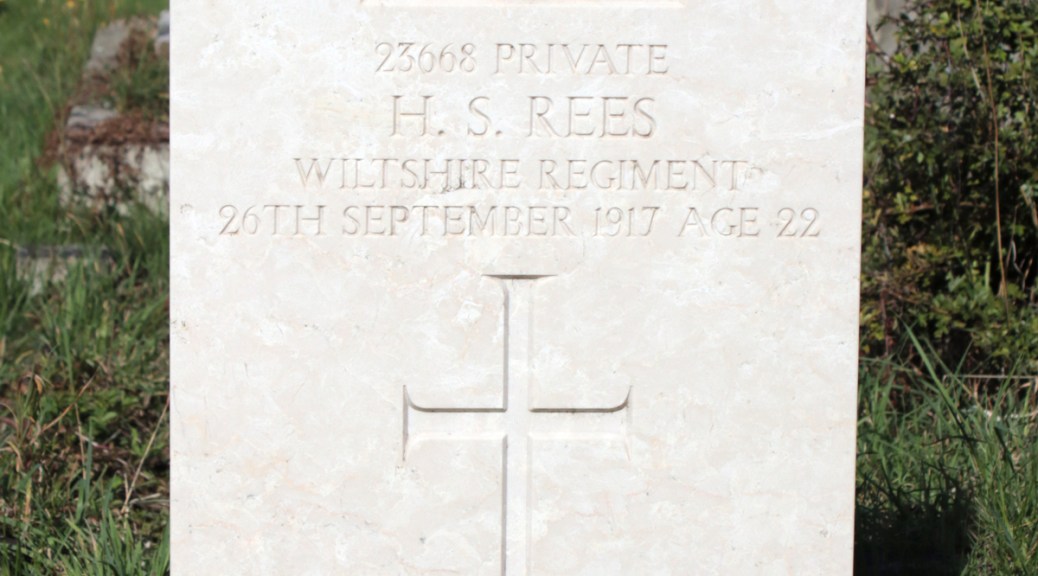
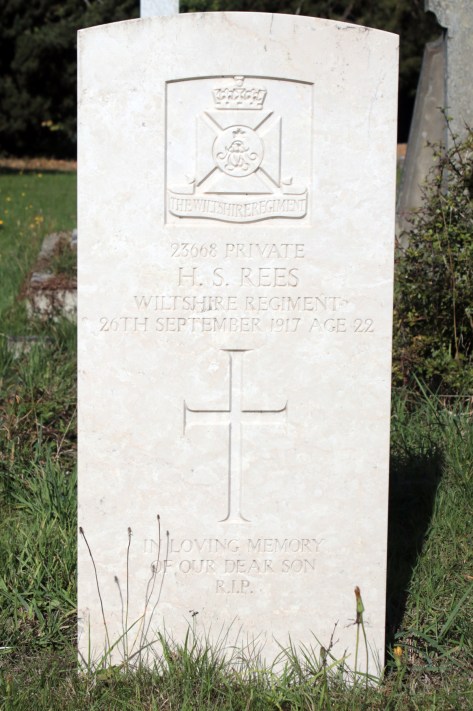
Howard Stephen Rees was born in the spring of 1895 in Trowbridge, Wiltshire. He was the second of six children – and the older of two sons – to Stephen and Annie. Stephen was an engine driver, and the 1901 census found the family living in a small terraced house at 18 Gloucester Road, a short walk from the town’s railway station.
By the time of the next census, the family had moved to a larger house, and were living at 15 Innox Road, to the north of the town centre. Stephen was still employed as an engine driver, while there were too further wages coming into the household. Howard’s older sister, Catherine, was working as a rug weaver, while he himself was employed as a page boy, a bell hop for one of the hotels in the town.
By the time war broke out, Howard had moved from page boy to cellarman. The pull to serve his country was strong, though, and he gave up his job to enlist in the army on 7th September 1914, just a month after the start of the conflict.
Private Rees was assigned to the Wiltshire Regiment. His service papers show that he was 5ft 11ins (1.8m) tall and weighed 120lbs (54.4kg). He was noted as having brown hair, brown eyes and a fair complexion. Howard’s medical examination was to conclude that he was not fit for army service, due to a ‘very poor physique and.. an impediment of speech’. He was recorded as being quite unfit for a soldier. His time in the army was to last just 20 days.
Howard was not deterred by this setback, however, and it seems that he tried to enlist again at some point, and this time succeeded. Full details have been lost, but from the documents that remain, he had joined the 2nd Battalion of the Wiltshire Regiment by the spring of 1917.
The funeral took place on Monday a the cemetery of Private Howard Stephen Rees, Wilts Regiment, aged 22 years, who passed way after a painful illness lasting five months, at the Bath War Hospital on Wednesday September 26th from wounds received in action in France on April 23rd.
[Wiltshire Times and Trowbridge Advertiser: Saturday 6th October 1917]
Howard Stephen Rees received his injuries during the Arras Offensive of 1917, his eagerness to be included in the war having led to his death. His body was taken back to Wiltshire, and was laid to rest in Trowbridge Cemetery.
William John Cockerton was born in the autumn of 1896 in Holloway, Middlesex. The older of two children, his parents were baker John Cockerton and his wife, Elizabeth.
The 1901 census found the family living at 28 Highbury Station Road. The house is long since gone, but the Cockerton’s neighbours included a horse keeper, porter and a police constable.
By the time of the 1911 census, William had left London, and was living with his paternal uncle and aunt, Fred and Amy, in Trowbridge, Wiltshire. Fred was an ironmonger, and his nephew had taken an apprenticeship with him. The census notes two visitors to the property – 22 Clarendon Villas – William’s mother and sister, Elizabeth and Dolly.
In his spare time, William started volunteering with the local militia. When war broke out, he was quick to enlist, formally joining the Wiltshire Regiment as a Private. Assigned to the 2nd Battalion, by December 1914, he found himself in India. A later newspaper report detailed how his military service unfolded:
..after a period of garrison duty in India, he volunteered for duty with the Mesopotamian Expeditionary Force, and took part in some of the biggest engagements against the Turks, being eventually wounded, captured and reported dead. For some two years he was held in captivity, during which he ensured great hardships that seriously undermined his health.
[Wiltshire Times and Trowbridge Advertiser: Saturday 26th April 1919]
William was reported missing in February 1917, with an understandably grief-stricken John and Elizabeth later being informed that he had been severely wounded in the chest, succumbing to his injuries half-an-hour later. His name was placed on the roll of honour at Trowbridge, but in July 1917, William’s parents received a card from Turkey in his handwriting, explaining that he was a prisoner of war.
Private Cockerton was released on 16th November 1918, and returned to Britain.
Early in March, he went to Harrow-on-the-Hill for a holiday, staying with his uncle. Here he was taken ill with malarial fever and pneumonia, which resulted in his death.
[Wiltshire Times and Trowbridge Advertiser: Saturday 26th April 1919]
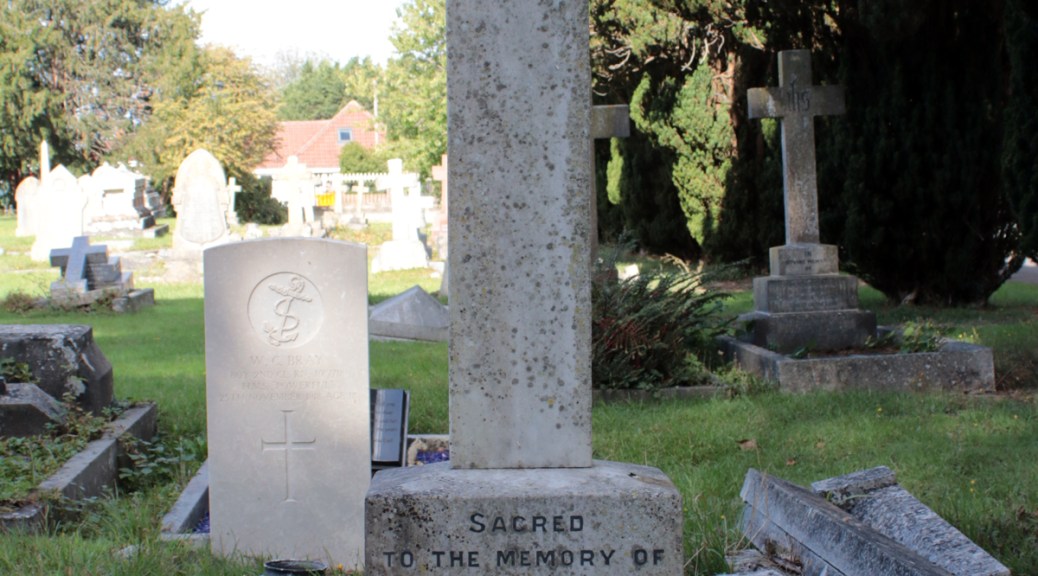
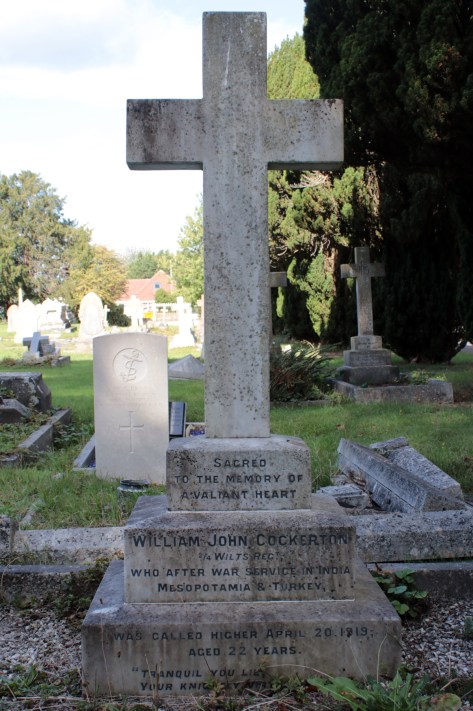
William John Cockerton was just 22 years of age when he passed away on 20th April 1919. His body was taken back to Wiltshire for burial, and he was laid to rest in Trowbridge Cemetery. He lies at rest in the family plot, alongside his father, who had passed away in the autumn of 1916.
Private William Cockerton (from britishnewspaperarchive.co.uk)