
Tag Archives: leukaemia

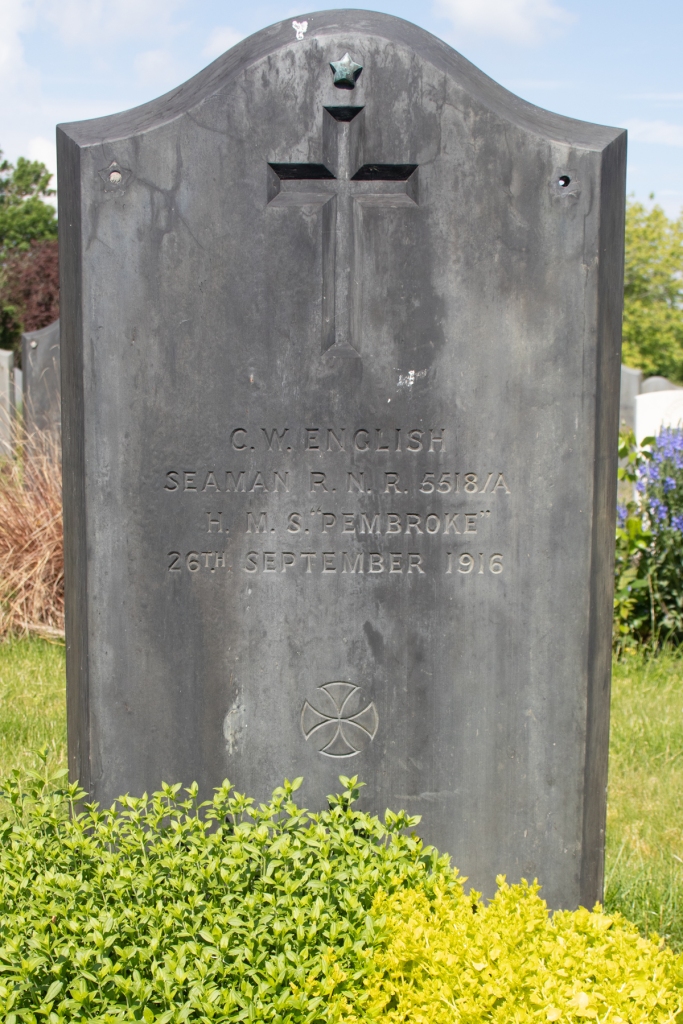
Seaman Charles English

Seaman Charles English

Charles William English was born on 30th August 1895 in the Suffolk town of Southwold. According to his later naval service records, his parents were Ellis and Sarah English, although there is little other information available to back this up.

Charles evidently had a draw to the sea and, when he enlisted in the Royal Naval Reserve on 10th January 1914, he was working as a fisherman. His service records confirm that he was 5ft 9ins (1.75m) tall, with grey eyes and a fresh complexion.

Over the next few years, Seaman English served off the east coast, and was attached to HMS Mantua, a former cruise ship taken over by the Royal Navy to patrol the North Sea. In between trips, Charles made HMS Pembroke, the Royal Naval Dockyard in Chatham, Kent, his home and it was to here that he returned in the autumn of 1916 when he fell ill.

Charles was admitted to the Royal Naval Hospital in the town, tests showing that he was suffering from lymphatic leukaemia. This was to prove fatal, and Seaman English passed away on 26th September 1916, aged just 21 years of age.

It seems likely that Charles William English’s family were unable to foot the bill for bringing their son back to Suffolk. Instead, he was laid to rest in Woodlands Cemetery, Gillingham, not far from the base he had come to call home.

Private Oliver Chubb

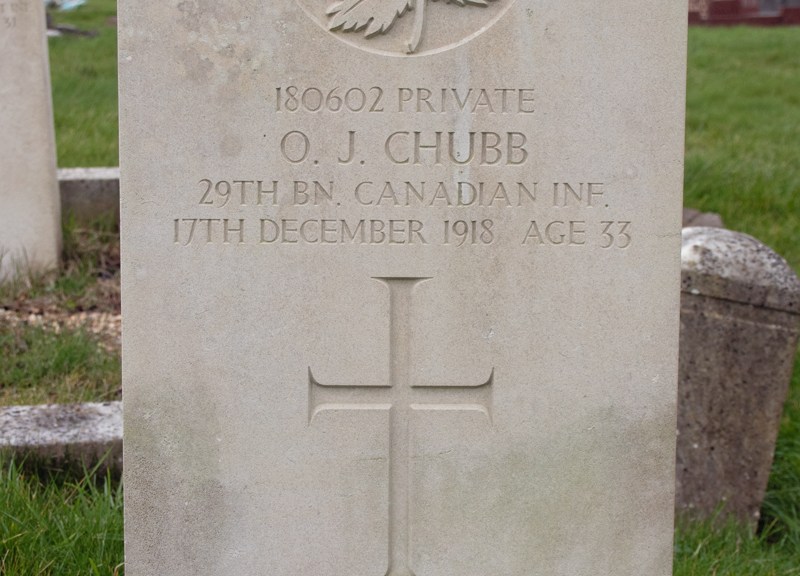
Private Oliver Chubb

Oliver Job Chubb was born on 3rd December 1884 in the village of Smallbridge in Devon. He was one of six children to Job Chubb, who was an agricultural labourer, and his wife Louisa. Oliver did not seem to be one for settling down; after his parents had moved the family to Ilminster in Somerset when he was just a child, by 1901 he was living in Lyme Regis, working as a carter in a market garden.

In 1902, at the age of 17, Oliver enlisted in the Somerset Light Infantry. Eighteen months later he transferred to the Royal Navy, serving as a Stoker on a number of ships during what would become twelve years’ service, including the Royal Oak, Skirmisher and Newcastle.

In 1906 he married Rosina Keirle, a brickmaker’s daughter from Somerset. The wedding was in Bridgwater, and the couple went on to have three children, Olive, Albert and Cecil.

There is a sense that Oliver either had perpetually itchy feet, or that he was always running from something. The 1911 census found him aboard HMS Suffolk in the Mediterranean, where he listed himself as single. By the end of his naval service in November 1915, however, Stoker Chubb disembarked in the port of Victoria, British Colombia, and immediately signed up for military service with the Canadian Expeditionary Force.

Again, however, indecision seems to have set in. He listed his marital status as ‘single’ and confirmed his next of kin as his sister Elsie, but on his military will, he left everything to Rosina.

Private Chubb was assigned to the 29th Battalion of the Canadian Infantry; they served on the Western Front from early in 1915 through to the end of the war. He was involved in the fighting at Ypres, and, in September 1916, was treated in England for an inguinal hernia. After three months’ recover, he returned to the front.

While Private Chubb seems to have had a good overall manner, there were blips in his character. In May 1917, he was sentenced to three days’ field punishment for being absent without leave for 21hrs. In March 1918, he was sentenced to another five days’ field punishment for going AWOL for 48 hours. On 11th April 1918, Private Chubb received 14 days’ field punishment for drunkenness on duty.

In December of that year, Oliver was invalided back to England for medical treatment; he was admitted to the Fort Pitt Military Hospital in Chatham with lymphatic leukaemia. Sadly, Private Chubb passed away shortly after being admitted, dying on 17th December 1918. He was 34 years old.

Oliver Job Chubb lies at rest in St John’s Cemetery in Bridgwater, where his family still lived.