Tag Archives: Private

Private William Rawle

Private William Henry Rawle

William Henry Rawle was born in 1890, the eldest child of George Rawle, a sailor, and Louisa, his wife.

At the time of the 1911 census, William was working as a carter on a farm not far from Porlock in Somerset.

He enlisted in August 1914, joining the Somerset Light Infantry and serving as part of the Expeditionary Force. After a couple of postings, Private Rawle was transferred to the Pioneer Depot in March 1916.

Six months later William was medically discharged as unfit for continued service. His notes highlight his distinguishing marks as 3 marks on his left arm, birth mark under his right nipple and gunshot wound to the left eye (which I am guessing is what led to his discharge).

William died on 11th June 1921, aged 27 years old. I have been unable to find anything specific relating to his death and it is likely, therefore, that no misadventure was involved.

Private William Henry Rawle lies at peace in the churchyard of Lydeard St Lawrence, alongside his brothers Stephen and Ernest.


George and Louisa’s other son – Edward – also served, enlisting in the Somerset Light Infantry and fighting in the Balkans. Private Edward Rawle survived the war, returning home in March 1919.

It should be noted that, by June 1921, George and Louisa had lost three of her four sons to the Great War. Their daughter, Norah, had also passed away in 1918.

The 1921 census found Louisa living in East Town, in the parish of Tolland, not far from Lydeard St Lawrence. Edward was living with her, as were her three-year-old granddaughter, Lorna, and her eighteen-month-old grandson Beatty. It is unclear whose children they were. George, at this point, was helping his younger brother out on the family farm in Williton.


Private George Symons

Private George Symons

George Symons was born in 1895 to Charles and Rosa Symons. He was the third of five sons.

Charles worked as a carter on a farm, and his son became a cowman as soon as he could leave school.

Military records for George Symons are pretty sparse. From his gravestone we know he had joined the Somerset Light Infantry by the end of 1917. Assigned to the 4th Battalion, Private Symons’ unit served in India and the Middle East throughout the war, and it was while he was overseas that he was caught up on the fighting.

In the confusion of battle, George was initially recorded as ‘presumed dead’. Subsequently identified as badly injured, he was medically repatriated to Britain for treatment. Admitted to hospital, his wounds were to prove too severe: Private Symons passed away on 23rd June 1918: he was 23 years old.

George Symons’ body was taken back to Somerset for burial. He lies at rest in the churchyard of St Michael and All Angels in Milverton.


Private Charles Stodgell

Private Charles William Stodgell

Charles William Stodgell was born in Somerset in 1878, the eldest son of Samuel and Mary Stodgell. His father was an agricultural labourer, while his mother was a glover. Charles followed into farm work, becoming a carter by time of the 1901 census.

Charles married Mabel Duke in 1898 and the young couple had two daughters – Ida and Florence – in the following few years.

When war came, Charles was called up. He enlisted in June 1916, joining the Devonshire Regiment before being transferred to the Agricultural Company. His record shows that he stood at 5ft 6ins (1.67m) and weighed 10st 2lbs (64kg) and his build, health and experience is probably why he ended up in service where he did.

Private Stodgell was demobbed at the end of the war, and returned home on furlough (a word not just linked to everything 2020 has thrown at us!). Sadly, before he was fully demobbed, he contracted influenza, and died on 2nd February 1919.

Charles William Stodgell lies at rest in his home village of North Curry, in the churchyard of St Peter & St Paul.

Private Arthur Palmer

Private Arthur Palmer

Arthur Palmer was born in Bicester in 1889 to groomsman George Palmer and his wife Annie. Arthur was the eldest of five children, five boys and one girl.

By 1911, the family had moved to Dorset, where George continued to work as a groom. His son, Arthur, had also gone into domestic service, and was a footman. Presumably this was under the same employ as his father, although the records do not confirm this.

This is where the trail for Arthur Palmer dries up.

From his gravestone, we know he served in the Machine Gun Corps (MGC). The Register of Soldiers’ Effects confirms he was in the 3rd Company; this was formed in January 1916, so Private Palmer can only have enlisted after that date.

Online research only brings up MGC military service records for an Arthur George Palmer, who lived in Kettering. However, this Private survived the war, so could not be the one buried in Dorset. There is nothing in contemporary newspapers to suggest that there was anything untoward or unusual about his passing.

All I can say for certain is that Private Arthur Palmer died at the Cannock Chase Military Hospital on 13th November 1918.

He lies at rest in Sherborne Cemetery, Dorset. He was 30 years old.

Private John Kennell

Private John Kennell

John Kennell was born in Yeovil in 1872. One of five children, he was the only son of bootmaker Francis Kennell and his wife Elizabeth.

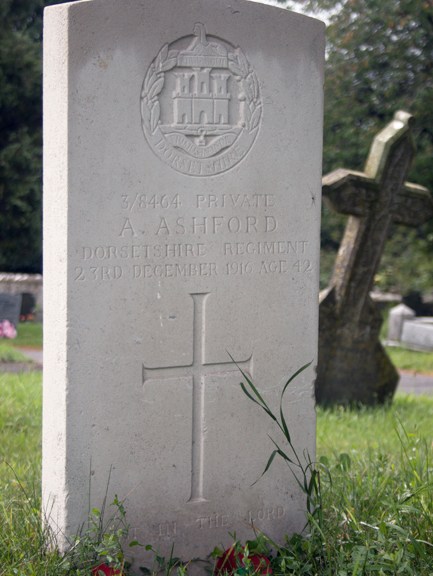
John enlisted in the Dorsetshire Regiment in 1888. Interestingly, his enlistment records give his surname – and that of his parents – as Hosegood. When he was discharged, however, the documents give him as John Hosegood alias Kennell (the census records confirm his family name as Kennell, however).

Private Hosegood was initially based at The Citadel Military Barracks in Plymouth. His service meant he travelled the world – he spent two years in Egypt, four in India and two in South Africa (where he was involved in the relief of Ladysmith). In all, John served 14 years in the army and was discharged in May 1902.

John married Bessie Greenstock six weeks after being demobbed; the Banns show they wed in the Parish Church of Sherborne (or Sherborne Abbey), and list John as a soldier. He was 30, Bessie seven years older.

By the time of the 1911 census, the couple were living with their two young children – Francis and Edith – and Bessie’s widowed mother in the village of Oborne, two miles to the west of Sherborne in Dorset.

When war broke out, John reenlisted within weeks. After a period of re-training, Private Kennell was posted to France as part of the British Expeditionary Force on 23rd October 1914, and served nearly three years on the Western Front.

Private Kennell returned to the UK on 30th December 1916, and remained there until being discharged as no longer fit for war service in July 1917. Sadly, I have been unable to find any details of what led to him being discharged, but the service records do not suggest that he was wounded in any way.

After his discharge, details of John’s life are sparse. His name does not appear in any newspapers of the time, and all I have been able to find it that he passed away on Christmas Eve 1919. He was 47 years old and was buried five days later.

Private John Kennell lies at rest in Sherborne Cemetery, Dorset.

Private Augustus Dodge

Private Augustus Dodge

Augustus Kenneth Seymour Dodge was born in September 1898 to shoe and furniture dealer Augustus William Dodge and his wife Mildred. The elder of two children, Augustus and his family lived on Cheap Street, the main retails thoroughfare of his home town, Sherborne.

Augustus William had been plying his trade for a number of years, having been apprenticed to his father – another Augustus – in Frome and Devizes.

Augustus Kenneth joined the 7th Battalion of the Dorsetshire Regiment, a territorial reserve, which was trained in North Wales and based on a camp in Wool, near Bovington, Dorset. Sadly, I have been able to find little else of his military life, but it is unlikely that he was involved on the front line.

Private Dodge died on 31st March 1917, aged just 18. Nothing in the newspapers of the time suggest an unusual or violent passing, so it can only be assumed that he died from an illness, possibly influenza or pneumonia.

Augustus Kenneth Seymour Dodge lies at peace in the cemetery of his home town, Sherborne.


I was intrigued that Augustus Kenneth’s gravestone also commemorates his father – Augustus William Dodge – and so I did a bit more research. I found that the 1910s were not a good time for the Dodge family.

Augustus Dodge Sr (Augustus William’s father) died in 1912, at the age of 88. He left his estate – totalling more than £500,000 in today’s money – to his widow, Mary Ann, and two of his sons, including Augustus William.

Mary Ann Dodge passed away in April 1916, as the local newspaper reported:

Mrs Dodge, widow of the late Mr Augustus Dodge [Sr] died unexpectedly at her residence at Butts-hill on Thursday last. Mrs Dodge, who was in her 82nd year, walked down to St John’s Church in the morning and attended a service, and then walked up the hill to her home. She was taken ill at noon and passed away two hours later. On Saturday morning, the family received the news that Mr Hubert Dodge, bootmaker, or Warminster (brother of the late Me Augustus Dodge) had died.

Somerset Standard: Friday 28th April 1916

By this point, and within six years, Augustus William Dodge had lost both of his parents and his uncle Hubert. He had also lost his daughter, Ethel, who had died in 1910.

Another of Augustus William’s uncles, Albion Dodge, died in 1917, as did Private Augustus Kenneth Dodge, his son, and the protagonist of this post.

The effect of these losses – particularly that of his eldest son – cannot be underestimated and may well have contributed to his own passing, a year later.

Augustus William Dodge died on 17th June 1918, aged 51.

The Somerset Standard show how much of a businessman he had been, however, with an announcement of the sale of his estate, which included:

LARGE SHOP AND DWELLING-HOUSE, with extensive Premises in the rear, No 3 Stony-street, Frome, in the occupation of Mr Arthur Dodge, at £40 per annum.

SHOP AND PREMISES, No 4 Stony-street, Frome, in the occupation of the Argentine Meat Co. Ltd’, t £25 per annum.

SHOP AND PREMISES, No 13 Market-place, Frome, in the occupation of the National Party, at £18 per annum.

Substantially-built and Commodious TWO-STOREY WAREHOUSE, with Accommodation for Motor Car or Van, situate in the Blue Boar Yard, Frome. The top story is in the occupation of the Frome Town Band, at £12 per annum. The bottom storey is void.

DWELLING-HOUSE AND PREMISES, No 25 King-street, Frome, in the occupation of Mrs Thomas at £13 8s 8d per annum.

DWELLING-HOUSE AND PREMISES, No 1 Willow Vale, Frome, lately occupied by Mr Clarke, a £15 12s per annum.

TWO Substantially-built RESIDENCES with large Gardens, Nos 1 and 2 Hythe House, Rodden Lake, Frome, together with PADDOCK adjoining, in the occupation of Messrs Webb, Golden and Haddrell, at the net annual rental of £37.

FIVE COTTAGES AND GARDENS, Nos 2, 3, 4, 5, 6 Rodden Lake, Frome.

A commodious 3-storey WAREHOUSE, with double-door entrance for vans and side entrance, situate and being No 22 Vicarage-street Frome, in the occupation of Mr E Glass at £8 per annum.

SHOP, with DWELLING-HOUSE AND GARDEN, in Cheap-street, Sherborne, Dorset, in the occupation of Miss Beedell, at £20 per annum.

Somerset Standard: Friday 25 October 1918.

Private Nelson Pitman

Private Nelson Pitman

Nelson Victor Pitman was born in April 1890, the fourth of eight children to George Pitman and Amy Roles Pitman (née Treasure). George was a butcher’s assistant, and the family lived in their home town of Sherborne in Dorset.

As with a number of the other servicemen I have been researching, Nelson’s military records are sparse, probably lost to time. He is not listed as living with his parents on the 1911 census and, in fact, is nowhere to be found.

On 2nd January 1915, Nelson marries Alice Moores at the parish church (Sherborne Abbey). His profession is listed as soldier, so we know that, but this point in the war, he had enlisted.

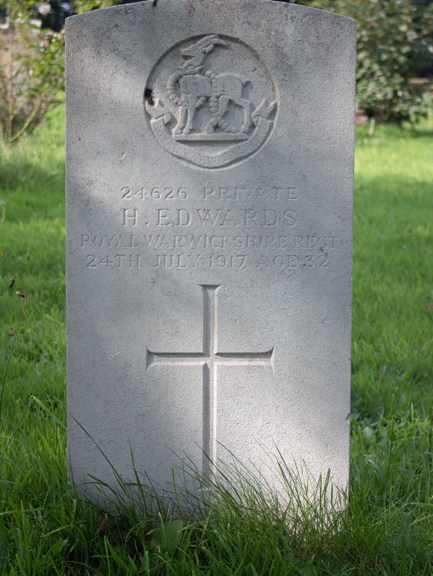
While there are no records of Private Pitman’s service, his battalion, the 1st Royal Warwickshire Regiment was involved in a number of the key battles of the war, including the second Ypres, Arras and Passchendaele. The battalion was also involved in the Christmas Truce, so there is a slight chance that Nelson played football with his German counterparts in one of the defining moments of the Great War.

Private Pitman survived the war to end all wars, but was discharged on 22nd February 1919 with a disability. He was suffering from bronchitis, and steadily went downhill.

Private Nelson Pitman passed away eighteen months later, on 21st November 1920. He was 31 years old.

He lies at rest in Sherborne Cemetery.

Private Samuel Cook

Private Samuel Cook

Samuel Cook was born in Bedfordshire, the eldest of two children to Alfred and Phoebe Cook.

Alfred was a forester, which saw the family move around the country; the 1881 census found them living in Rutland, ten years later the family was recorded in Northamptonshire and by the 1911 census, they were in Dorset.

Samuel was quick to follow in his father’s footsteps, supporting his mother and sister after Alfred died in 1906.

The war was underway when Samuel was called up. His Devonshire Regiment service records show that he enlisted on 11th December 1915. His fitness seemed to have determined the path his military career would take.

Initially Private Cook was classified as C1 (free from serious organic diseases and able to serve in garrisons at home, able to walk 5 miles, see to shoot with glasses, and hear well), but was upgraded to B2 within six months. This identified that he was free from serious organic diseases, able to stand service on lines of communication in France, or in garrisons in the tropics and able to walk 5 miles, see and hear sufficiently for ordinary purposes.

Samuel was first enrolled in 13th (Works) Battalion of the Devonshire Regiment, before being transferred to the 311th (HS) Labour Company in Plymouth.

Private Cook was one of the thousands of soldiers who contracted influenza and subsequently died of pneumonia on 1st November 1918.

There seems to be some dispute over how and when Samuel fell ill. A request for a detailed medical report was sent, “as he appeared to have contracted the disease from which he died whilst on leave for the purpose of getting married”. The same request confirms that he was never admitted to hospital while in the company. (There are no records oh Samuel having married, so I am assuming that his leave may have been for wedding preparations, of normal leave.)

The report came back confirming that he has died from “pneumonia complicating influenza which was contracted whilst on service at Beaulieu”.

However and wherever it happened, the disease claimed Private Samuel Cook’s life; he lies at rest in Sherborne Cemetery, Dorset.

Private William Earrey

William George Earrey was born in 1900, the eldest of three children to William George and Rosina Earrey. While he was baptised William George, later records – including those for his military service – show him as George William; presumably this had avoided any confusion with his father as the young William was growing up.

William Sr worked as a ships boiler maker and, while they appear somewhat disparate over the census records, the Earreys were based in Gillingham, Kent. (Given his employment, this would ensure William Sr’s proximity to the dockyard in Chatham.)

While his enlistment records are not readily available, William Jr appears to have signed up as soon as his age allowed. He enlisted in the Surrey Yeomanry and was shipped to Ireland, where the regiment has two reserve bases.

On 10th October 1918, aged 18 years old, William was returning home on leave from Ireland. He was one of 500 military personnel on board the RMS Leinster, which also had around 200 civilian passengers and 77 crew on board. Just after 10am the ship was around Kish Bank, just off the coast from Dublin, when passengers reported seeing a torpedo pass just in front of the ship’s bow. This was quickly followed by a second torpedo, which hit the ship on the port side. While it was being turned about to seek shelter back in port, a third torpedo struck, causing an explosion and the RMS Leinster sank.

The crew had managed to launch a number of lifeboats, while other passengers were able to get into the sea, clutching life rafts. Many people – William included – died during the sinking, while some of the survivors also subsequently perished.

The exact number of dead in the torpedoing of the RMS Leinster is not known, but it is estimated that at least 560 souls were lost, making it the biggest maritime disaster in the Irish Sea.

Newspapers of the time heralded the nation’s uproar at such a maritime tragedy – the sinking of the Leinster was the largest loss of life at sea around the British coast since the Lusitania three years earlier. The Derry Journal reported on the ‘fiendish crime’, that had occurred as a result of the ‘German policy of frightfulness at sea’.

The article went on to describe some of the challenges facing Dublin in the immediate aftermath of the disaster.

Owing to a strike in the undertaking trade, considerable difficulty is experienced in making arrangements for the burial of the victims. There is an insufficiency of coffins in Dublin, and all but three posting establishments are closed. The Lord Mayor is endeavouring to arrange the suspension of the strike till the Leinster victims are buried. It is stated that on a very rough estimate about three hundred bodies have been recovered…

Derry Journal: Monday 14th October 1918

Sadly, William Earrey’s body was not one of those to have been recovered; this undoubtedly left a lack of closure for his family at the lost of their young son.

Private Earrey is commemorated at the Hollybrook War Memorial in Southampton.


William George Earrey was my first cousin twice removed.

Private Frank Woods

Frank Ernest Woods was born in 1885, one of seven children to Thomas and Alice. Thomas was a labourer and he raised his family in Worcestershire.

Frank left home early – by the time of the 1901 census, he was living as a gardener for the Cornforth family, who were grain merchants in South Claines, near Worcester.

Frank’s work with the family continued; the 1911 census show that they had relocated to Kensington. The Cornforth family were now running the Eaton Court Hotel, a boarding house with nineteen rooms; the 25-year-old Frank had been elevated to the role of waiter.

Another of the Cornforths’ staff was a housemaid, 20-year-old Ethel Elizabeth James; within a matter of years, the couple were courting, and Frank and Ethel married in November 1915.

The Great War was already being waged across the Channel, and Frank enlisted, joining the Rifle Brigade in June 1916. Within three months, he was fighting on the Western Front.

Private Frank Woods was killed in action in Belgium on 10th October 1918. He was 33 years old. He is remembered on the Tyne Cot Memorial in Zonnebeke.


Frank Ernest Woods was the first husband of my Great Great Great Aunt, Ethel Elizabeth James.