Tag Archives: Royal West Kent Regiment

Rifleman Walter Bromley

Rifleman Walter Bromley

Walter Vaine Bromley was born in March 1877, one of seven children to Frederick and Jane Bromley. Frederick was a gardener, and the family lived in Maidstone, Kent. Sadly Jane died when Walter was only two years old; while the cause of her death is not noted, she passed away in the Barming Lunatic Asylum in Kent.

Things must have been tough for Frederick; his maternal aunt, Sarah, came to live with the family to help raise his children, but further support seems to have been needed and, by the time of the 1891 census, Walter was a student at the Kent County Industrial School, which was, in effect, a boys home, near Ashford.

By the end of that year, having left school, he enlisted in the army, joining the Royal West Kent Regiment. He served most of his twelve years’ enrolment in India, although he suffered numerous hospital admissions for dysentery, ague and orchitis (a swelling of the testicles, often brought about by a sexually transmitted bacterial infection), amongst other ailments.

On being demobbed, Walter became a postman; he moved to Gillingham, and was given a round serving the Eastcourt area of the town. A year later, he married Rose Brenchley, and the couple went on to have four children; Ada, Violet, Frederick and Hilda.

Hostilities began, and, in July 1915, Walter enlisted in the 8th (City of London) Battalion, The London Regiment (Post Office Rifles). Rifleman Bromley served as part of the Territorial Force for his first year, before being sent to France in August 1916.

His time there was cut short, however, as he received a gunshot wound in the left ankle. William was repatriated to England for treatment, and was eventually medically discharged from the army on 22nd August 1917.

Surprisingly, it seems not to have been the ankle wound that led to Rifleman Bromley’s passing, however. His pension records, instead, give his cause of death as a goitre contracted whilst on active service. Either way, he passed on 9th July 1918, at the age of 41 years old.

Walter Vaine Bromley lies at rest in the Woodlands Cemetery in his adopted home town of Gillingham in Kent.


Walter Bromley (from ancestry.co.uk)

Private Edward Carver

Private Edward Carver

Edward Carver is one of those soldiers whose details have been lost in the mists of time.

From the information I have been able to gather, Edward was born in Kent in 1887, although I have been unable to track down his parents or any firm census records.

Edward married Violet Ethel Caroline Belsey in April 1918 and enlisted in the Royal West Kent (Queen’s Own) Regiment, although he later transferred to the Labour Corps. I have nothing to confirm, however, in which order these three events happened.

The Army Register of Soldier’s Effects records that Private Carver died at home – Chestnut Street in Sittingbourne – and confirms that this was on 20th November 1918, around six months after he and Violet married.

Nothing in contemporary media suggests that his passing was unusual, so it can only be assumed that something like pneumonia or influenza was the cause of his death. (It might also had had something to do with his transfer of regiments, although, again, I have nothing to confirm that this might be the case.)

Edward Carver lies at rest in the churchyard of St Mary the Virgin in Newington, Kent. He was 31 years old.


As an aside, Edward’s widow, Violet, married an Arthur Beaumont in December 1919, and the couple went on to have two children.


Lance Corporal William Larkin

Lance Corporal William Larkin

William Larkin was born in 1863, the eldest son of Alfred and Frances Larkin from Cranbrook in Kent.

He disappears off the radar for a few censuses – there are too many variations on his surname to identify exactly where he was on the 1881 and 1891 documents.

From later documents, however, we can identify that he married Eliza in around 1886; the couple had no children. By the 1901 censes the couple were living to the north of Maidstone; ten years later, they were running the Fox & Goose pub in Weavering, Kent.

Private Larkin’s military service is also lacking in documentation, but some information can be pieced together.

Originally enlisting in the Royal West Kent Regiment, he (was) transferred over to the Royal Defence Corps, and served on home soil.

On Sunday 2nd April 1916, Lance Corporal Larkin was on guard at a gunpowder factory in Faversham, Kent. As the Ministry of Munitions reported at the time:

During the weekend a serious fire broke out in a powder factory in Kent, which led to a series of explosions in the works.

The fire, which was purely accidental, was discovered at midday and the last of the explosions took place shortly after two in the afternoon.

The approximate number of casualties is 200.

Thanet Advertiser: Saturday 8th April 1916.

William was not killed during the Faversham Explosion, but Boxley Parish Council (who covered the Weavering area) carried out research on the names on the village war memorial. According to that research, William “developed cancer after the ‘Faversham Powder Works’ explosion”. He died two months later, on 8th July 1916. He was 53 years of age.

Lance Corporal William Larkin lies at rest in the graveyard of St Mary & All Saints Church in Boxley, Kent.


More details of the Faversham Explosion, along with the servicemen who died there, can be found here.

Corporal Sidney Hornby

This image has an empty alt attribute; its file name is photo-01-11-2020-12-01-50-e1605266325697.jpg

Sidney Horace Hornby was born to John and Emily in March 1880. John was a tailor’s assistant from Paddington, and the family – Sidney was the eldest of six siblings – initially lived in the Greenwich.

Sidney enlisted in the army in 1898. He joined the East Kent Regiment for a short service of seven years and was sent to South Africa. In March 1900 he was wounded at the Battle of Driefontein. His service, though, saw him promoted through the ranks from Private to Sergeant.

Something must have happened during his enlistment, however, as on 2nd September 1901 Sergeant Hornby’s military record marks him as having deserted.

Sidney’s records pick him up again on 24th April 1908, when he is put on court martial. Found guilty of desertion, he is reduced to the ranks and sentenced to three years’ penal servitude (later reduced to two years’ hard labour).

His attitude seems to continue, however, as within a matter of months he was discharged due to misconduct and denied any pension for his previous service.

Sidney’s family had moved from Greenwich to Kent at some point before the 1901 census, and his father died three years later. By the 1911 census, he had moved back in with his mother, and worked as a labourer to help look after them.

The Great War called, however, and it seems that Sidney’s previous misdemeanours did not excluding him from fighting again. He joined the Royal West Kent Regiment although his full service for the 1914-18 campaign are not accessible. Again, his service seems to have been good, as he was elevated to the rank of Sergeant for a second time.

Hints of Sergeant Hornby’s rebellious nature remain, however, as he was court marshalled again in February 1916. He was convicted of drunkenness, and reduced to the rank of Corporal.

That was the summer of the Battle of the Somme, and by the autumn Hornby was one of the many who fell during that time. He died on 4th October 1916 and was 36 years old.

Corporal Sidney Hornby is commemorated on the Thiepval Memorial.


Sidney Horace Hornby was my 1st cousin, four times removed.

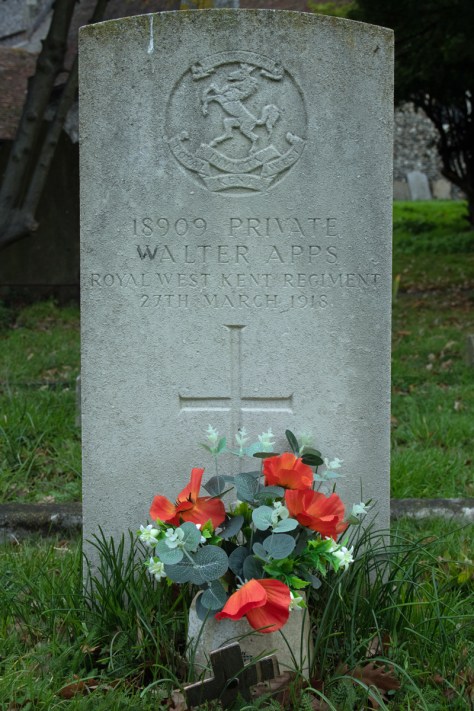
Private Walter Apps

Private Walter Apps

Walter Apps was born in 1896 in Kent. He was one of thirteen children to Richard Apps, a shepherd, and his wife Emeline. By the age of 14 he was listed as working on the farm the family lived on; his older brother Bertie was also helping out.

In February 1916 Walter was called up; his enlistment papers show he worked as a horseman, and that he joined the Royal East Kent Regiment (also known as the Buffs because of the colour of their tunic).

Private Apps was posted to the Western Front as part of the British Expeditionary Force in October 1916, and was soon transferred to the Royal West Kent Regiment.

He saw active service, and was wounded on 17th July 1917, receiving a gun shot wound to the face, which resulted in him losing the sight in his left eye.

Private Apps was repatriated on 8th August 1917, and remained there. He was discharged from the army as being no longer medically fit to serve at the beginning of the following March, but sadly passed away on 27th March 1918. He was just 22 years old.

Walter Apps lies at rest in the graveyard of St Bartholomew’s Church in Bobbing, Kent.

Private Frederick Smith

Private Frederick Smith

Frederick Smith was one of twelve children to George and Ann Smith of Rainham in Kent. Sadly, the couple lost their first four children early on, but at least seven of Frederick’s siblings survived beyond childhood.

His father was a labourer, and Frederick’s two surviving older brothers followed him into this profession.

A lot of Frederick’s service records are missing, but I have been able to ascertain that he enlisted in early 1915, joining the 8th Battalion, Queen’s Own (Royal West Kent Regiment). He trained at Fort Darland in Chatham before being shipped overseas.

The battalion was involved in the Battle of Loos later that year, but it was the fighting at Wulverghem in Western Flanders that changed Private Smith’s life. The German army launched a gas attack on the Allied lines on 30th April 1916; in the second attack on 17th June, Frederick was injured by the gas, and was shipped back to home soil.

The East Kent Gazette takes up the story:

He was brought to Camberwell Hospital, where he was for seven weeks. Enteric fever developed, and young Smith died on Thursday in last week [14th September].

East Kent Gazette: Saturday 23rd September 1916.

Frederick was just 19 years old.

Private Frederick Smith lies at rest in the graveyard of St Margaret’s Church in Rainham, Kent.