Tag Archives: tuberculosis

Saddler Tom Rawlings

Saddler Tom Rawlings

Tom Hallett Walter Rawlings was born in 1896, the eldest of six children (and only son) to Walter and Jane Rawlings. Dorset-born Walter had worked as a carpenter and a groom, and Tom had joined him as a stable lad by the time of the 1911 census.

By the time he enlisted in July 1915, Tom’s work with all things equine helped land him a role in the Royal Army Service Corps as a Saddler. His role was backed up as he had previously been apprenticed to Ernest Cottle, a saddler in Blandford, Dorset.

Initially he worked on the Home Front, but he was posted to France as part of the British Expeditionary Force in January 1916, as part of the 1st Company.

Saddler Rawlings’ time overseas was brief; within three months of being shipped overseas he had contracted phthisis (also known as tuberculosis), and he was sent home for treatment on 22nd April 1916.

His health reached the point where he was discharged as being medically unfit on 12th June, and within a matter of weeks, Tom has passed away.

Tom Hallett Walter Rawlings died on 20th June 1916; he was 19 years old. He lies at rest in the cemetery of his home town, Sherborne.


Tom’s father Walter also entered the army as worked in the Royal Army Service Corps. While records of his military career are not immediately evident, it seems that he survived the war, although he may have been discharged in 1919 having fallen ill with malaria.


Private Ernest Rawle

Private Ernest Charles Rawle

Ernest Charles Rawle was born in 1899, the fourth son of George Rawle, a sailor, and Louisa, his wife.

Ernest was still at school at the time of the 1911 census, and enlisted in the West Somerset Yeomanry, but enlisted in the army in April 1915. His served on the Home Front, but was discharged as being unfit for war service on 22nd July 1916.

Private Rawle’s discharge records confirm that he had pulmonary tuberculosis, which he had contracted a couple of months before. They go on to suggest that it was not a permanent condition, but was likely to render him unfit for service for a number of months.

Eager to do his bit, Ernest’s record show that he re-enlisted in August 1916, and that he was considered fit for military service by the November of that year.

His medical records continue further – he was admitted to a field hospital again in March 1917, again suffering from tuberculosis. He was moved back to base as he was “a danger to his comrades”.

His records after March 1917 are not available, but he passed way from TB in November 1919. He was just 21 years old.

Private Ernest Rawle lies at peace in the churchyard of Lydeard St Lawrence, alongside his two brothers, Stephen and William.


George and Louisa’s other son – Edward – also served, enlisting in the Somerset Light Infantry and fighting in the Balkans. Private Edward Rawle survived the war, returning home in March 1919.

It should be noted that, by June 1921, George and Louisa had lost three of her four sons to the Great War. Their daughter, Norah, had also passed away in 1918.

The 1921 census found Louisa living in East Town, in the parish of Tolland, not far from Lydeard St Lawrence. Edward was living with her, as were her three-year-old granddaughter, Lorna, and her eighteen-month-old grandson Beatty. It is unclear whose children they were. George, at this point, was helping his younger brother out on the family farm in Williton.


Air Mechanic Reuben Hadlow

Air Mechanic Reuben Hadlow

Reuben Victor Stanley Hadlow was born in the spring of 1898. He was one of thirteen children to John Charles Tarpe Hadlow and his wife Gertrude, publicans at the Star pub in Whitstable, Kent.

When war broke out, Reuben was working as a blacksmith; he enlisted in the army in the summer of 1914, serving on the home front.

In February 1916 Private Hadlow transferred to the Royal Flying Corps as a Air Mechanic 2nd Class, and was assigned to the 65 Training Squadron in Croydon. He was promoted to Air Mechanic 1st Class six months later.

When the RFC became the Royal Air Force, Air Mechanic Hadlow moved across to the new institution. He moved to support 156 Squadron in November 1918, then the 35 Training Depot Station shortly after.

Air Mechanic Hadlow contracted phthisis (tuberculosis) towards the end of that year, which led to his being discharged from the RAF on 22nd January 1919.

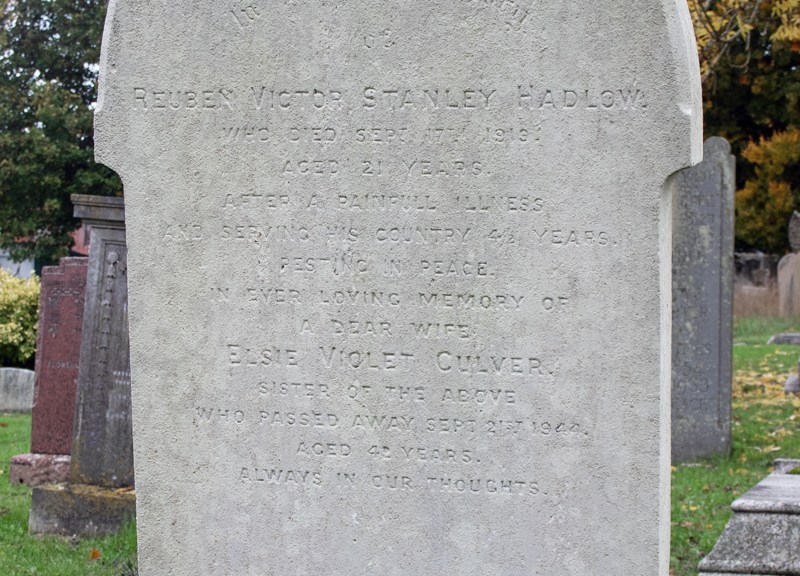
Reuben’s health did not recover after returning home – his parents were running the King’s Arms pub in Boxley near Maidstone by this point. He passed away on 17th September 1919, aged twenty-one.

He lies at rest in the churchyard of St Mary and All Saints, in his parent’s village.

Poignantly, his gravestone is not a traditional war grave. Instead it states that he died “after a painful illness and serving his country 4 1/2 years”.