
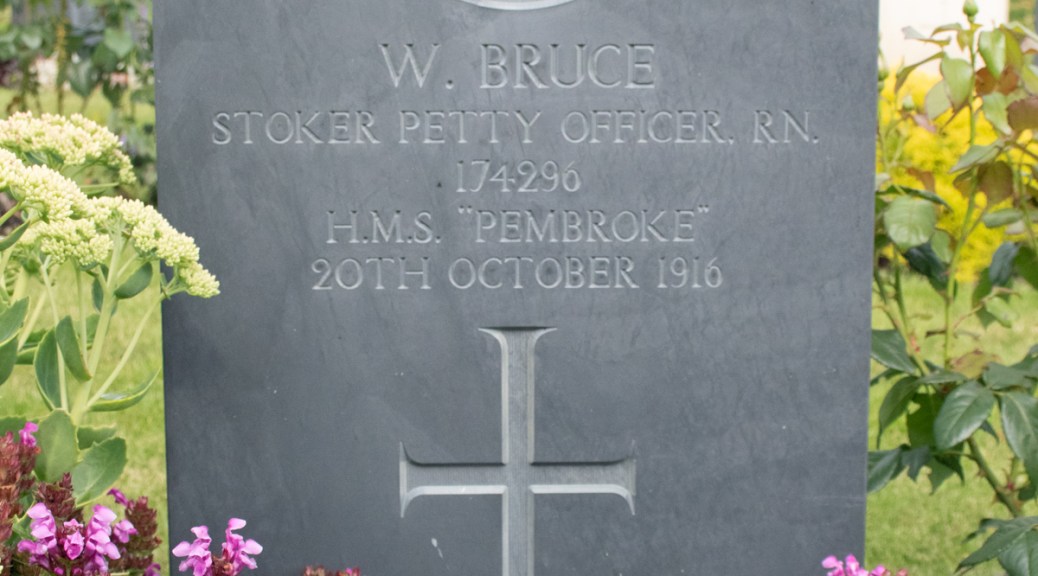
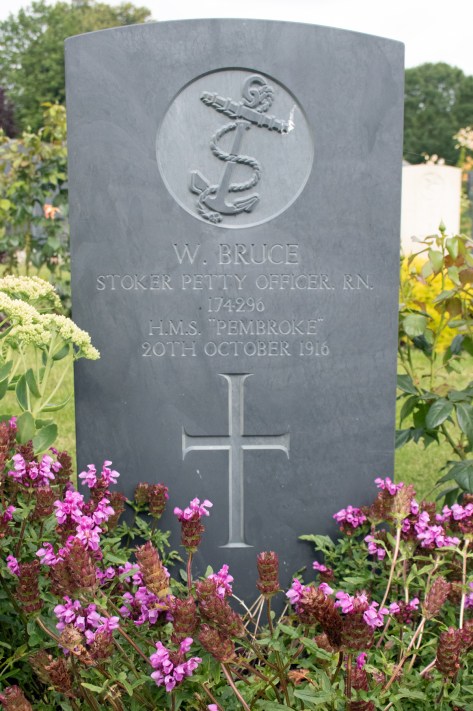
William Bruce was born in Chatham, Kent, on 3rd July 1873. The oldest of fourteen children, his parents were David and Sarah Bruce. David worked as a blacksmith in the local dockyard, and this is a job that William also followed when he finished his schooling.
For the early part of William’s life, the Bruce family lived on Fort Pitt Street, initially at No. 29, then, as the family grew, No. 42. Working as a blacksmith brought in a salary, but the navy offered William more of a career and, on 20th June 1893, he signed up.
Stoker 2nd Class Bruce’s service papers show that he was 5ft 4ins (1.63m) tall, with dark brown hair, brown eyes and a fresh complexion. He would spend a total of 13 years with the Royal Navy and, unsurprisingly, given where he was living, he would be based out of HMS Pembroke, the Royal Naval Dockyard in Chatham.
William spent six months at HMS Wildfire – the dockyard in Sheerness, Kent – during the summer of 1893, before returning to Pembroke. She would remain his home for the next three years, during which time he was promoted to Stoker 1st Class. His time back at Pembroke was not without incident, however, and he spent three days in the cells for an unconfirmed misdemeanour in August 1894.
On 14th January 1896, Stoker Bruce was given his first sea-going posting, on board the cruiser HMS Endymion. Over the remaining nine years of his initial contract, he would go on to spend time on three further ships. William’s commitment to the role was now becoming evident: he was promoted to Leading Stoker 2nd Class in October 1900, and Leading Stoker 1st Class less than four years later.
Away from the sea, love was blossoming for William. On 12th February 1900, he married Nellie Benster, a dressmaker and lady’s companion from Chatham. The couple took rooms at 145 Thorold Road, a home for the new bride while her husband was away at sea.
When Leading Stoker Bruce’s 12-year contract came to an end, he immediately renewed it. In August 1905, he was assigned to the battleship HMS Resolution, and he remained on board for the next nine months. William’s next assignment was another battleship, HMS Triumph, and he would be attached to her for nearly six years.
On 1st July 1906, William was promoted to Stoker Petty Officer. He retained this rank until December 1910, when he reverted to Leading Stoker. His papers hint at the cause for this demotion: his annual review had dropped from very good to merely good after he took the new role.
Over the next two years, Leading Stoker Bruce went on to serve on three further ships: the depot ship HMS Aquarius, the cruiser HMS Talbot and the sloop HMS Cadmus. By December 1912, William seems to have proved his mettle once more, and was promoted to Stoker Petty Officer again.
William remained on Cadmus for more than three years, returning to Chatham in the spring of 1916. Over the next few months, his health began to suffer and he was admitted to the town’s Royal Naval Hospital with pneumonia. The condition would get the better of him, and he passed away on 20th October 1916, at the age of 43 years old.
The body of William Bruce was laid to rest in the naval section of Woodlands Cemetery, Gillingham, Kent.

