
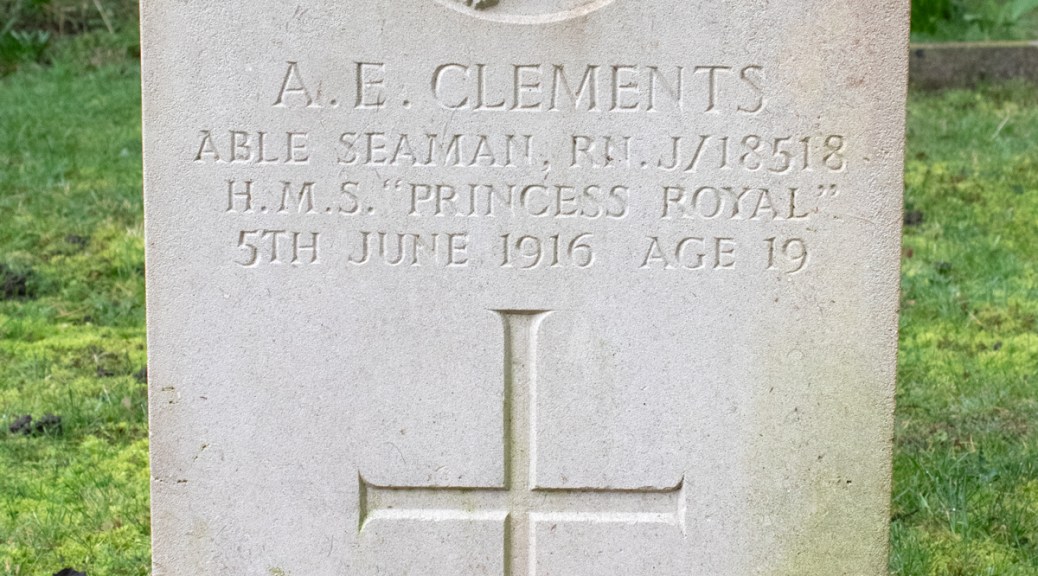
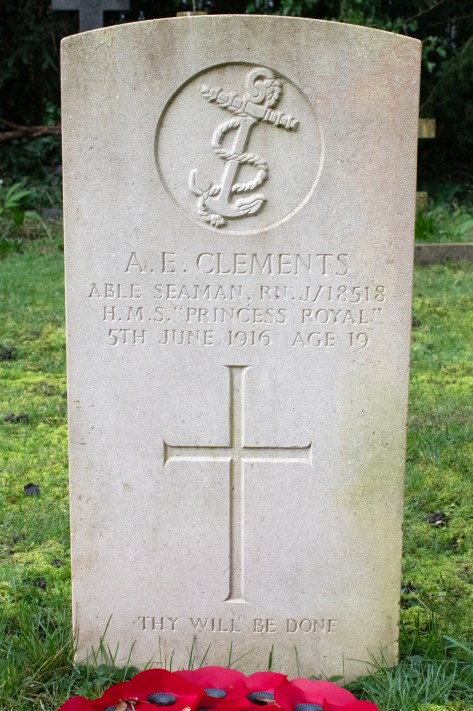
In spite of unpropitious weather, an exceedingly large number of people of all classes paid a last tribute to Able-Seaman Albert Edward Clements, at Eton, on Saturday last. The deceased, whose home was at 3, Tangier-lane, Eton, was on HMS Princess Royal, which took part in the naval fight in the North Sea, and he as severely injured by burns. He was taken on board HM Hospital Ship Plassy, but died on 31st May, and his remains were brought home on Thursday evening last week from Scotland. Clements as a boy showed an affection for the sea, and when old enough joined the merchant service and made several voyages. Five years ago from the day he was laid to rest he joined the Navy, and was at first on HMS Warspite and afterwards on the ship on which he received his mortal wounds. He was a loyal and devoted son, and after the death of his father three years ago was of great assistance to his mother. His father was for 29 years in the Royal service at Frogmore and consequently served under three Sovereigns – Queen Victoria, King Edward and King George. His elder brother, Charles George, was in the Oxford and Bucks LI, and was killed at Loos a year ago. The Admiralty, through pressure, was not able to send a representative, but his mother had received from that department a letter expressing its sympathy and appreciation of his services. A letter of sympathy has also been received from the King.
[Windsor and Eton Express: Saturday 17th June 1916]
The early life of Albert Edward Clements is a challenge to piece together. Born in 30th October 1896 in Marylebone, details of his parents are unclear and, by the time of the 1901 census, he seems to have been adopted by his paternal grandparents, George and Louisa. By this point the family were living at 4 Sunbury Road, Eton, the household being made up of Albert, his grandparents, and his four uncles and aunts.
At 45 years of age, George was a gardener’s labourer, but, as the newspaper report suggests, Albert had a hankering for the sea. He served on merchant vessels, but enlisted in the Royal Navy on 12th June 1912. Sent to HMS Ganges – the training base near Ipswich, Suffolk – he was given the Rank of Boy 2nd Class, as he was too young to formally join up.
By January 1913, Albert was assigned to the dreadnought battleship HMS St Vincent. Within four months he had moved to the heavy cruiser-turned-aircraft carrier HMS Vindictive. By the end of the year, however, Boy Clements received his main move, to HMS Princess Royal.
Albert was formally inducted in the Royal Navy on 28th May 1914, and was given the rank of Ordinary Seaman. His service records notes that he was 5ft 5ins (1.65m) tall, with dark brown hair, blue eyes and a fresh complexion. He was also recorded as having a birth mark on the back of his left arm.
Princess Royal would remain Albert’s home for more than three years and, on 1st April 1915, he received a promotion to Able Seaman. His ship would be involved in some of the Royal Navy’s fiercest skirmishes, including Heligoland Bight and Dogger Bank, but it was during the Battle of Jutland, on the night of the 31st May 1916, that Albert was injured and died of his wounds. He was just 19 years of age.
The hospital ship Plessy brought the body of Albert Edward Clements back to shore, and he was taken home to Berkshire for burial. He was laid to rest in the cemetery of St John’s Church in Eton.

