Category Archives: Egypt

Private Joseph Dodge

Private Joseph Dodge

Joseph Dodge was born in the summer of 1883, and was one of twelve children, including eleven boys. His parents were David and Eliza Dodge, who raised their growing family in Stoke-sub-Hamdon, a few miles to the east of Yeovil, Somerset.

David was a mason and stone sawyer, but his children went into other roles when they left school; Joseph found work as an agricultural labourer.

In October 1903, Joseph married Elizabeth Ann Case – better known as Annie – who came from just over the Dorset border in the village of Corscombe. Setting up home in Yeovil itself, the couple went on to have two children – both boys – Walter and Norman.

War was coming to Europe, and Joseph was intent on doing his bit. Full service details are not available, but the documents that exist confirm that he enlisted as a Private in the Wiltshire Regiment. Initially assigned to the 1/4th Battalion (which served in Egypt), he transferred to the 2/4th Battalion (which served in India).

Sadly, there is no documentation to give service dates, it is impossible to establish when or if Joseph actually served in these locations. India seems likely, however, as he later transferred to the 1st Garrison Battalion of the East Yorkshire Regiment, which was based in Lucknow.

Private Dodge survived the war and came back to England, but seems to have contracted pneumonia on the journey home. Admitted to hospital in Liverpool, the condition sadly got the better of him. He passed away on 16th February 1919, at the age of 35 years old.

Joseph’s body was brought back to the county of his birth; he was laid to rest in Yeovil Cemetery.


Joseph came from a very patriotic family, and local newspapers early in the war highlighted that many of the Stoke-sub-Hamdon brothers had enlisted to serve King and Country.

At the time of the article, six had enlisted – Thomas, Arthur and Percy (all in the Somerset Light Infantry), Albert (West Somerset Yeomanry), Evan (Royal Navy) and David (Canadian Infantry).

Corporal David Dodge seems definitely to have distinguished himself. Having emigrated to Canada before the war, he returned to Europe when conflict broke out. An article in the Western Chronicle reported that he had “been awarded the Military Medal for conspicuous bravery on the field under heavy fire.[Western Chronicle: Friday 15th November 1918]

Amazingly, of the seven brothers who fought in the conflict, only Joseph perished.


An earlier series of articles tells the tragic story of another of Joseph’s siblings. Henry Dodge (known as William) had moved to Senghenydd, to the north of Cardiff, in 1910; mining work was plentiful there and he and a number of his fellow villagers had sought money from the black gold.

On the 14th October 1913, and explosion happened in the mine and together with the resulting fire and subsequent poisonous gas outpouring killed more than 430 miners. Initially reported missing, William was later confirmed dead; he was just twenty years old and left a widow and child.

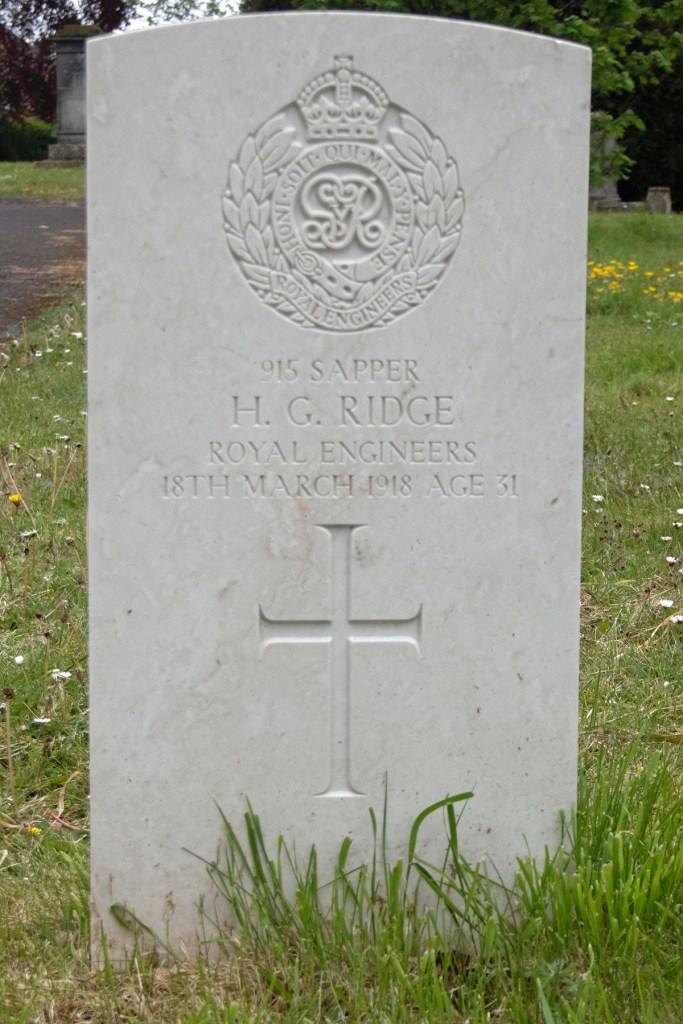
Sapper Herbert Ridge

Sapper Herbert Ridge

Herbert Gladstone Ridge was born in December 1886, the youngest of three children to Alfred and Sarah. Alfred was from Lancashire and had met and married his wife in Ireland, which is where Herbert’s older siblings had been born.

Sarah had died when Herbert was only eleven years old. Alfred’s skills were as a machine engineer, and, after his wife had passed away, he brought his family down to Somerset. Initially living with his father in Taunton, Herbert had found work as a piano tuner, and moved to a boarding house in Bristol to further his trade.

War was close, however, and, in July 1915, Herbert enlisted. Joining the Welsh Field Company of the Royal Engineers as a Sapper, he was quickly posted as part of the Mediterranean Expeditionary Force. He served nearly a year in Egypt, before being sent back to England in September 1916.

By this point, Sapper Ridge was suffering from a bout of tuberculosis, and had been sent back to England for treatment. The condition refused to clear up, however, and he was eventually discharged from the army on medical grounds three months after returning home.

Details of Herbert’s life after the army are sparse. It can be assumed, however, that he remained dogged by tuberculosis, and this is what eventually killed him. He passed away on 18th March 1918, aged just 31 years old.

Herbert Gladstone Ridge lies at rest in St Mary’s Cemetery in his adopted home town of Taunton in Somerset.


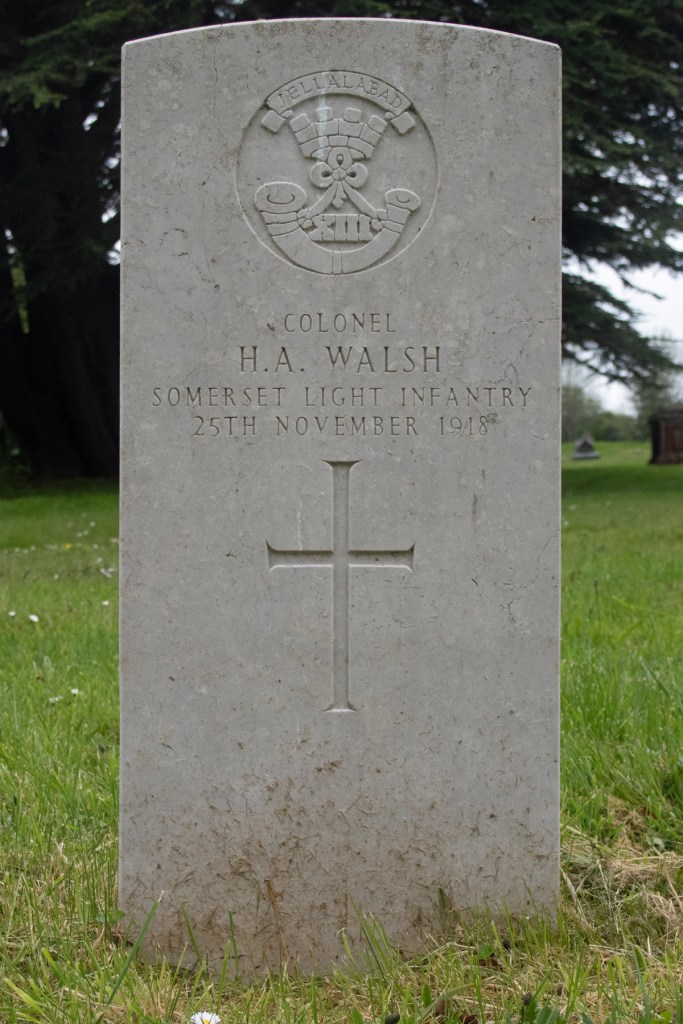
Colonel Henry Walsh

Colonel Henry Walsh

Henry Alfred Walsh was born near Taunton, Somerset, in September 1853, the eldest of five children to Theobald and Isabel Walsh. Theobald was a magistrate with some military connections, and it was military service that Henry went into.

While full details aren’t readily available, the 1881 census finds him living in Devon, with his employment simply as “military”. Presumably, he had enrolled in the Somerset Light Infantry, the regiment he had a lifelong commitment to.

By the early 1880s, Henry had married Ann Sparrow. The couple went on to have three children – Theobald, Gwladys and Archibald.

The 1891 finds Henry and his family in the Somerset Light Infantry Barracks at Farnborough. Henry was a Sergeant Major by this time, and was assigned to the 1st Battalion. Also living in the same accommodation – and presumably helping Ann with the running of the household – were a governess and cook.

The census also highlights the transient nature of army life. Henry, as mentioned before, was born in Taunton, while Ann came from Plymouth in Devon. Theobald was born in Taunton, while Gwladys and her younger brother were both born in Devon. Military service brought a sense of stability, but not necessarily geographically.

Henry eventually took a step back from the army; by the time of the 1911 census, he was living back in Bishop’s Hull, the village of his birth in Somerset, and listed as a retired colonel. When war broke out, however, he volunteered his services again, and was appointed the officer commanding the No. 8 District in Exeter.


While Henry came out of retirement to serve his country again, his two sons had also forged their own military careers. Theobald also joined the Somerset Light Infantry, also achieving the rank of Colonel. Archibald joined the Royal Horse Artillery; his story can be found by clicking here.


When Henry passed away in 1918, local newspapers were unanimous in their praise of the long-serving officer, outlining both his military service and his charitable work.

Colonel Walsh had had a distinguished military career, dating from 1870, when he joined the old Somerset Militia at Taunton. [He] was created a CB in 1905, and held the medal and clasp for Zululand, and the medal and two clasps and the Khedive’s Bronze Star for his services in Egypt.

He was a JP for Somerset and a member of the Army and Navy Club. [He] threw himself wholeheartedly into the work of the Boy Scout organisation.

The greatest work in which Colonel Walsh had been identified during the war, however, was undoubtedly that of feeding the Somerset prisoners of war in Germany, and his name will ever be linked in grateful memory with that of his honoured wife for having raised and maintained a fund capable of bearing the strain of over £3,000 expenditure per month to save the Somerset men in Germany from starvation.

Well Journal: Friday 29th November 1918

Ironically, for all this exultation, there is no immediate record of the cause of Henry’s death; given his age – he was 65 when he passed – it seems likely that he died following an illness.

Colonel Henry Alfred Walsh lies at rest in St Mary’s Cemetery in Taunton, Somerset. He is buried next to his son, Archibald.