Category Archives: Dragoon Guards

Private Maurice Chapman

Private Maurice Chapman

Maurice Chapman was born in the summer of 1883 in Newington, Surrey (now in the London borough of Southwark. The younger of two children, his parents were Charles and Jessie Chapman. Charles was a horse collar maker and, by the time Jessie passed away in 1899, Maurice was following in his father’s footsteps.

Maurice sought a bigger career, however, and, on 6th April 1899, he enlisted in the Royal Artillery. His service records show that he was 5ft 6ins (1.68m) tall, and that he weighed 118lbs (53.5kg). In the section relating to any distinguishing marks, it was noted that his eyebrows met, he had a scar on his forehead and two tattoos, one on each forearm.

Maurice’s military career was not to be a lengthy one. He was recorded as being absent without leave on 18th May, and docked 6 days’ pay. Admitted to a hospital in Woolwich on 26th May, he spent a week there, suffering from scabies. On 27th July, Maurice was formally discharged from the army, when it was discovered that he had lied about his age: on his enlistment papers, he stated he was 18 years 7 months old (he was, in fact, just sixteen.

Returning to the family home, Maurice took up his father’s trade once more. Charles remarried in 1905, to a woman called Rosa. The 1911 census found the two living in two rooms in a house in Kennington Lane, but of his children, there is no sign. Maurice does not appear on any of the 1911 census records. It is also not possible to track down his older sister Charlotte either, there are a number of Charlotte Chapmans in the that year’s records, and it is also unclear whether she had married by this point.

Maurice only reappears on 1st March 1916, when he stepped up to serve his King and his Country. Initially signing up for the Labour Corps, he wasn’t formally mobilised for eighteen months. Maurice gave his profession as a barman, but also noted that he had served for two years in the 2nd Battalion of the Dragoon Guards, before being discharged in 1904, although there is no other record to corroborate this.

Private Chapman’s service records provide some, but not a lot of, information. There is no record of him spending time overseas, but he spent ten months with the Labour Corps, before transferring to the Tank Corps on 30th August 1918. Over the next year-and-a-half, he moved between a couple of the regiment’s depots and their reserve unit, and remained on active service long after the Armistice was signed.

Maurice remained on active service with the Tank Corps until November 1920, when he was medically discharged. He had been unwell for a while by this point, and a combination of diabetes and a perineal fistula meant that he was no longer physically fit enough to serve.

It is likely that Maurice was in the War Hospital in Bath, Somerset, when he was discharged, as this is where he passed away, on 22nd December 1920. He was 37 years of age.

Maurice Chapman did not travel far to his final resting place. He was buried in the grounds of the Locksbrook Cemetery in Bath, Somerset.

Lieutenant Colonel Charles Holroyd-Smyth

Lieutenant Colonel Charles Holroyd-Smyth

Charles Edward Ridley Holroyd-Smyth was born in Ballynatray, Co. Waterford, Ireland, on 16th August 1882. The seventh of nine children, his parents were John and Harriette Holroyd-Smyth. John was a colonel in the army and, while from a a renowned family, there is actually little documented about Charles’ early life.

Given his father’s military career, it seemed natural for Charles to follow suit. His service records are tantalisingly elusive, but he certainly served in South Africa during the Second Boer War at the turn of the century.

When war broke out, Charles took up the rank of Captain in the 3rd Dragoon Guards (Prince of Wales’ Own). He set sail for France on 1st November 1914, and he found himself in the very thick of the fighting, where his battalion fought at Ypres, Loos and Arras. His conduct during the war earned him both the Distinguished Service Order and a Military Cross.

On 29th October 1916, Charles married Norah Layard, the daughter of another army officer, who had been born in Ceylon. Charles was soon back in France, however, and was promoted to Lieutenant-Colonel, and given command of the 15th Battalion of the Durham Light Infantry.

Over the course of 1918, Lieutenant-Colonel Holroyd-Smyth led his troop in the Battles of Bapaume, Messines, Kemmel and Aisne. However, it was during the Battle of Epehy that he was badly wounded. Initially treated on sight, he was quickly evacuated back to Britain for further treatment.

Lieutenant-Colonel Holroyd-Smyth was admitted to the Royal Victoria Hospital in Netley, Southampton, but his wounds were to prove too severe. He passed away on 23rd September 1918, at the age of just 36 years of age.

The body of Charles Edward Ridley Holroyd-Smyth was brought back to Somerset, where Norah was living. His funeral, at St Stephen’s Church, in Bath, was marked with some ceremony, and he was laid to rest in Lansdown Cemetery, overlooking the city.


(from ancestry.co.uk)

Charles’ death came just nine days after the passing of his mother, back in Waterford. He and Norah didn’t have any children, although tragically a newspaper report from July 1918 did note a birth: “On the 3rd July, at East Hayes House, Bath, the wife of Lieutenant-Colonel CE Holroyd-Smyth MC, a son (stillborn).” [Bath Chronicle and Weekly Gazette: Saturday 13th July 1918]


Serjeant Major Ernest Simmons

Serjeant Major Ernest Simmons

Ernest Simmons was born in Priddy, Somerset, in 1869, the oldest child to Henry and Ellen Simmons. Henry was a mason who, by the time of the 1881 census, was employing ten men and a boy. Three doors down lived another Simmons family, Daniel and Elizabeth, and it is likely that Ernest’s father was somehow related to them.

Ernest sought a bigger and better life away from the Somerset countryside, and enlisted in the army, joining the Army Veterinary Corps. “[He] served for 28 years… 10 of which were spent in India and 5 in South Africa.” [Wells Journal: Friday 23rd August 1918]

His service did him well, and he progressed through the ranks. The 1911 census recorded him back in the UK, renting a room in a terraced house in Preston, near Brighton. He was still serving in the army, however, and was listed as being a Farrier Sergeant Major in the 4th Battalion of the Dragoon Guards.

When war was declared, Ernest was quick to return to the fray, arriving in France on 16th August 1914. He served his battalion well, and was mentioned in dispatches for his action in the retreat from Mons the following month.

Farrier Sergeant Major Simmons returned to Britain, and transferred across to the 6th Reserve Regiment of Cavalry. This new regiment, formed in 1917, trained men for a number of regiments, including the 3rd, 4th, 6th and 7th Battalions of the Dragoon Guards. Ernest’s previous experience with horses, including his time in the Army Veterinary Corps, likely stood him in good stead for the role.

It was while he was at the camp in Tidworth, on Salisbury Plain, Wiltshire, that Ernest met with an accident. “[He] was thrown through his horse tripping over some wire. He was found in an unconscious state and died the same day.” [Wells Journal: Friday 23rd August 1918] Farrier Sergeant Major Simmons died on 26th July 1918: he was 49 years of age.

Ernest Simmons’ body was brought back to Somerset for burial. He was laid to rest in the peaceful graveyard of St Lawrence’s Church in his home village of Priddy.


Private William Bullock

Private William Bullock

Frederick William Bullock, who was known by his middle name, was born in the spring of 1894 in the small Somerset village of Hillfarrance. His parents were Frederick and Mary, and he was one of eleven children.

Frederick Sr was an agricultural labourer, but William wanted a life of adventure, and, by 1910, he had joined the army. It seems likely that he lied about his age when he enlisted, as he would only have been 16 years of age. Assigned as a Private to the 6th Dragoon Guards (The Carabiniers), he was based in Aldershot, Hampshire. His service records show that he was 5ft 6ins (1.68m) tall, had black hair and grey eyes.

Private Bullock’s early years of service were seemingly free of incident but this was to change. On 22md January 1914, his troop were preparing to board ship to sail to Egypt, but William went AWOL. He was apprehended a week later, tried and convicted of desertion. He was imprisoned for 56 days and his previous service with the army was forfeited.

On 16th August, just a fortnight after war was declared, Private Bullock was sent to France. He spent three months on the Western Front before returning to England. In June 1915, he had transferred to the 3rd (Prince of Wales) Dragoon Guards, and was again sent to France.

William remained in France until the end of July 1916, when he fell ill and was medically evacuated to England for treatment. He was initially admitted to the 2nd Southern General Hospital in Bristol with a crumbling spine, but then transferred to the 2nd Western General Hospital in Manchester for more specialist treatment.

The condition, while not aggravated by his military service, was enough to have him medically discharged because of it. Private Bullock left the army on 28th July 1917.

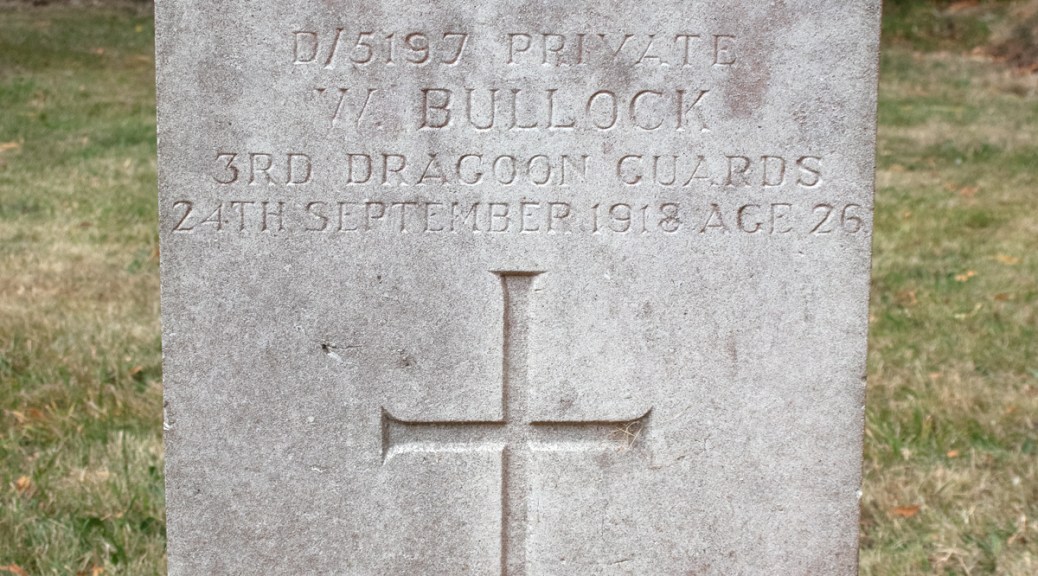
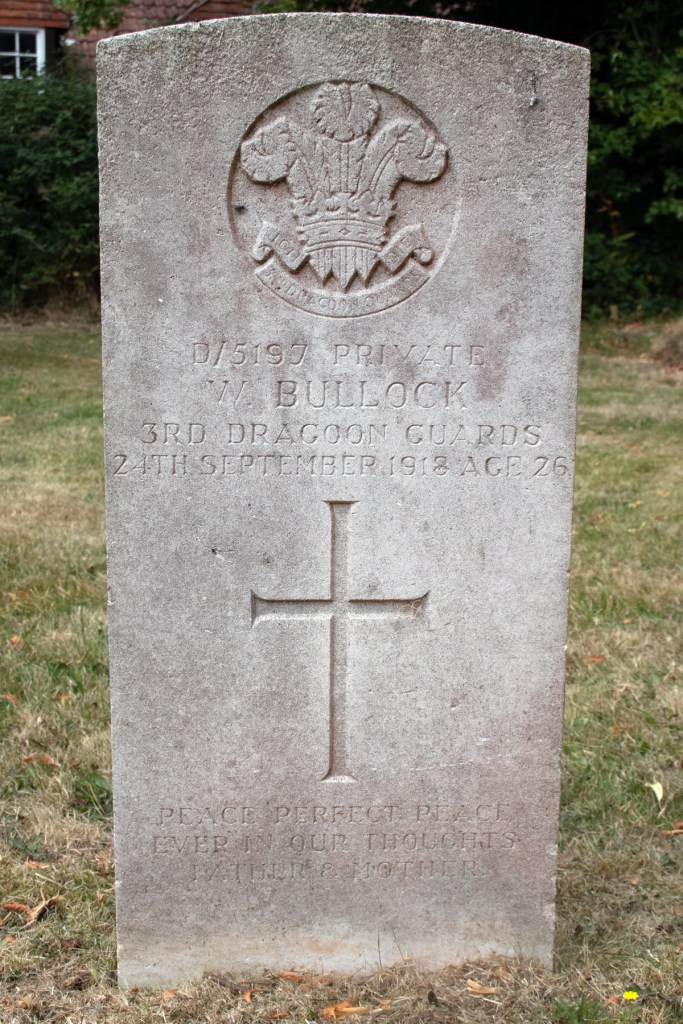
At this point, William’s trail goes cold. What can be confirmed is that he passed away on 24th September 1918, at the age of 24 years old. He was laid to rest in the graveyard of St Giles’ Church in Bradford-on-Tone, a village not far from his birthplace, where his family now lived.


Private John Hallett

Private John Hallett

John Hallett – better known as Jack – was born in the spring of 1891 in the Somerset town of Frome. One of twelve children, his parents were carpenter Frederick Hallett and his wife, Elizabeth. When he left school, Jack found work at a printer’s, helping with the typesetting.

War was approaching, and Jack was keen to do his bit. While full details of his military service are not available, it is clear that he enlisted as a Private in the Royal Irish Dragoon Guards. He served in France with the 4th Battalion, arriving there in October 1915.

A later report suggests that Private Hallett was “seriously wounded several times during the war” [Somerset Standard: Friday 30th January 1920], although no specific details are available about his injuries. He survived the conflict and was awarded the British and Victory Medals and the 1915 Star for his service.

Demobbed and back at home, it seems that John did not fully recover from his wounds. He was admitted to the Victoria Hospital in Frome in January 1920, and died there a matter of days later. He was just 28 years old.

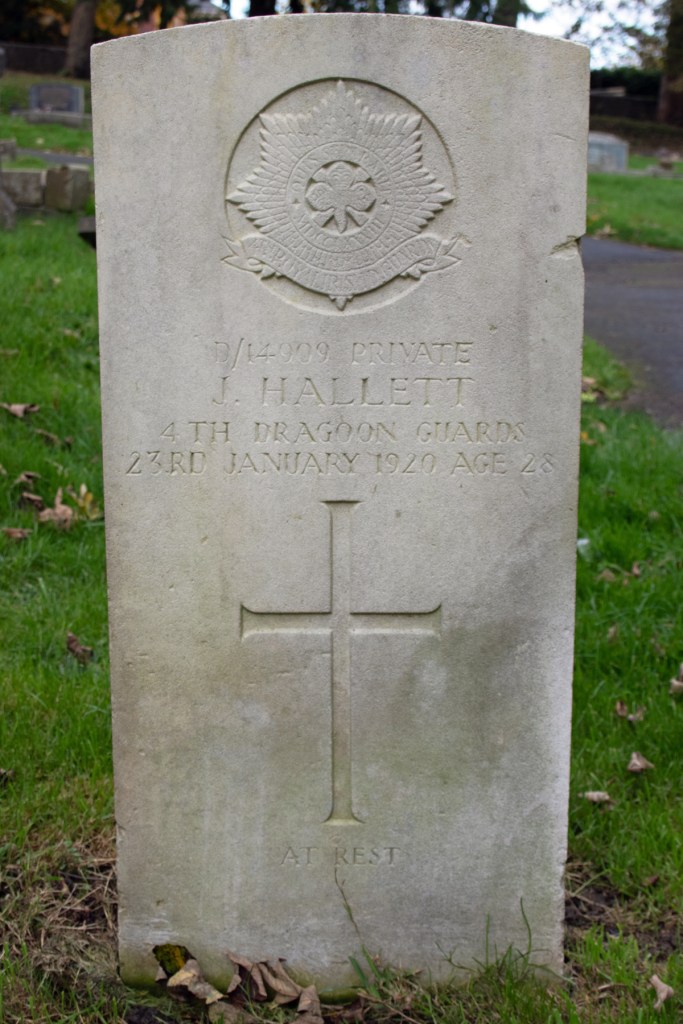
John Hallett was laid to rest in the graveyard of Christ Church in his home town of Frome, Somerset.


The local newspaper gave a more detailed report on John’s funeral:

Ex-Soldier’s Death

The funeral took place yesterday afternoon at Christ Church of Mr John Hallett, aged 29, of The Butts, Frome, who passed away at the Victoria Hospital on Friday last. Deceased had been seriously wounded several times during the war, and a day or two ago was removed to the hospital. The Rev. J Howard Lewis conducted the service, which was attended by local Oddfellows, to which society the deceased belonged, and by a number of other representative mourners.

Somerset Standard: Friday 20th January 1920