Category Archives: Royal Garrison Artillery

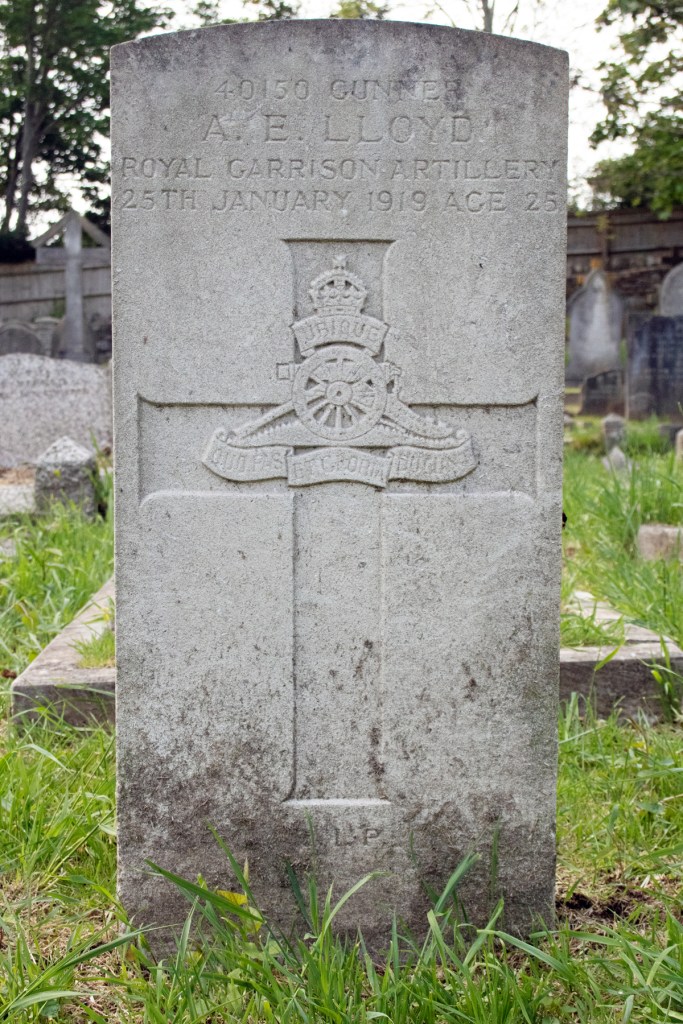
Gunner Albert Lloyd

Gunner Albert Lloyd

Albert Edward Prankard Lloyd was born in Somerset on 25th September 1893, in the Somerset village of Kewstoke (now a suburb of Weston-super-Mare). He was one of eight children to Jabez and Charity Lloyd. Jabez was initially a mason, but later went on to find work as a miner in South Wales. Charity worked as a laundress to help bring in extra money.

When Albert left school, he found employment as a labourer, remaining at home with Charity, with Jabez working away, and three of his sisters working as housemaids or laundresses. By 1911, however, he had moved to Wales with his father to work as a miner; steady employment that brought in a little more money because of the risks involved.

War, however, was on the horizon, and Albert enlisted before hostilities broke out. Joining up on 12th January 1914, his military records show him as standing 5ft 7ins (1.7m) tall and weighing in at 166lbs (75.3kg). He joined the Royal Garrison Artillery and, over the next five years, served three tours of duty in France, totalling just over three years on the Western Front.

Gunner Lloyd’s military service was not without incident, however. In November 1914 he was admitted to hospital for a week, suffering from shock. In April 1917, a shell exploded close to him and he was again found to be suffering from shock. His records note that, following the injury, he had had suicidal thoughts, and wished he was dead.

Just a month later, back on the battlefield, Albert received a gunshot wound to his right thigh. Nine months later, he was admitted to the Hermitage General Hospital in Higham, Kent for three weeks. (The ailment is a mystery, with just the term SCT Toe to identify it.)

When the Armistice came, Gunner Lloyd remained in France, finally returning home on 13th January 1919 ready to be demobbed. While not clear in his records, it seems that the initial ‘shock’ he had suffered from in 1914 had continued throughout the war.

One of the last comments on Albert’s service records is stark. “Found dead on Great Western Railway near Weston-super-Mare. 25.01.19“. Frustratingly, there is no other documentary evidence to expand on this curt phrase, no contemporary newspapers seem to have reported on the event, and nothing more than a scribbled police report was provided for the inquest (again, of which nothing remains).

It seems that the effects of five years of conflict proved too much for Gunner Lloyd; he committed suicide at the age of just 25 years old.

Albert Edward Prankard Lloyd lies at peace at last in the Milton Cemetery in his home town of Weston-super-Mare.


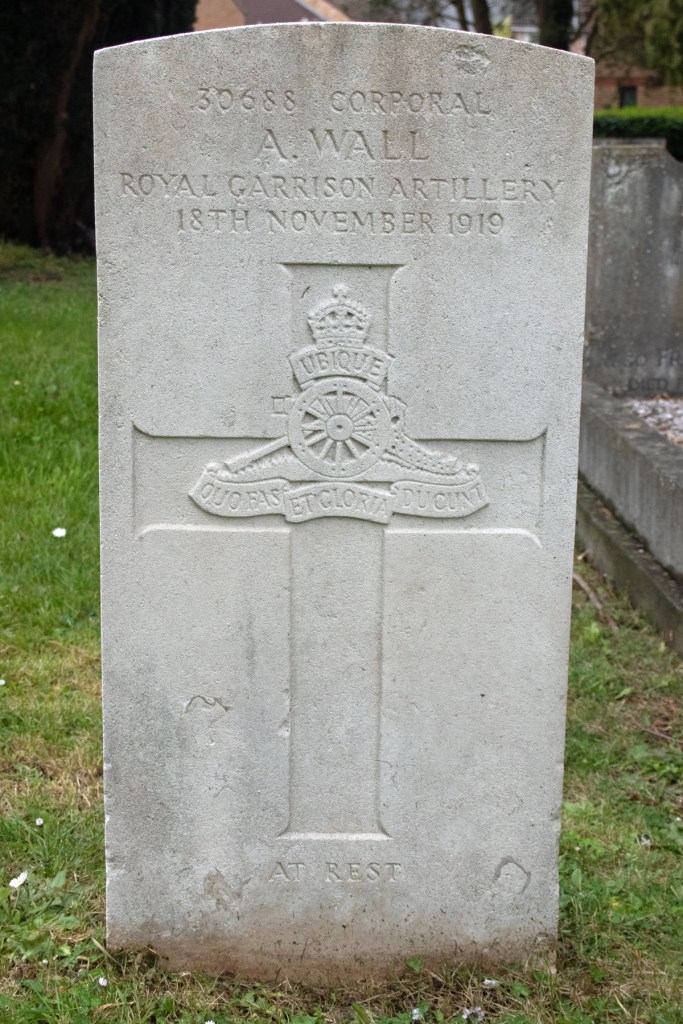
Corporal Albert Wall

Corporal Albert Wall

Albert Wall was born in the spring of 1890, one of eight children to James Wall and his wife Louise. James was a mason’s labourer from Taunton, Somerset, and brought his family up in his home town.

Details of Albert’s life are tantalisingly absent. It appears that he had a sense of adventure, and joined the Royal Garrison Artillery when his age allowed. By 1911, he was stationed at Port Royal in Jamaica, and was listed as a Gunner.

Gunner Wall’s involvement with the Royal Garrison Artillery extended into the Great War. He was sent to Egypt in April 1915, and, as part of his service, gained the Victory and British Medals and the 1915 Star. Albert seems to have been luck in that he saw out the war fairly unscathed, and was promoted to the rank of Corporal.

In the winter of 1918, Albert married Beatrice Salter. The war over, he was subsequently discharged from active service in April 1919.

Life on civvy street was not destined to be a long one, however, as, on 18th November 1919, he passed away from kidney disease. He was just 29 years of age.

Albert Wall was laid to rest in the St James Cemetery in his home town of Taunton.


As a sad footnote to this story, on 5th March 1920, Beatrice gave birth to a little boy, who she called Gordon. Albert was never to see his son.


Gunner William Howard

Gunner William Howard

William Arnold Howard was born in Cumbria towards the end of 1887. He was the youngest of two children, the son of gospel minister Edwin Howard and his wife Alethea. Edwin’s role took him across the country; by the time William was four, the family were settled in Worksop, Nottinghamshire; ten years later, they were based in Taunton, Somerset.

William’s older sister became a music teacher, and was presumably inspired by her father’s calling. William, however, took a different route, and, by the time of the 1911 census, was listed as a physical culture expert.

He had, by this time, met and married a woman called Alice, and the couple had two children, Edna and Marjorie. The census found the young couple living in a three-roomed house in the middle of Taunton.

War was on the horizon, and William enlisted as a Gunner in the Royal Garrison Artillery. His battalion – the 3rd/4th Siege Reserve Brigade – were those manning with large scale weaponry, although, as part of the reserve, Gunner Howard was based in England for the duration of the conflict.

William was awarded the Victory and British Medals for his service but once the Armistice was declared it seems that he fell ill. He was admitted to the Military Hospital in Taunton with exhaustion following a bout of enteritis, and succumbed to this on 15th January 1919. He was 31 years old.

William Arnold Howard lies at rest in the St James Cemetery in Taunton, Somerset.


Second Lieutenant William Bradbeer

Second Lieutenant William Bradbeer

William James Bradbeer was born in the spring of 1888, the youngest of eight children to Alfred and Jane Bradbeer from Bridgwater in Somerset. Alfred was a carriage trimmer, fitting out the train coaches for the local railways.

Sadly, William lost both of his parents in 1910; by this point he was 22, and was working as a schoolmaster along with his older brother Alfred. Five of the Bradbeer siblings were living together by this point, along with Sidney Palfrey, a photographer, who was boarding with them.

On 27th December 1911, William married Selina Nurse, who was also from Bridgwater, and whose father was a master mariner. The couple did not have any children together.

There is little evidence of William’s life after his marriage. He was enlisted in the Royal Garrison Artillery during the war, although no details of his military service are available. The battalions provided support in key forts primarily along the south coast of England, but also in places like the Channel Isles, Malta and Sierra Leone. Without Second Lieutenant Bradbeer’s records, it is impossible to know specifically where he served, but it would seem likely that he remained in England during the war.

The last years of William’s are also shrouded in mystery; he passed away on 8th August 1920, at the age of 32. I have been unable to uncover a cause of death, but it seems likely to have been an illness, as there is nothing in the contemporary media to suggest anything unusual or untoward.

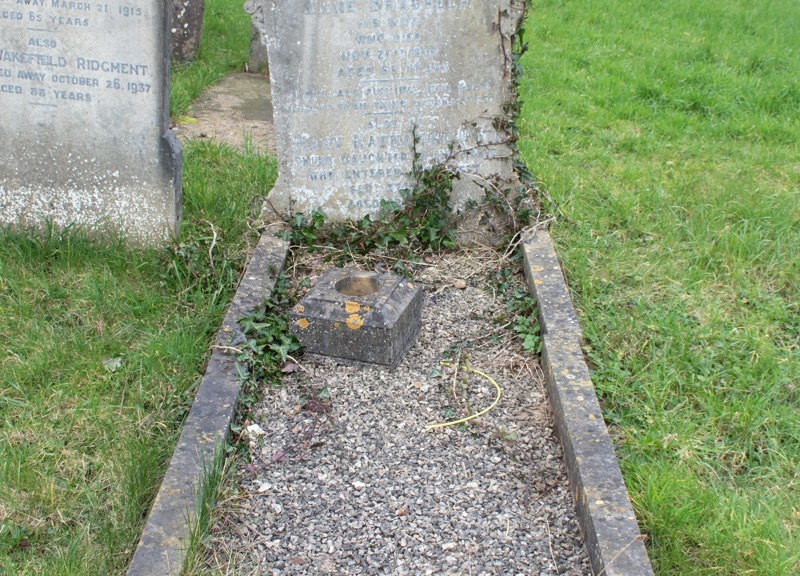
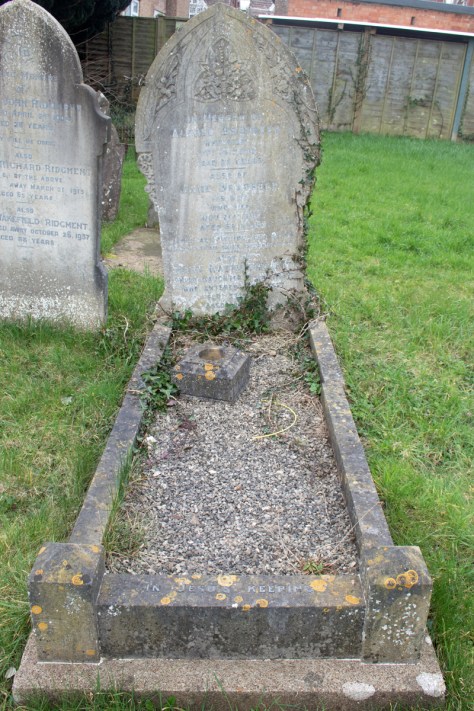
William James Bradbeer lies at rest in the Wembdon Road Cemetery in his home town of Bridgwater. Sadly, though, his grave is also lost to time, and I was unable to pinpoint its location. In death, as in his later years, William remains a mystery.


Note: The grave at the top of this page, however, is of a couple of his Bradbeer relatives, buried in the same cemetery.


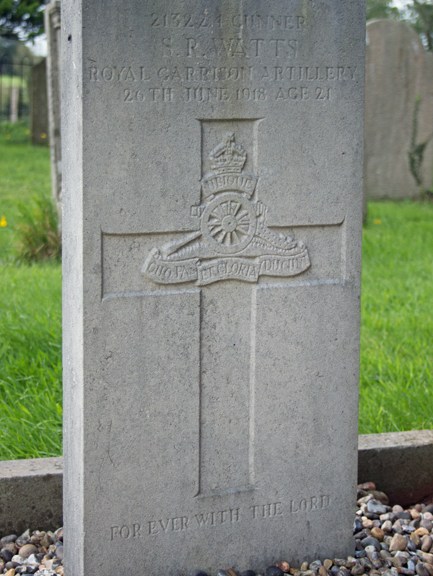
Gunner Samuel Watts

Gunner Samuel Watts

Samuel Reginald Watts was born in 1897, the seventh of eight children of Samuel and Augusta Watts.

He followed his father and brothers into the main industry in the area – coal mining – and was certainly working down the pits by the time of the 1911 census.

Samuel enlisted on 21st April 1918, and joined the Royal Garrison Artillery, which focused on heavy, large-calibre guns and howitzers that were positioned some way behind the front line. He was 5’5″ (1.65m) tall and weighed 144lbs (65kg). According to his war records, he had brown hair, hazel eyes and a fresh complexion.

His service started the very next day, when he was transferred to the Citadel in Plymouth for training.

After feeling unwell, complaining of headaches and a sensitivity to light, Gunner Watts was admitted to the Netley Hospital in Southampton on 18th June 1918. He was diagnosed with cerebrospinal fever, more commonly known as meningitis, and was treated over the next week.

Sadly, the treatment did not work, and Gunner Samuel Watts passed away on the evening of 26th June 1918. He had been in the army for a little over two months and had not seen active service.

Samuel Watts lies at peace in the graveyard of St John’s Church, Farrington Gurney.