
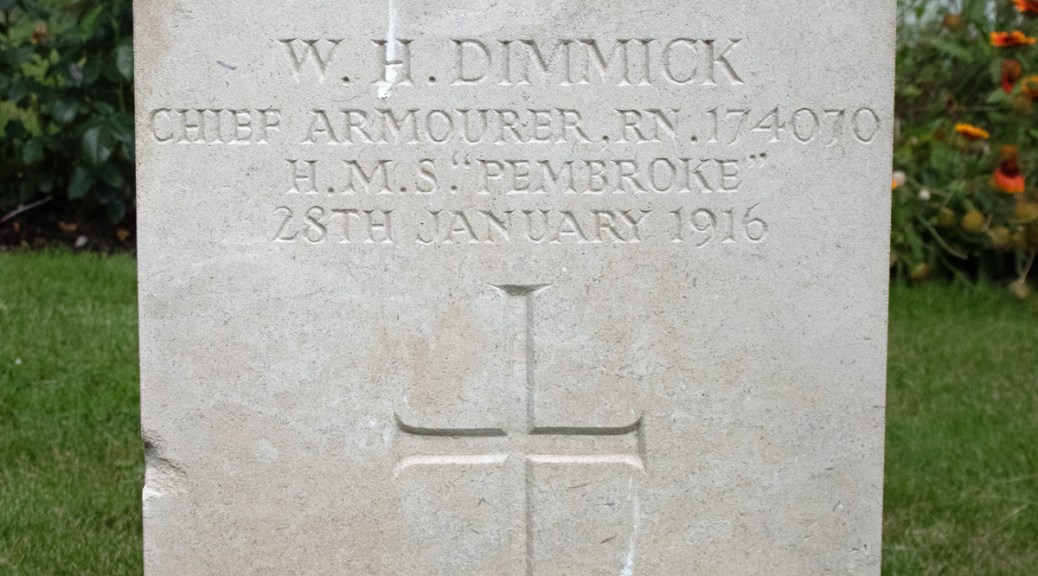
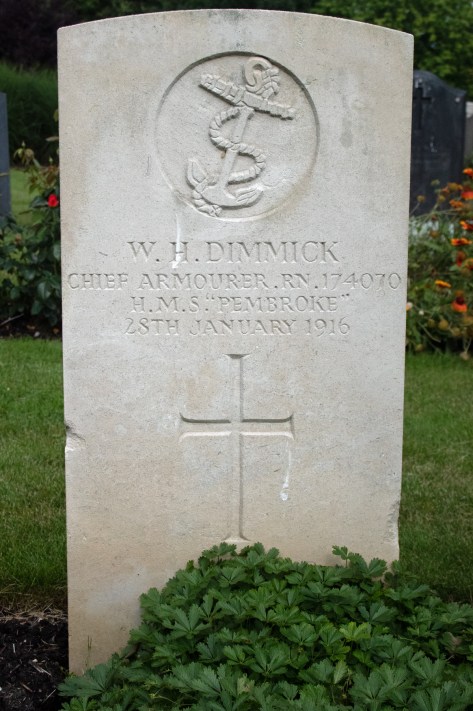
William Henry Dimmick was born in Titchfield, Hampshire, on 10th November 1871. The oldest of four children, his parents were John and Harriett Dimmick. John was a butcher, but when he completed his schooling, he became chose a different path.
The 1891 census recorded William as lodging with the Merritt family in Clanfield, to the north of Waterlooville, Hampshire. He was employed as a blacksmith, but either this was a means to an end, or he had itchy feet.
On 30th June 1893, William enlisted in the Royal Navy. Part of the Armourer’s Crew, his service records show that he was 5ft 7ins (1.7m) tall, with light hair, blue eyes and a fresh complexion. He was sent to HMS Excellent, the shore base on Whale Island in the Solent, and she would become the home to which he would return over the next few years.
Armourer’s Crew Dimmick’s contract was for twelve years and, during that time, he would serve on five separate ships. A lot of his time, however, was spent ashore, and his service papers note spells at both HMS Wildfire and HMS Pembroke, both on the North Kent Coast.
William’s time was not mis-spent, however, and he started to rise through the ranks. On 20th April 1897 he was promoted to Armourer’s Mate; in November 1898 he was made an Armourer. On 1st November 1902 he rose to Acting Chief Armourer, a role that was made permanent twelve months later.
Away from work, William found love. He married Florence Dunford in around 1902, and the couple would go on to have three children – William Jr, John and Florence Jr – between 1902 and 1911.
When William’s contract came to an end, he immediately re-enlisted. Over the next few years, he was given five more postings, before being assigned to HMS Natal in September 1912. An armoured cruiser, she was attached to the Grand Fleet during the First World War, but did not take part in any battles.
On 30th December 1915, Natal was moored in the Cromarty Firth, when an internal explosion from faulty cordite ripped her apart. She sank, and at least 390 crew and civilians were killed.
The next record for William is that of his passing – from pneumonia, at home, on 28th January 1916. He was 45 years of age. It is unclear whether he had been on board Natal a month before, and whether there was any connection between his illness and the explosion.
The family were living in Sheerness, Kent, at the time of William’s death, His body, however, was laid to rest in the naval section of Woodlands Cemetery, Gillingham, not far from HMS Pembroke, the dockyard in Chatham, Kent, which he had called home for some time.
 Death and Service