William James Hodge was born on 23rd November 1896 in Portsmouth, Hampshire. The oldest of seven children, six of whom were boys, his parents were James and Edith Hodge. James was a carpenter and labourer and, when he finished his schooling, William initially found work as a grocer’s errand boy.
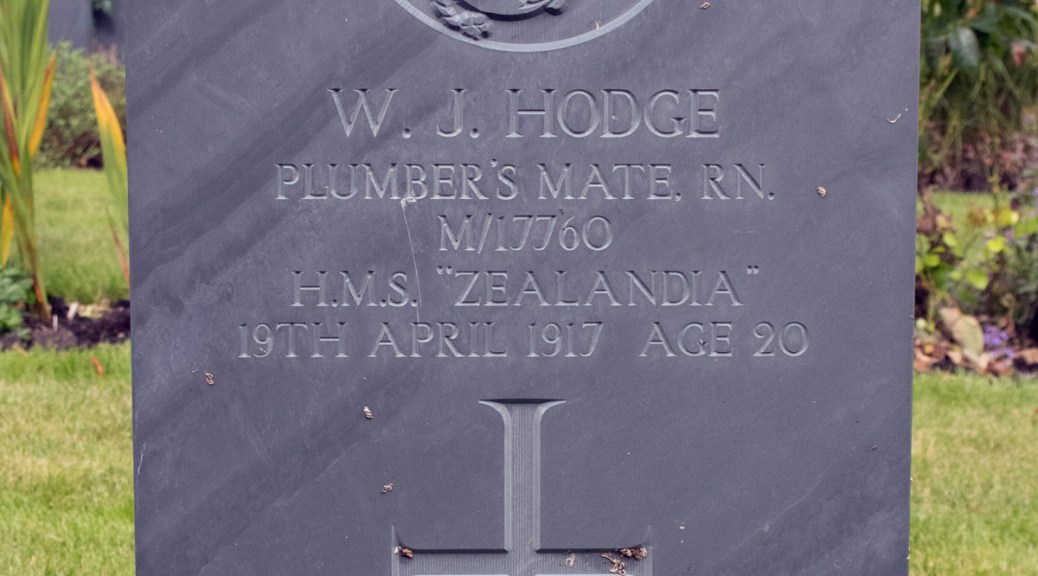
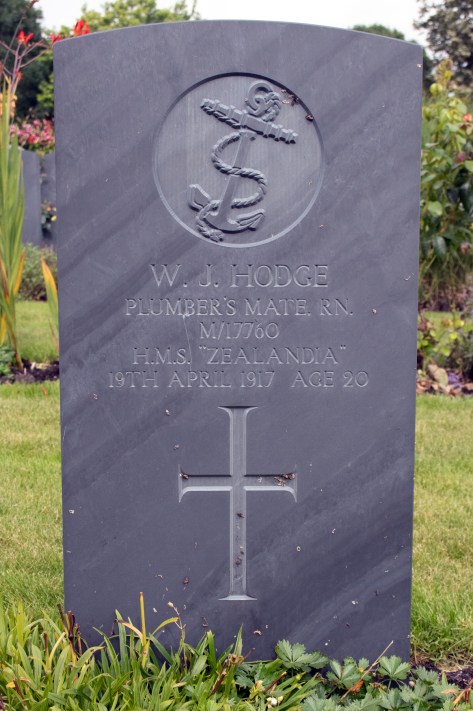
William went on to find work as a plumber’s mate and, when war was declared, he saw an opportunity to put his stills to good use. The Royal Navy offered career prospects and, on 14th December 1915, he enlisted. His service papers show that he was 5ft 6ins (1.67m) tall, with black hair, brown eyes and a dark complexion.
Initial training took place not far from home at the Portsmouth shore based HMS Victory and HMS Fisgard. In November 1916, however, Plumber’s Mate Hodge was given his first sea-faring assignment, on board the battleship HMS Zealandia. She would remain his home for the next six months.
In the spring of 1917, William came down with tuberculosis. He was admitted to the Royal Naval Hospital in Chatham, Kent, but the condition would prove too severe. He passed away on 19th April 1917, aged just 20 years old.
The body of William James Hodge was laid to rest in the naval section of Woodlands Cemetery, Gillingham, Kent.
Edwin Charles Hocking was born in Newton Abbot, Devon, on 28th January 1873. The youngest of four children, his parents were Richard and Harriet Hocking. Richard was an engine driver, and he was to die less than a year after his youngest boy’s birth:
Mr Deputy-Coroner Square and a jury of twenty-two to-day brought to a conclusion the inquest on the death of the engine driver Richard Hocking. The evidence of numerous witnesses went to show that the accident, which occurred on the morning of the 2nd inst., between Menheniot and St Germans stations occurred in consequence of the guards of two trains being called Dick. The morning was very dark, and at Menheniot there was standing at the station an up and a down goods, and a second down goods was on its way from St Germans, but this was unknown to the up goods. The porter Pratt at Menheniot gave the order to the guard (Wills) of the down train to start, saying “All right, Dick.” The driver of the up train (Scantlebury) was also called Dick, and when he heard the words he said “Is it right for me?” and Pratt, not seeing Scantlebury, and thinking Wills asked the question, repeated “It’s all right, Dick.” Scantlebury through it was meant for him, and gave the order to the deceased, “Right away.” Pratt, who had gone to let out the down train, hearing the starting whistle of the up train, rushed back to the platform waving his hand “danger” light. This attracted the attention of Scantlebury, the head guard, and he missed his van in consequence. Pratt said, “Wherever are you going?” Scantlebury replied, “Right away isn’t it?” Pratt said “God bless the man, who gave you ‘right’? The up goods is ten minutes off St Germans.” Scantlebury cried out “Oh! my God! Oh! my God!” Together they shouted and waved the danger light, but were unable to attract the drivers of either of the two engines attached to the train. The trains came into collision at full speed about two miles away. The deceased and the other driver were at great fault in leaving Menheniot, notwithstanding the order of the guard, for the signal was against them, and they did not observe the rules of the Company. They should not have gone on without hearing the second whistle of the guard, and after starting they should have satisfied themselves that they had the head guard in the train by seeing his lamp. Richard Scantlebury, the head guard, after being cautioned that he need not say anything to criminate himself, gave evidence that when Pratt said “All right Dick” he certainly thought it referred to him, especially as his train had nothing to do at Menheniot.
The jury deliberated for half-an-hour, and then returned a verdict of “Accidental death,” exonerating Pratt and Scantlebury from all blame. The appended a recommendation to the South Devon and Cornwall Railways to provide for a strict observance of their bye-laws for the use of some definite word for the up and down trains, and Christian names never to be used in such cases; that there be communication between the driver and guard on luggage trains as well as passenger trains, and that there be to men at least at each station on duty.
[Western Times: Wednesday 17th December 1873]
Harriet was just 28 years old when her husband died. With four children to raise, she married again – to John Staple – and went on to have four children with him too.
John also passed away in the spring of 1885, and the 1891 census found Harriet and six of her children living at 43 Richmond Terrace, to the west of the centre of Truro, Cornwall. Harriet was working as a washer woman, while Edwin, who was 18 by this point, was employed as a plumber’s assistant.
It is clear that Edwin wanted a better life for himself and in the spring of 1896, he took the skills that he learnt and signed up to the Royal Navy. His service papers show that he was 5ft 5ins (1.64m) tall with dark brown hair, grey eyes and a fresh complexion. He was also noted as having a tattoo on his left forearm.
Edwin took the rank of Plumber’s Mate, and spent the first two years split between two shore establishments – HMS Vivid and HMS Pembroke, the Royal Naval Dockyards in Devonport, Devon, and Chatham, Kent. He had enlisted for a twelve-year term and, over that time, he would serve on five ships, returning to Chatham in between assignments.
Plumber’s Mate Hocking consistently received very good reviews at his annual appraisals and, when his initial contract came to an end in May 1908, he immediately re-enlisted. He had a family to support by this point, having married Fanny Sears in Camberwell, Surrey, on 16th March 1902. A bricklayer’s daughter, she moved to Gillingham, Kent, to be close to Chatham Dockyard. The couple went on to have five children: Henry, Raymond, Doris, Elsie and Percival.
Back at sea, Edwin’s career continued with some consistency. His annual appraisals noted not on a character that was very good, but an excellent ability. Nevertheless, it would only be in the spring of 1916 that he would gain a promotion to full Plumber. Notwithstanding his general character, Edwin seems to have been a flawed character: in 1909 he applied for a discharge to the Royal Naval Reserve, but this was not approved as he had been found to be “carrying on a business as [a] bookmaker.” Instead, he was to be sent “to sea forthwith and warned that unless his betting practices [were] not stopped his discharge will have to be considered.”
By the summer of 1916, Plumber Hocking was eight years into his second term of service, and had served on five further ships. HMS Pembroke remained his shore base, and it was here that he attained his increased rank.
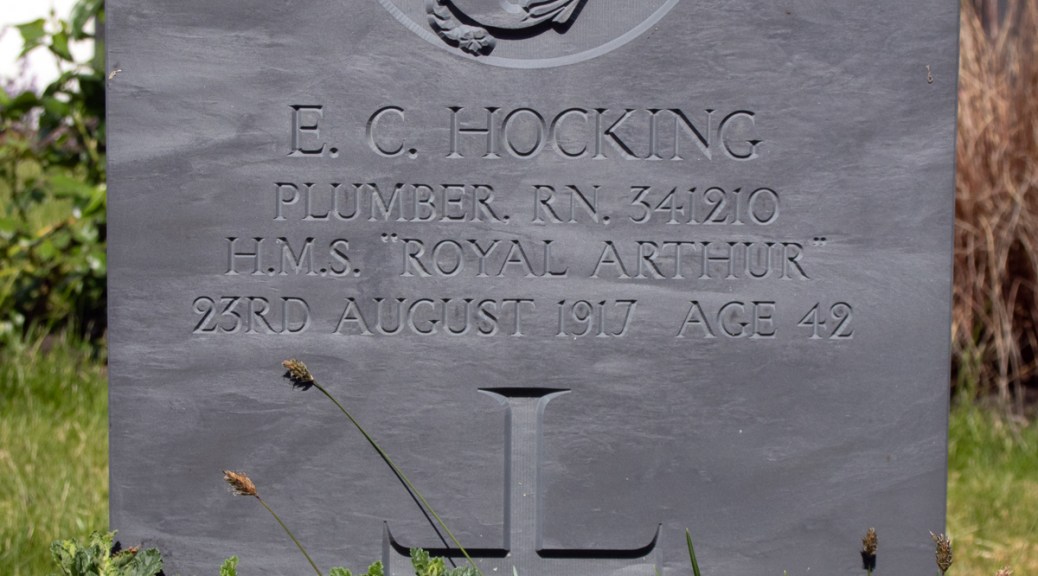
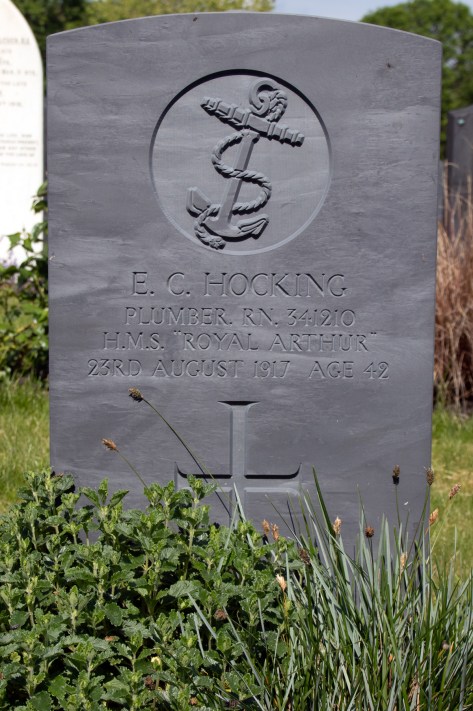
In October 1916, Edwin was given what would be his final assignment, on board the armoured cruiser HMS Royal Arthur. Based at Scapa Flow in the Orkneys, she was employed as a depot ship for submarines. Plumber Hocking spent ten months on board, before illness hit. Coming down with gastroenteritis following food poisoning, he was transferred back to Kent, and admitted to the Royal Naval Hospital in Chatham. The condition was to prove his undoing, and he passed away on 23rd August 1917: he was 44 years of age.
The body of Edwin Charles Hocking was laid to rest in the naval section of Woodlands Cemetery, Gillingham, a short distance from his grieving family’s home in King Edward Road.

 Death and Service