
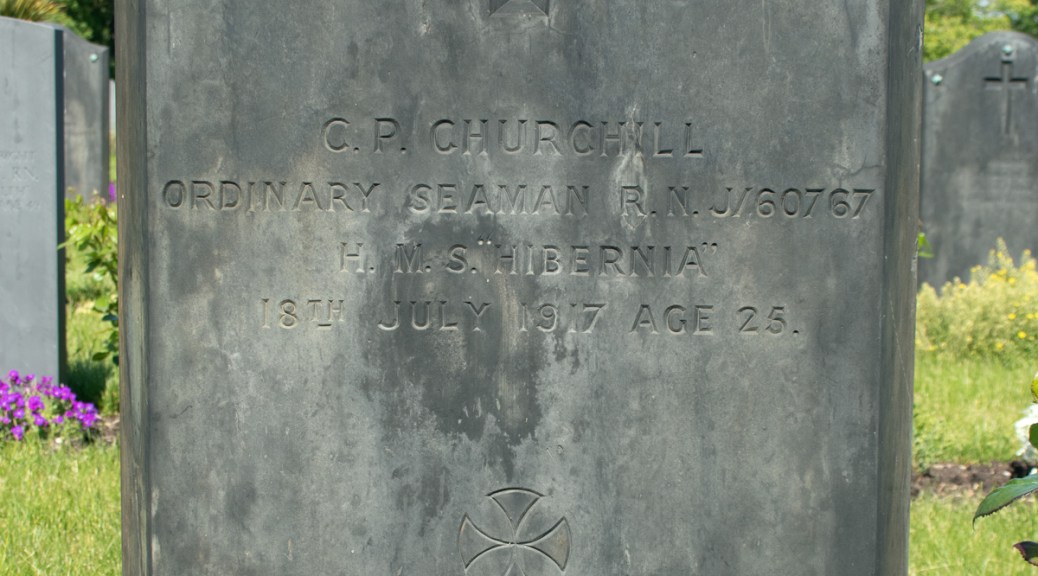
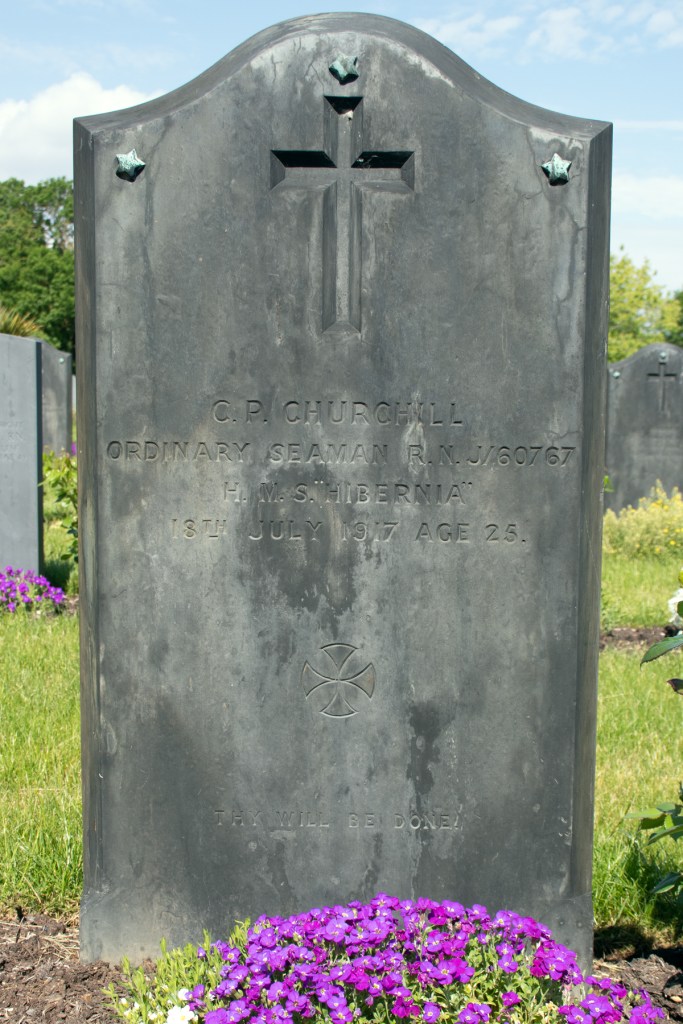
Charles Percival Churchill was born on 31st January 1892 in Marylebone, London. The oldest of three children, his parents were Charles and Annie Churchill.
Charles Sr was a farrier, and was 18 years his wife’s senior. When he died in 1904, at the age of 54, Annie got married again. At this point, Charles Jr found work as a houseboy to John and Florence Cassley-Whitaker, a couple living on their own means in Frinton-on-Sea, Essex.
When war came to Europe, Charles would be called upon to play his part. Conscripted in the autumn of 1916, he enlisted in the Royal Navy, and was given the rank of Ordinary Seaman. His service records show that he was 5ft 6.5ins (1.69m) tall, with brown hair, blue eyes and a dark complexion.
Ordinary Seaman Churchill was initially sent to HMS Pembroke, the Royal Naval Dockyard in Chatham, Kent, for training. He remained there until March 1917, when he was assigned to the battleship HMS Hibernia. Part of the Nore Command she helped patrol the Thames Estuary and protect the north Kent coast.
Charles’ time at sea was not to be a lengthy one. In July 1917 he was admitted to the Royal Naval Hospital in Chatham, Kent, having contracted anthrax. The condition was to ravage his body, and he died on 18th July: he was 25 years of age.
The body of Charles Percival Churchill was laid to rest in Woodlands Cemetery, Gillingham, Kent, not far from the naval base he had so briefly called home.
It was reported to the Chatham Town Council on Wednesday that a fatal case of anthrax had occurred at the Royal Naval Hospital. The deceased bought and used a cheap shaving brush from a shop in the borough, and a similar brush purchased at the same shop for experimental purposes was found at the Royal Naval Laboratory to contain a bacillus similar to the anthrax bacillus. The Medical Officer took possession of the whole of the stock of brushes and sent some to the County Council Laboratory and others to the Local Government Board for examination. Some of the brushes had been found to contain anthrax spores, and further tests were being made.
South Eastern Gazette: Tuesday 18th September 1917
While Ordinary Seaman Churchill’s name is not mentioned in the article, the severity of the condition, and the timing of the report would suggest that this was how Charles had met his fate.
 Death and Service