
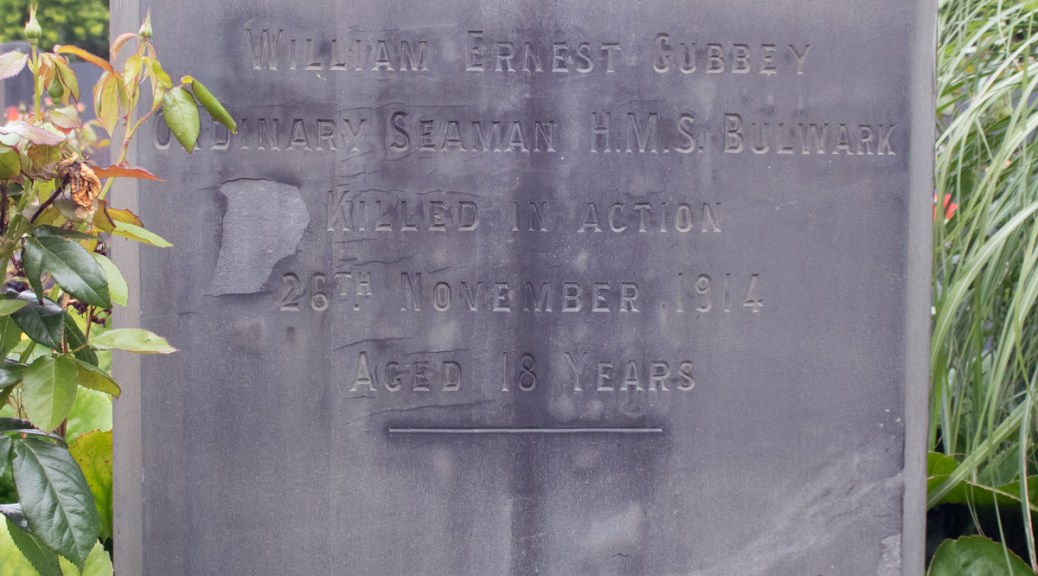
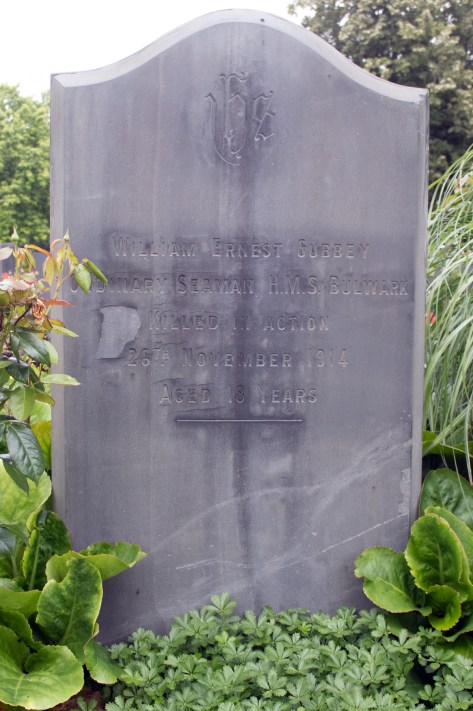
William Ernest Gubbey was born on 21st February 1896 in Portsmouth, Hampshire. He was the only child to William and Alice Gubbey. William Sr was a Petty Officer in the Coastguard, and the family travelled to where he was needed. The 1901 census found them in Malinmore, County Donegal, while ten years later, they were living in Tara, County Down.
It seemed natural for William Jr to follow in his father’s footsteps and, on 3rd August 1912, he joined the Royal Navy. He was too young to formally enlist, and was given the rank of Boy 2nd Class. Sent to HMS Impregnable, the school ship based in Devonport, she would remain his home for the next ten months while he was trained.
William was promoted to Boy 1st Class on 17th June 1913, and was assigned to the cruiser HMS Gibraltar the following day. After six months on board, and a short stopover at HMS Victory, the Royal Naval Dockyard in Portsmouth, Hampshire, he received his next posting, the battleship HMS Bulwark.
Boy Gubbey would spend the next year attached to Bulwark and, during this time, he came of age. Now formally inducted into the navy as an Ordinary Seaman, his service papers show the young man he had become. He was recorded as being 5ft 5.5ins (1.66m) tall, with brown hair, blue eyes and a dark complexion.
When was was declared in the summer of 1914, Bulwark was assigned to the Channel Fleet, patrolling and defending Britain’s southern coast. On 26th November 1914, she was moored in the River Medway, close to Sheerness, Kent, being reloaded with ammunition.
Some of the new cargo overheated and the resulting explosion ripped through the battleship. More than 740 crew were killed, including Ordinary Seaman Gubbey: he was just 18 years of age.
The bodes of the dead were laid to rest in Woodlands Cemetery, Gillingham, Kent. As his had been identified, William Ernest Gubbey was laid to rest in a marked grave.


 Death and Service