
Tag Archives: Drummer

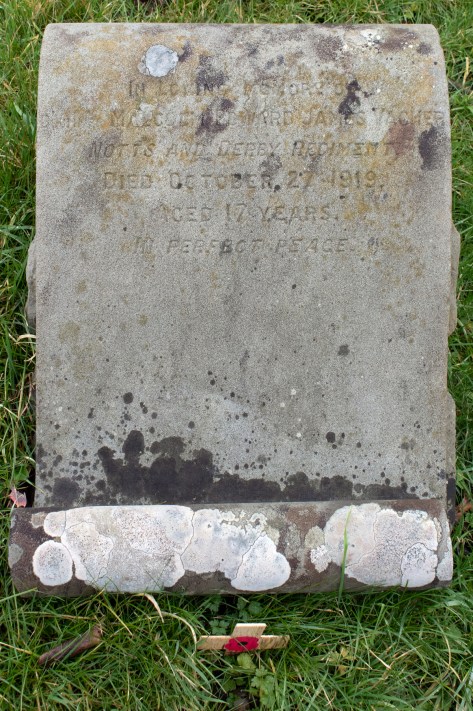
Drummer Malcolm Vacher

Drummer Malcolm Vacher

Born at the start of 1902, Malcolm Edward James Vacher was the younger of two children to James and Alice Vacher. James was a domestic coachman and both he and Alice were born in Milton Abbas, Dorset. By the time Malcolm was born, the family had relocated to the village of Mortimer, Berkshire.

Alice died when her youngest was just five, and James moved the family to the village of Kelstern in Lincolnshire, possibly for work. Sadly, James passed away in 1916, leaving Malcolm and his older sister, Gladys, as orphans.

By this point war was raging across Europe, and it seems that Malcolm looked to the army as a new family. He enlisted in the Sherwood Foresters (Notts and Derby Regiment), although his service papers have been lost to time.

It is unclear how or where Drummer Vacher served. He survived the war, however, and by the autumn of 1919, found himself on furlough in Wiltshire. His death certificate records that died on 26th October, from a combination of appendicitis and heart failure. Just 17 years of age, his sister was by his side when he passed.

Malcolm Edward James Vacher was laid to rest in St John’s Churchyard, Warminster. The Grave Registration Form notes that the headstone was paid for by his uncle.


By this point, Gladys had lost her parents and her brother. Twenty-one years of age when her sibling died, she nonetheless found the resilience to carry on.

The 1921 census recorded Gladys living at 1 Corporation Street, Kidderminster. Boarding with Jane Smith, she was working as garage assistant for the motorcycle department of the Castle Motor Co Ltd on Vicar Street.

In the spring of 1925, Gladys married radio engineer and dealer George Whitford. By the time of the 1939 Register, the couple were living at 81 New Road, Kidderminster. Gladys was helping her husband with the business, and was recorded as being a radio dealer and travel agent.

Gladys Whitford, née Vacher, passed away in the spring of 1960. An obituary outlined the life she had forged for herself after losing her brother:

Mrs Gladys Mary Whitford, who has died at her home in New Road, Kidderminster, aged 63, had conducted one of the oldest travel agencies in the Midlands for 30 years. The firm, founded by her husband’s grandfather in 1856, arranged emigration for many families seeking a new life in the Commonwealth.

Mrs Whitford joined the Women’s Legion in 1916 and was one of the first motor-cycle despatch riders attached to the Royal Army Service Corps. She was a member of the Kidderminster Chamber of Commerce and of the committee of the Kidderminster Retail Traders’ Association. She is survived by her husband, Mr George Whitford, a radio and television dealer.

[Birmingham Daily Post – Tuesday 12 January 1960]


My thanks go to Peter Calver and the members of the Lost Cousins website for their help in filling in details of Gladys’ life after the loss of her family.

Private Francis Chick

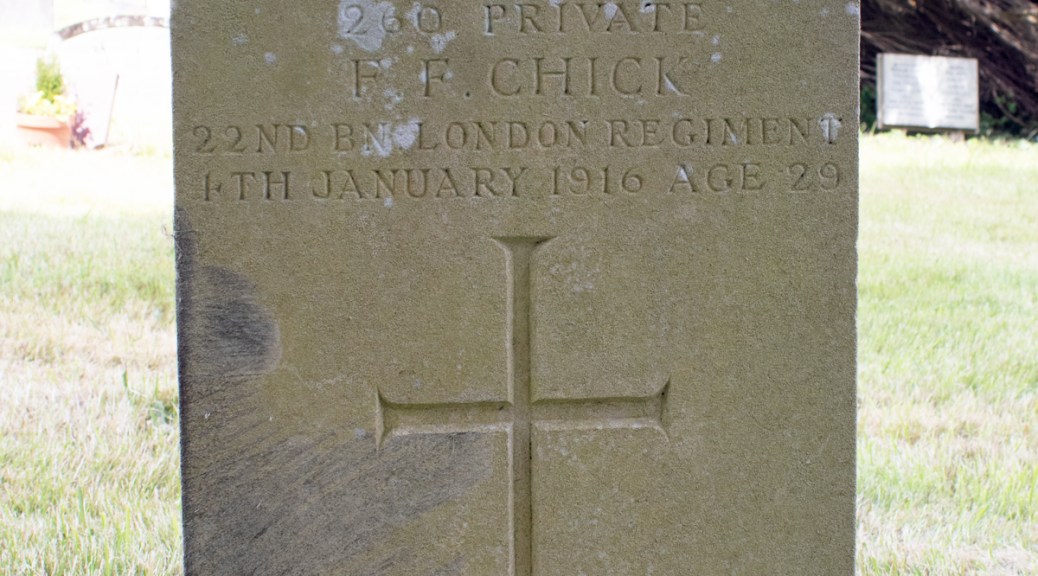
Private Francis Chick

Francis Frederick Chick was born in the spring of 1886 in Axminster, Devon. One of eight children, his parents were brickmaker Edwin (or Edward) Chick and his wife, Elizabeth.

When he completed his schooling, Francis found work as a sawyer’s apprentice. However, he wanted bigger and better things and, on 19th November 1900, he enlisted in the army. At 14 years of age, he was just short of 5ft (1.52m) in height, and had fair hair, blue eyes and a fresh complexion.

Initially enlisting in the Royal Marine Light Infantry, Boy Chick was to serve three years in the naval division. The 1901 census found him based at the East Stonehouse Barracks in Devonport, Devon, where he was a Bugler.

In September 1903, Francis transferred across to the Devonshire Regiment, remaining within the band structure. He came of age in March 1904, and, as a Private, he took on the role of Drummer. By the start of 1909, his unit had moved overseas, and the next census, taken in 1911, found Private Chick billeted in St George’s Barracks in Malta.

Francis remained in Malta for three years, and moved to Egypt with his unit in January 1912. By this point, having completed nearly twelve years’ service, he elected to stay on and renewed his contract. While serving in North Africa, he completed his induction into the Camel Corps, although by the end of the year, he was back on home soil after nearly four years abroad.

At this point, Francis seems to fall off the radar. It is unclear whether his move back to Britain was because he had been placed on reserve status, or due to medical reasons. To add to the mystery, when war broke out, he did not re-join the Devonshire Regiment, but enlisted in the London Regiment instead. He was assigned to the 22nd (County of London) Battalion, but later records note a connection to the 22nd (Wessex and Welsh) Battalion of the Rifle Brigade.

Private Chick was in Buckinghamshire by the winter of 1915/16, and it was here that he became unwell. Admitted to hospital in Aylesbury, he died of pneumonia on 4th January 1916: he was 29 years of age.

The body of Francis Frederick Chick was taken back to Devon for burial. He was laid to rest in the cemetery of his home town, Axminster.


Serjeant Frederick Reid

Serjeant Frederick Reid

Frederick William Reid was born in January 1876 in Liverpool, Lancashire. Little information is available for his early life, and his trail only really becomes traceable when he joined the Royal Irish Regiment at the age of 16 years old.

Frederick’s service records confirm that his mother was called Elizabeth, who lived in Bedminster, near Bristol. He was already volunteering for the regiment when he enlisted, and was working as a musician when he joined up. His papers confirm that he was 5ft 4ins (1.63m) tall, and weighed 112lbs (60.8kg). He had brown hair, hazel eyes and a fresh complexion.

Frederick was given the rank of Drummer when he joined up and was attached to the Royal Irish Regiment’s 3rd Depot. He spent more than seven years on home soil, rising to the rank of Corporal in May 1898. The following January he reverted to the rank of Private at his own request, but his superiors obviously saw something in him, and he was supported in a new role – Lance Corporal – just a month later.

In October 1899, however, Frederick’s life was to take a new turn, when he was sent to India with his troop.

Corporal Reid was based in Lahore, and had found the life that he was seeking. Over the next forty months, he successfully took on a variety of clerical roles. He was promoted to Lance Sergeant in October 1901 and given oversight of the Officers’ Room.

In March 1903, Frederick returned to Britain. With the move came a further promotion, to the rank of full Sergeant, again, overseeing the Officer’s Room. He seems to have been based in Gloucestershire by this point, as, on 18th November 1903, he married Isabella Jane Parke at a Registry Office in Bristol. There is no further record for the young couple, however, so the new Mrs Reid is destined to remain a mystery.

Frederick was destined to return to India, and in January 1905, that is exactly what he did. His regiment returned to Lahore, and he was given the role of Clerk Steward at one of the Lawrence Memorial Asylum. The name is misleading, as the asylums were a series of four military-style boarding schools across India. Sergeant Reid’s records do not confirm which of the four he was attached to, but it would have been Sanawar, Mount Abu, Lovedale or Ghora Gali.

Given his military background, it seems that the role of clerk was something Frederick settled into quite happily. He was recalled back to army service in November 1909, and, within seven months, he requested a discharge from the army. This was granted, as he had, by this point, completed more than eighteen years’ service.

Frederick remained in India, however, and on 28th September 1913, he married Elizabeth Marshall in Lahore. They had two children, Florence, who was born in Quetta on 2nd September 1914, and Lily, who was born on 1st January 1916 in Lahore.

War had come to the world by this point, and in spite of his age – he was 39 by now – Frederick felt it only right to step up and play his part again. On 28th October 1914, he enlisted again, and was assigned to the 1st Battalion of the Duke of Wellington’s (West Riding Regiment). His new medical noted that he was 5ft 7ins (1.7m) tall, and weighed in at 9st (57.2kg). His complexion was recorded as pale, while he had a number of tattoos on his left forearm: the crossed swords, harp and crown of the Royal Irish Regiment, along with the initials VR.

While part of the West Riding Regiment, Sergeant Reid was attached to the 3rd Mule Corps of the Indian Supply & Transport Corps. He was involved in arranging provisions for the various battalions who needed them.

By March 1916, his battalion had been sent to Salonika, and it was here that Frederick contracted tuberculosis. Medically evacuated to Britain, he was admitted to the Southwark Military Hospital. He was confirmed as no longer being medically fit for army service and was discharged on 16th August 1916. His medical report noted that he “is anxious to have sanatorium treatment, but is not an insured man, owing to having been stationed in India.”

On his discharge, Frederick moved to Weston-super-Mare, Somerset, which is where his mother was by now living. His wife and children also came to live in England and, the family settled in Pawlett, near Bridgwater.

After leaving the army, Frederick’s trail goes cold. The next confirmation of his life is that of his passing. He died on 12th October 1919, presumably from his lung condition. He was 43 years of age.

Frederick William Reid, who had been born in Liverpool, who had had two separate careers in the army, and who had lived and married in India, was laid to rest in the peaceful graveyard of St John the Baptist’s Church in Pawlett, Somerset.